Boosting Emotional Intelligence: A Practical Guide to EQ
Emotional intelligence is trainable, but most advice stops at "be more empathetic." Here is what EQ actually is, how it's measured, where the evidence is genuinely strong, the mistakes that quietly undo progress, and a 30-day plan.
Rewritten with AI and republished automatically. Our editors set the standards and fix reported errors — how we work.
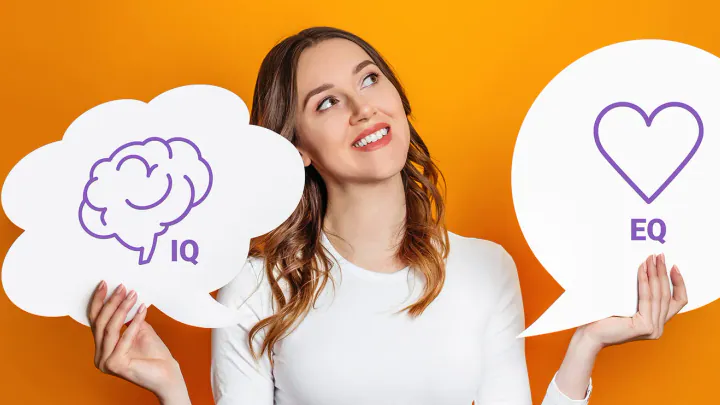
TL;DR: Emotional intelligence is a trainable set of skills — noticing emotions, naming them precisely, regulating your response, and reading other people accurately. It matters most in emotionally demanding work. Build it with daily labeling practice, a deliberate pause, real feedback from others, and protected sleep. Skip the free online quizzes.
What is emotional intelligence, exactly?
Emotional intelligence is the ability to perceive emotions accurately, understand what caused them, and use that information to guide your thinking, decisions, and behavior — both your own emotions and other people's. It is a skill set, not a personality type, which is why it can be practiced and improved.
Two models dominate the field. Psychologists Peter Salovey and John Mayer proposed the original academic version: a four-branch ability model covering perceiving emotions, using emotions to assist thought, understanding emotional meaning, and managing emotions. Daniel Goleman's 1995 book popularized a broader, more workplace-oriented framework of five components:
- Self-awareness — recognizing your emotional triggers, patterns, and physical cues in real time.
- Self-regulation — choosing your response instead of defaulting to the impulse.
- Motivation — sustaining effort toward goals through setbacks and boredom.
- Empathy — accurately reading what another person is experiencing.
- Social skills — building rapport, handling conflict, and repairing relationships after damage.
The distinction matters more than it sounds. Goleman's model includes traits like motivation that overlap with conscientiousness; the Salovey–Mayer model treats EQ strictly as a mental ability, like verbal reasoning. When someone says "EQ predicts success," ask which model they mean.
Is high EQ actually linked to better performance at work?
Yes, but the effect is narrower than popular coverage suggests. The honest summary: emotional intelligence adds meaningful predictive value on top of cognitive ability and personality, and it adds the most value in jobs with high emotional labor — management, healthcare, teaching, sales, negotiation, customer support, any role where reading a room is part of the job.
You will see the claim that a very high percentage of top performers have high EQ. We are not repeating figures we cannot verify. What is well supported is more modest and more useful: in emotionally demanding roles, people who regulate well and read others accurately tend to handle conflict, retain teams, and recover from setbacks better than people who don't. In a solitary, low-interaction technical role, EQ predicts far less about output.
That nuance is a feature, not a caveat. It tells you where to spend your practice time. If your week is mostly deep solo work, your leverage may lie in focus systems rather than interpersonal skill — our guide to focus rules that hold in 2026 covers that side of the equation.
How is EQ measured, and which assessments are worth taking?
Credible EQ assessments fall into two families: ability tests, which score your answers against expert consensus, and self-report inventories, which ask how you think you behave. Ability tests are harder to game; self-reports are cheaper and faster but measure self-image as much as skill.
| Instrument | Type | Best for | Main limitation |
|---|---|---|---|
| MSCEIT (Mayer–Salovey–Caruso) | Ability test | Measuring actual emotional reasoning skill | Longer, usually requires a certified administrator |
| EQ-i 2.0 (Bar-On model) | Self-report | Coaching and leadership development | Reflects self-perception; inflatable by motivated test-takers |
| TEIQue (Petrides) | Self-report, trait model | Research and personality-adjacent profiling | Overlaps heavily with standard personality traits |
| 360-degree feedback | Observer ratings | Finding blind spots others can see | Quality depends entirely on rater honesty |
| Free online "EQ quiz" | Unvalidated self-report | Curiosity only | No established validity; treat the number as noise |
Decision rule: if you only do one, do the 360. The gap between how you rate your listening and how three colleagues rate it is the single most actionable data point available to you, and it costs nothing but nerve.
How do you build self-awareness when you can't see your own blind spots?
You build it by increasing emotional precision and by collecting outside evidence. Precision first: most people describe their internal states with three or four words — stressed, fine, annoyed, tired. Researchers call the ability to distinguish finer shades emotional granularity, and it is trainable simply by reaching for a more exact word.
"Annoyed" could be resentful, rushed, embarrassed, under-slept, or territorial about a project. Each of those points to a different response. Labeling the feeling more specifically tends to reduce its intensity and, more importantly, tells you what to actually do about it.
Practical version: twice a day, write one sentence in the form "I feel ___ because ___, and what I want is ___." A mood-tracking app works, a phone note works, paper works. The format matters more than the tool.
Then collect outside evidence. Ask two people who see you under pressure: "When I'm stressed, what do I do that's hard to be around?" Do not explain or defend the answer for 24 hours. That discipline is the exercise.
What do you do in the moments between trigger and reaction?
You create a deliberate gap and fill it with a label instead of a response. The sequence that works under real pressure: notice the body signal (jaw, chest, heat in the face), take one slow exhale that is longer than the inhale, silently name the emotion, then choose your first sentence.
A few sentences that buy you time without costing you credibility:
- "I want to answer this properly — give me until after lunch."
- "I'm reacting strongly, so let me check I've understood you."
- "That landed badly for me. Can you say it another way?"
Edge case worth knowing: regulation strategies fail predictably when you are sleep-deprived. Short sleep reliably increases emotional reactivity and reduces impulse control, which means a week of poor rest can wipe out months of practice.
How do you listen and respond with empathy without absorbing everyone's problems?
Aim for compassion rather than emotional matching. Empathy that means feeling what the other person feels is expensive and, past a point, counterproductive — a manager who becomes as distressed as their report cannot help them. Compassion means understanding the state accurately, caring about it, and remaining steady enough to be useful.
Three mechanics that make listening visible:
- Paraphrase before you problem-solve. "So the deadline isn't the issue — it's that nobody told you it moved." If you're wrong, they correct you, and you've still gained.
- Name the emotion tentatively. "That sounds frustrating" invites correction; "You're furious" tells them what they feel.
- Ask what kind of response they want. "Do you want ideas or do you want to vent?" This single question prevents most of the unwanted-advice conflicts in offices and marriages alike.
And keep the "I" statement discipline from classic conflict training: "I feel concerned when deadlines slip without a heads-up" beats "you're always late," because the first describes an experience and the second assigns a character flaw.
What are the costliest mistakes people make when developing EQ?
The three that quietly undo progress:
1. Mistaking suppression for regulation. Swallowing frustration to keep the peace is not emotional intelligence. It postpones the conversation, and postponed conversations get more expensive. Regulation means you felt it clearly and chose the timing and the wording.
2. Mistaking agreeableness for EQ. Highly emotionally intelligent people deliver difficult feedback more often than average, not less — they are simply better at doing it without triggering a defensive spiral. If your "EQ journey" has made you avoid every hard conversation, you have built conflict avoidance, not skill.
3. Using emotional skill as leverage. Accurately reading someone's insecurity and then using it in a negotiation is emotional intelligence deployed without ethics. Research on the dark side of these abilities is a genuine strand of the field. Skill is neutral; intent is not.
Does this apply if you're introverted, neurodivergent, or working across cultures?
Partly, and the caveats are real. Most popular EQ advice assumes a Western, extroverted, direct-communication workplace. Eye contact norms, acceptable emotional display, and what counts as "warm" vary substantially across cultures — the same behavior that reads as engaged in one context reads as intrusive in another.
For autistic people and others who process social signals differently, the "read the room intuitively" framing can be actively unhelpful. Explicit approaches work better: asking directly rather than inferring, agreeing on communication preferences up front, and treating clarity as a courtesy. That is a legitimate form of emotional intelligence, not a workaround for a missing one.
If emotional reactivity, persistent low mood, or relationship difficulties are significantly affecting your daily life, skills practice is not a substitute for care. Please consult a qualified mental health professional.
What does a realistic 30-day EQ practice plan look like?
Here is the worked example we recommend for people starting from zero. One focus per week; keep the previous week's habit running.
- Week 1 — Labeling. Twice daily, write the sentence: "I feel ___ because ___, and what I want is ___." Force a new emotion word each time.
- Week 2 — The pause. Pick one recurring trigger (a specific person, a specific type of message). Every time it fires, one long exhale and a silent label before you respond. Log whether you managed it.
- Week 3 — Listening. In every conversation over five minutes, paraphrase once before offering anything. Ask "ideas or vent?" at least three times this week.
- Week 4 — Feedback and repair. Ask two people the blind-spot question. Then initiate one conversation you have been avoiding, using an "I" statement to open it.
Measure it the way you'd measure any habit: not by how you feel about your progress, but by counting. Days you logged, times you paused, conversations you stopped avoiding. The same honest-ledger logic behind planning for predictable expenses works here — vague intentions produce vague results.
Which books, courses, and tools are actually worth your time?
A short, non-sponsored shortlist. We have no commercial relationship with any of these.
- Emotional Intelligence by Daniel Goleman — the origin of the popular framework; dated in places, still the common reference point.
- Permission to Feel by Marc Brackett — strongest on emotion labeling and on teaching these skills to children.
- Nonviolent Communication by Marshall Rosenberg — the most practical script-level book on saying hard things without escalation.
- Emotional Intelligence 2.0 by Travis Bradberry and Jean Greaves — checklist-driven and workplace-focused; useful if you want tactics over theory.
- Coursera's Inspiring Leadership through Emotional Intelligence (Richard Boyatzis, Case Western) — a structured option if you prefer a course format.
- Apps — Headspace or Calm for attention training; any mood tracker for the labeling habit. The app is scaffolding, not the skill.
Key takeaways
- Emotional intelligence is a trainable skill set — perceiving, understanding, regulating, and using emotions — not a fixed trait or a personality type.
- It predicts performance most strongly in emotionally demanding roles; claims that it outweighs cognitive ability across the board are overstated.
- The highest-leverage first step is outside feedback, because self-report tells you about your self-image, not your skill.
- Suppression is not regulation, and agreeableness is not emotional intelligence — high-EQ people have hard conversations more often, just better.
- Sleep and attention are the physical substrate of self-control; restore those before adding another technique.
- Aim for compassion over emotional matching: a person who stays steady is the person who can actually help.
Frequently asked questions
What is emotional intelligence in simple terms?
Emotional intelligence is the ability to notice emotions accurately, understand what is causing them, and use that information to guide how you think, decide, and respond — in yourself and with other people. It is a set of learnable skills, not a fixed personality trait.
Can emotional intelligence actually be improved, or are you born with it?
It can be improved. The underlying skills — noticing bodily signals, naming feelings precisely, pausing before reacting, listening without rehearsing a reply — all respond to deliberate practice, and structured training programs generally show measurable gains. Temperament influences your starting point, not your ceiling.
What are the five components of emotional intelligence?
In Daniel Goleman's widely used framework they are self-awareness, self-regulation, motivation, empathy, and social skills. An earlier academic model from Peter Salovey and John Mayer describes four branches instead: perceiving, using, understanding, and managing emotions.
How is EQ measured, and are free online quizzes accurate?
Formal measures include the ability-based MSCEIT and self-report instruments such as the EQ-i 2.0 and TEIQue, usually administered through certified practitioners. Free online quizzes are entertainment-grade at best; they measure your self-image rather than your skill, so treat the score as a conversation starter, not a diagnosis.
Is emotional intelligence more important than IQ for career success?
No — that claim is overstated. Cognitive ability and conscientiousness remain strong predictors of job performance across most roles. EQ adds the most value in jobs with heavy emotional demands: management, sales, healthcare, teaching, customer-facing and negotiation-heavy work.
What is the most common mistake people make when trying to build EQ?
Confusing emotional suppression with emotional regulation. Swallowing frustration to keep the peace is not high EQ; it postpones the conversation and usually raises the cost of it. Regulation means feeling the emotion accurately and choosing the timing and wording of your response.
Does empathy at work lead to burnout?
It can, when empathy means absorbing other people's distress rather than understanding it. Compassion — caring about someone while staying separate from their emotional state — is more sustainable and more useful, because a person who stays steady can actually help.