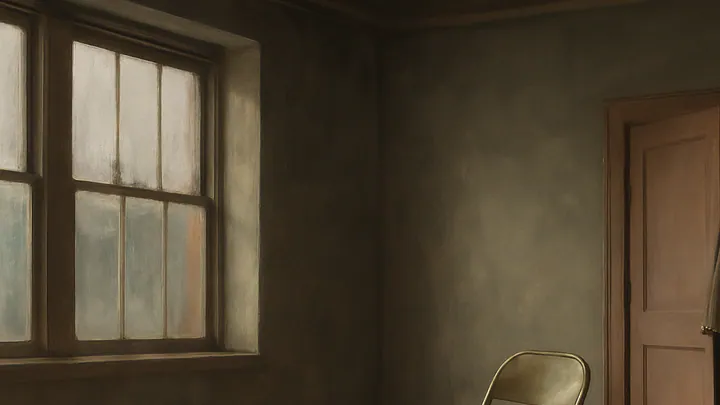
The Auctioneer of Forgotten Things
At a Saturday auction house that trades in the unclaimed, a young auctioneer discovers a lot no one placed on the ledger. What she bids will change how she hears her own name.

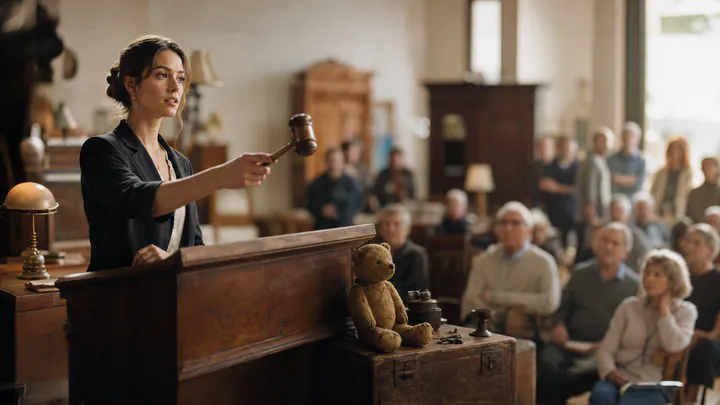
The gavel had belonged to her grandfather, and it still smelled faintly of pipe tobacco when Lena held it close. She was twenty-six years old, the youngest auctioneer Hallam & Sons had ever registered, and the Saturday crowd was already shuffling into the folding chairs, coats damp from the drizzle outside.
Hallam & Sons did not sell paintings by famous hands, or jewelry with a provenance longer than a paragraph. It sold what people had left behind: storage lockers gone unpaid for a year, estates without inheritors, luggage abandoned at the old bus depot across the square. A house of forgotten things, her grandfather used to say, is only a library of stories nobody has claimed yet.
Lena adjusted the microphone and glanced at the ledger. Thirty-two lots. A brass carriage clock. A collection of nautical charts. Three boxes of sheet music, unsorted. A taxidermied owl, which she suspected would be the day's small drama. She traced a finger down the page and stopped.
Lot 33.
She hadn't written a lot 33. Nobody had. The line was in a hand she didn't recognize, a looping, patient script that seemed to lean into the paper. One evening, unclaimed. Reserve: negotiable.
"Marcus," she called toward the back office, where her uncle was fussing with the receipt printer. "Did you add something to the ledger?"
"Only what you told me to, chickadee."
She stared at the entry a moment longer, then closed the book. The clock over the door said one minute to eleven. There was no time for mysteries.
The Room in Session
Auctioneering, done well, is a kind of singing. Her grandfather had taught her that. You find the pitch of the room — the coughs, the shuffle of programs, the slow lean of the woman in the third row who wants the porcelain but doesn't want to want it — and you sing over it, under it, threading numbers like a melody until someone joins in.
Lena sang. The carriage clock went for eighty. The nautical charts, surprisingly, sparked a small war between a bearded man in a fisherman's sweater and a woman with a leather satchel, and closed at two hundred and forty. The owl provoked laughter and then a serious bid from a schoolteacher who said, quite gravely, that her students had been asking about predators. Lena banged the gavel and felt her grandfather's warmth in her palm.
By lot 32, the crowd had thinned. The rain had thickened. She looked down at the ledger and there it still was, in that unfamiliar hand.
She cleared her throat.
"Lot 33," she said, and her voice sounded thinner than she meant it to. "One evening. Unclaimed."
A silence settled over the room that was different from the silence before other lots. It was the silence of a held breath. Lena looked up. There were perhaps fifteen people left. None of them seemed surprised.
"An evening," she said again, feeling foolish. "Ah — provenance unknown. Condition… I suppose, intact." She attempted a small laugh. Nobody laughed with her.
From the second row, an old woman raised a gloved hand. "Ten," she said.
Lena blinked. "Ten pounds?"
"Ten years," said the woman, patiently, as if correcting a child's arithmetic.
The bearded fisherman lifted his paddle. "Twelve."
"Fifteen," said the schoolteacher, without looking up from her program.
Lena's mouth went dry. She wanted very badly to laugh, or to call for Marcus, or to sit down. Instead she heard herself say, in her grandfather's cadence, "Fifteen years, I have fifteen years, do I hear sixteen?"
"Sixteen," said a young man near the back, whom she had not noticed before.
The bidding climbed. Twenty. Twenty-two. Twenty-five. The room was warm now, warm in a way the radiators could not explain, and Lena's voice had found its old singing rhythm even though her hands were shaking. At thirty years the fisherman shook his head and set down his paddle. At thirty-four the schoolteacher folded her program. At thirty-six the old woman in the gloves smiled sadly and looked away.
"Thirty-six years," Lena said. "Going once."
The young man at the back did not raise his paddle again. Nobody did.
"Going twice."
She waited. Rain ticked against the tall windows.
"Sold," she said, and brought down the gavel, and only then did she look at the ledger to write the buyer's number, and only then did she see that the winning bid was written in her own hand, and the buyer's name was written in her own hand, and the name was hers.
What She Had Bought
Afterwards, when the room had emptied and Marcus was counting the cash box and complaining about the owl paperwork, Lena sat in the third row with the ledger open on her lap.
She could not remember bidding. She could remember the singing, and the smell of the tobacco in the gavel, and the schoolteacher folding her program. She could not remember lifting her own paddle. But there it was, in ink: Buyer: L. Hallam. Lot: one evening. Price: thirty-six years.
She thought she would feel robbed. She waited to feel robbed. Instead she felt as though someone had passed her a warm cup of tea in a season she had not known was cold.
She was thirty-six years, more or less, from her own end. Everybody was some number, and hers, apparently, was that. She had spent it on an evening.
Which evening?
She closed her eyes.
She was small, and the kitchen smelled of onions and butter, and her mother — who had died when Lena was eleven, whom she remembered mostly as a coat on a hook and a laugh in another room — her mother was standing at the stove, singing something that had no words, only a rise and fall. Lena was sitting on the floor with a wooden spoon, conducting. Her mother turned, and her face was clear, absolutely clear, the mole on her left cheek, the small chip in her front tooth, the way her eyebrows lifted when she pretended to be scandalized. "Maestro," her mother said. "What next?"
Lena sat in the third row of the empty auction house and cried, quietly, the way one cries when the grief is old and the gift is new.
She had not remembered her mother's face in fifteen years. It had been sanded down by time into the shape of a coat on a hook. And now — for one evening, purchased fair and square from a house of forgotten things — she had her back. The mole. The tooth. The eyebrows.
Thirty-six years, she thought, was a lot. Thirty-six years was almost everything she had.
She thought about it for a long time, listening to Marcus mutter over the receipts. Then she picked up her pen and, in the same looping, patient hand that had written the lot into the ledger — she realized now whose hand it was, or had been — she wrote a small note in the margin.
Paid in full. No regrets.
She closed the book. Outside, the rain had stopped. She could hear, faintly, from somewhere she could not place, a woman humming a tune with no words, only a rise and fall, and Lena, walking home through the wet square with the gavel in her coat pocket, hummed it back.
Frequently asked questions
What does the auction house represent in the story?
It functions as a threshold between the practical world and the interior one, where the intangible — evenings, memories, hours — can be exchanged. The house of forgotten things suggests that what we lose is never entirely gone, only unclaimed.
Why do you think Lena feels no regret about the price she pays?
Her regret about her mother's blurred face has weighed heavier than the years she trades away. The story suggests that some griefs are worth ransoming, and that a clear memory can be more valuable than an extended future.
How does the grandfather's presence shape the narrative even though he never appears?
He lives in the gavel, the cadence of Lena's voice, and the philosophy of the auction house itself. His absence is a kind of scaffolding, showing how the dead furnish the living with instruments and beliefs.
What role does the handwriting in the ledger play thematically?
The looping script belongs to Lena's future self, or perhaps to her mother — the story leaves it open. It hints that memory works in both directions, and that our older selves may be quietly bidding on behalf of who we are now.