The Cactus Keeper of Mira Verde
In a desert town where nothing grows without permission, an old woman keeps a greenhouse of cacti that remember things people wish they could forget.
Drafted with AI and published automatically. Our editors set the standards and fix reported errors — how we work.
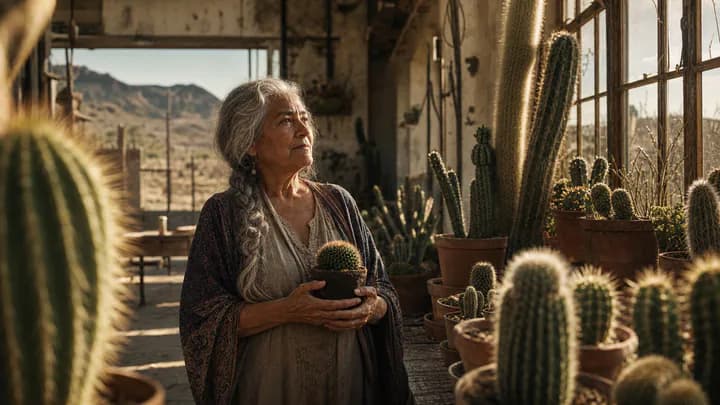
The first thing anyone learned about Mira Verde was that nothing grew there without being asked twice. The second thing was that Doña Cruz, who kept the little glass greenhouse at the west edge of town, had asked more times than anyone alive.
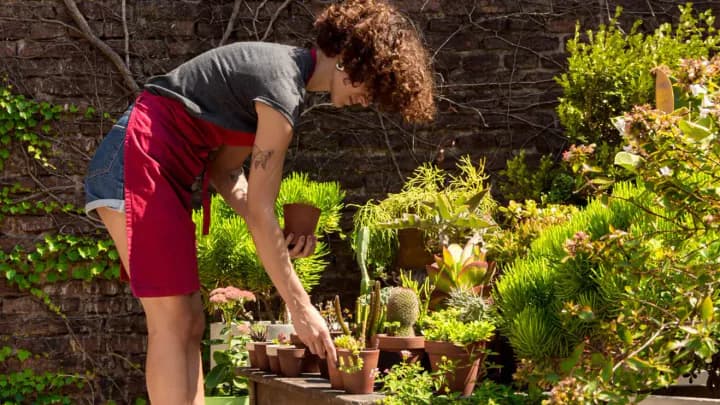
Her greenhouse squatted between the last house on Calle Sombra and the beginning of the flats, where the desert stretched pale and patient toward mountains that never seemed to get any closer. From the road it looked like a lantern half-buried in dust — panes catching the sun, iron ribs, a crooked door held shut with a length of copper wire. Inside grew cacti. Only cacti. Hundreds of them, in clay pots the color of dried blood, arranged on wooden benches Doña Cruz had built herself when her husband was still alive to hold the other end of the boards.
She was watering the barrel cactus by the door when the girl came in.
“Are you the keeper?” the girl asked. She was maybe nineteen, thin as a fence post, wearing a denim jacket too warm for the weather. Her eyes had that particular red-rimmed look of a person who had done her crying already, elsewhere, and come here for whatever was next.
“I keep them, yes,” said Doña Cruz. “But they mostly keep themselves.”
The girl looked at the rows of green and silver and shy pink flowers. “My abuela used to come here. She said you take things.”
“I don’t take,” said Doña Cruz gently. “The cacti do. And only if they want to.”
“How do you know if they want to?”
“They tell me.”
The girl was quiet for a while. Somewhere outside, a truck ground down the road toward the highway, and the panes rattled softly in their frames like teeth.
What the Cacti Held
It had started, Doña Cruz sometimes explained, with her mother, who had grown one prickly pear in a coffee can on the kitchen windowsill and told her daughter it held every unkind word her father had ever said. When the old man died, the prickly pear bloomed for three days straight, yellow as butter, and then quietly gave up. Her mother buried it under the lemon tree and never spoke of it again.
Doña Cruz had not believed her, exactly, until she was twenty-three and had watched a saguaro seedling in her own yard swell strangely the week her sister left for the coast and did not write. The seedling had grown a lopsided arm, low and reaching, in the exact shape her sister’s wave had made from the bus window. After that Doña Cruz began to notice things. The old fishhook barrel that took on a rusty tint the summer her neighbor lost his son. The pincushion cactus that shivered in still air whenever a certain widower came to sit on the bench outside.
She had built the greenhouse forty-one years ago, when she understood that not everyone in Mira Verde had a saguaro of their own.
People came. They did not always know why. A man would arrive with a wedding ring in his pocket and stand for an hour in front of the golden ball cactus, and leave lighter, though he could not have named what had left him. A grandmother would touch the smooth green flank of an old man cactus and weep without embarrassment for a brother who had died in another country. Sometimes a cactus would flower afterward. Sometimes it would simply darken, deepen, take on another ring inside itself the way trees do. Doña Cruz did not pretend to understand the mechanism. She only kept the door unwired for people who needed it, and swept the tile, and watered on Tuesdays and Fridays.
The Weight the Girl Brought
“I want to leave something,” the girl said finally.
“All right.”
“I don’t know if I’m allowed. It’s — it’s not sad, exactly. It’s more like —” She struggled. “Like I’ve been carrying somebody else’s coat for a long time. And I want to put it down. But I feel bad putting it down.”
Doña Cruz nodded slowly. She set the watering can on the tile. “Walk,” she said. “Slowly. Don’t look for the one. Let the one look for you.”
The girl walked. She moved past the tall ones first, the ribbed columns that stood like patient old men. She paused at a cluster of small round cacti fuzzed with white, then moved on. She trailed her fingertips near, but not touching, a shelf of little clay pots.
She stopped at a plain, unremarkable pincushion cactus near the back wall. It was not in flower. It was not especially healthy-looking. It sat in a chipped pot with a faded number 14 painted on the side in someone else’s handwriting.
“This one,” she said, surprised.
“All right,” said Doña Cruz.
“What do I do?”
“Put your hand near it. Not on the spines. Just near. And think about the coat.”
The girl held out her hand. Her fingers were shaking a little. She closed her eyes.
Doña Cruz watched, as she had watched a thousand times, the way the light in the greenhouse seemed to lean, very slightly, toward the small plant. It was not a thing you would notice if you weren’t looking for it. A softening, the way a room softens when someone begins to listen properly.
The girl’s shoulders came down half an inch. Then another half inch. Her breath, which had been shallow, went deeper, the way breath does when a person has stopped bracing.
After a long minute she opened her eyes.
“Is that it?” she whispered.
“That’s it.”
“I don’t feel — I don’t feel different.”
“You will,” said Doña Cruz. “Or you won’t, and that will also be all right. The coat is off you now. Whether you notice tomorrow or next spring, that is between you and your shoulders.”
The girl looked at the small cactus a long time. “Will it be okay?”
“It has held heavier,” said Doña Cruz, which was true.
The girl reached into her pocket and put a folded bill on the bench. Doña Cruz did not touch it. She never touched the money until after the person had gone; it seemed rude, somehow, like counting a gift in front of the giver.
At the door the girl turned back. “Doña — what happens to them? The cacti. When they’re full.”
Doña Cruz smiled, and the lines around her mouth were the lines of a woman who had answered this question in many voices over many years.
“They bloom,” she said. “Eventually. Every one of them. Even the ones that take forty years. That is the part people forget. Nothing here is only holding. Everything here is also, quietly, becoming a flower.”
The girl stood in the doorway a moment longer, the desert light warm on half her face. Then she nodded, once, and stepped out into the road, and Doña Cruz turned back to the barrel cactus by the door, which was thirsty, and had been waiting patiently for its turn.