The Ferryman of the Almost-Morning River
On a river that only exists between four and five a.m., a reluctant ferryman meets a passenger who refuses to say where she's going. What she carries changes everything.
Drafted with AI and published automatically. Our editors set the standards and fix reported errors — how we work.
The river only ran between four and five in the morning, and even then only if you believed in it hard enough to launch a boat. Odom had believed in it for thirty-one years, which was, he sometimes thought, longer than he'd believed in anything else, including himself.
He kept the skiff under a tarp behind the willow at the end of Weir Lane. At three forty-five he'd unpin the tarp, fold it into quarters the way his mother had taught him to fold sheets, and carry the oars down the slope where in daylight there was only a shallow ditch of nettles and cola cans. In the almost-morning, the ditch widened. Water rose from nowhere the way steam rose from a kettle, and by four the river was full and dark and moving.
He had never asked where it came from. He had asked, once, where it went. The answer had cost him a tooth and a year of dreams, and he did not ask again.
I.
Passengers were rare. Most nights he rowed empty, because the almost-morning was not a route most people knew how to book. Those who found the bank found it by accident — the sleepless, the newly bereaved, a boy once who had been walking since Tuesday and could not remember why. Odom took them across without charge. On the far bank they stepped off, blinked, and walked into a fog that thinned into whatever their next day was going to be. He had never followed. Following was against the small, unwritten rules he had assembled over three decades, and he suspected the rules were the only thing keeping the river polite.
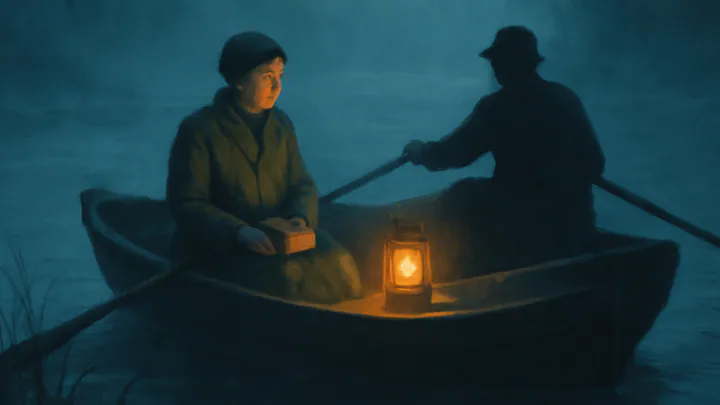
Tonight the passenger was a woman in a green coat, holding a tin box the size of a loaf of bread.
She was waiting on the bank when he arrived, which had never happened before. Usually he arrived first and swept the reeds with his lantern until someone stepped forward, apologetic, as if they'd wandered into the wrong room at a party. This woman stood as though she'd been standing there since Tuesday of a different year.
“You're the ferryman,” she said. Not a question.
“I row a boat,” Odom said. He preferred that phrasing. Ferryman sounded like something from a story he wasn't sure he wanted to be in.
She held up the tin. “I need to take this across.”
“People go across. Not things.”
“It's a thing that needs to go across.” Her face was younger than her voice by about a decade. “I'll pay.”
“I don't take payment.”
“Everyone takes payment,” she said. “They just call it different things.”
He considered her, then the tin, then the water, which had begun its slow eastward slide. Four-oh-two. He had fifty-eight minutes.
“Get in,” he said.
II.
The skiff rocked when she stepped down, and she sat too fast, the way people did when they were afraid of appearing afraid. She set the tin on her lap. It was old, printed with a fading pattern of pears, and there was a small padlock on it where a padlock had no business being.
Odom pushed off. The lantern swayed. The bank slipped backward into reeds and reeds slipped backward into mist, and then there was only the two of them and the sound of oars finding water.
“Do you always talk to your passengers?” she asked.
“I don't, usually.”
“Then why now.”
“Because you brought a box,” he said. “And I've been rowing this river long enough to know when something is going to make me break a rule.”
She looked down at her hands. Her nails were bitten. “What's the rule?”
“Don't ask what people are carrying.”
“Then don't ask.”
He rowed. The far bank was, at this hour, a suggestion — a smudge of darker dark against the dark. He knew it by feel now, the way a pianist knows the middle of the keyboard without looking. Twelve minutes out. Twelve back, if the current cooperated.
“It's letters,” she said, when he had stopped expecting her to speak. “From my sister. She wrote me one every week for nine years and I didn't open any of them.”
Odom kept rowing.
“She died in March,” the woman said. “And now I can't open them, because if I open them she'll be writing to a person she thought still existed. And I don't. Not that one. I haven't for a long time.” She touched the padlock. “I thought if I brought them here, I could just—”
“Leave them on the other side.”
“Yes.”
He thought about this for the length of six strokes. The lantern threw a soft yellow ring around them, and inside the ring her face was very still.
“The other side isn't a place to leave things,” he said. “It's a place people walk into. If I put the tin down over there, it won't stay. It'll come back with the next passenger, or the one after. Things try to find their owners on this river. It's one of the reasons I don't take payment.”
She was quiet a long time. “Then what do I do with them.”
“I don't know,” he said, honestly. “I row a boat.”
III.
They reached the far bank at four thirty-nine. He knew because he had, without meaning to, begun counting his strokes years ago, and the count now lived under his ribs like a second pulse.
She didn't get out.
“Take me back,” she said.
“With the tin?”
“With the tin.”
He turned the skiff. The current was against them now, and he had to work, and it was good to work, because it meant he didn't have to think about the fact that in thirty-one years no one had ever asked him to row them back.
Halfway across she opened the padlock. He heard the small click of it over the water. She did not take a letter out. She just lifted the lid an inch, then closed it again, then lifted it, the way someone tests whether a wound is still tender.
“I thought crossing would do it,” she said.
“Crossing doesn't do it,” Odom said. “Crossing is just crossing. The doing is on the other end of the crossing, and it's yours.”
“That's a terrible thing to tell someone at four in the morning.”
“It's a four-in-the-morning kind of truth.”
She laughed once, wetly. “Do you charge extra for those?”
“I don't charge at all. I told you.”
“Everyone charges,” she said again, but softer this time, like she was starting to understand what he'd meant, or what she'd meant, or that possibly they had meant different things all along and it hadn't mattered.
They reached the near bank at four fifty-eight. He held the boat steady while she climbed out with the tin under her arm. The water was already beginning to thin, becoming ditch again, becoming nettles and cola cans and the small ordinary indignities of Weir Lane at dawn.
She turned on the bank. “Will you be here tomorrow?”
“I'm here every morning.”
“I might not come back.”
“That would be all right,” he said. “That would mean you didn't need to.”
She nodded, and adjusted the tin, and walked up the slope, and the mist took her the way mist takes everyone, gently and without ceremony. Odom folded the tarp into quarters and carried the oars back to the willow. Above him, the sky was doing its long slow trick of becoming blue. He stood a moment, listening to a bird he could not name, and thought that in thirty-one years of rowing he had finally, for the first time, taken someone somewhere.