The Beekeeper's Lost Language
When a linguistics student inherits her grandmother's apiary, she discovers the bees have been keeping notes of their own. The translation will require more than dictionaries.
Drafted with AI and published automatically. Our editors set the standards and fix reported errors — how we work.
The bees knew Nonna was gone before Isolde did. That was what the neighbor told her, standing at the gate with a casserole and eyes gone soft at the corners, and Isolde nodded politely because she did not yet know how to argue with country people about country things.
She had come north on two trains and a bus, carrying a duffel bag and a dissertation she was no longer sure she believed in. Her thesis was on endangered phonemes — the small sounds that vanish when the last speaker of a language dies. Her advisor had called it elegiac, which Isolde had learned meant unlikely to be funded. Then the letter had come about Nonna, and about the house, and about the twelve hives at the edge of the orchard, and here she was.
The house smelled of rosemary and old woodsmoke. On the kitchen table, someone — the neighbor, perhaps — had left a jar of honey and a note in careful blue pen: They will need telling.
Isolde read it twice. She assumed it was a translation error.
In the morning she walked out to the orchard in Nonna's boots, which were a size too big and made her feel like a child playing at inheritance. The hives sat in a crooked row beneath the pear trees, painted in colors she remembered from childhood summers: dusk blue, ochre, a green like the underside of a leaf. She had not been here in nine years.
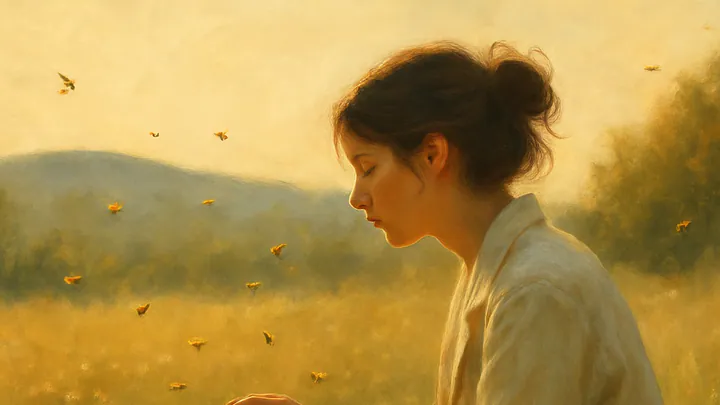
The bees did not swarm her, which she had half feared. They moved around her in a slow, considering way, as if reading a page. One landed on her wrist, walked three steps, and lifted off again.
"I don't know what to say to you," she told them, and felt immediately foolish.
She lifted the lid of the nearest hive the way Nonna had shown her once, long ago — slowly, with both hands, the way you might open a book you were afraid to damage. Inside, the comb was pale and dense and humming. And tucked between two frames, wrapped in a scrap of waxed cloth, was a folded piece of paper.
Isolde stared at it for a long moment before she reached in.
The paper was Nonna's. She recognized the handwriting the way you recognize a voice through a wall. It said, in Italian: Tell them when the pears bloom late. Tell them when Marco's boy is born. Tell them when I am tired.
Underneath, in a different, shakier hand, and in a different ink: We heard.
The Notebook
She found the notebook that evening, in the drawer beneath the bread board, where Nonna had kept anything she considered important enough to be near food. It was thick, water-stained, bound with a length of garden twine.
The first pages were what Isolde expected — recipes, weather, the price of sugar in 1976. But then the entries changed. They became short, addressed, almost liturgical.
Told them today: my sister has died. They quieted for a full minute. Then they resumed.
Told them today: rain is coming from the west. They already knew.
Told them today: I forgive Enzo. They forgave him with me.
Isolde read until the light went blue and then gray. She had studied twenty-two languages, some of them spoken by fewer than a hundred people, and she had never once considered that grief itself might be a grammar. She thought of her advisor, who would laugh. She thought of her mother, who would not.
At the back of the notebook, in the shakiest hand of all, Nonna had written: Isolde. If you are reading this, they will need telling. Start with the truth. They can tell when you lie.
She went out to the orchard the next morning with the notebook under her arm and a chair from the kitchen, because she did not know how long this would take.
She sat down in front of the dusk-blue hive. The bees came out in their considering way and made a small, drifting cloud around her head, and she felt, absurdly, as if she were being introduced to a roomful of great-aunts.
"I don't know how to do this," she said, in Italian, because it seemed right. "Nonna is dead. You know that. I'm sorry no one told you properly. I was on a train."
The humming did not change, exactly, but it seemed to gather.
"I don't know if I'm staying," she said. "I have a life in the city. I have a — a thing I'm supposed to be finishing. About dying languages." She laughed, once, a dry sound. "I didn't realize she'd been keeping one."
A bee landed on the open page of the notebook. It walked a slow figure over Nonna's handwriting and lifted off.
"I'm tired," Isolde said, more quietly. "I don't know what I inherited. I don't know if I want it. I don't know if I'm the right person."
The hive answered — not in words, of course; she was a linguist, not a fool — but in a shift of tone, a lowering, the way a room lowers when someone finally says the true thing. She sat with it. She sat with it for a long time.
When she stood, her legs were stiff and the sun had moved. She closed the notebook and walked back toward the house through grass that smelled of crushed thyme.
What Was Said
She stayed the summer. She had not meant to.
She learned to lift the frames without trembling, to read the weather in the direction of the foragers, to know from the pitch of the hum whether the queen was well. She wrote to her advisor and said she would be late with the chapter. She wrote again, later, and said she would not be finishing it at all — that she was writing something else now, something she did not yet have a name for.
In the evenings she sat with the notebook and added her own entries, in her own hand, beneath Nonna's.
Told them today: I am staying, I think. They approved, or the wind moved. It is hard to tell the difference and perhaps it does not matter.
Told them today: I am afraid I will do this wrong. They were patient, which is its own answer.
Told them today: thank you for waiting.
The pears bloomed late that year, as Nonna had once predicted to no one but the bees. Isolde stood beneath them in the soft, particular light of a country evening, and understood, at last, that some languages do not die. They only wait for someone quiet enough to be spoken to.