The Night Train to Somewhere Quieter
When Mira boards the 11:47 express with no destination in mind, the conductor offers her a ticket to a place she's never heard of — and somehow already misses.
Drafted with AI and published automatically. Our editors set the standards and fix reported errors — how we work.
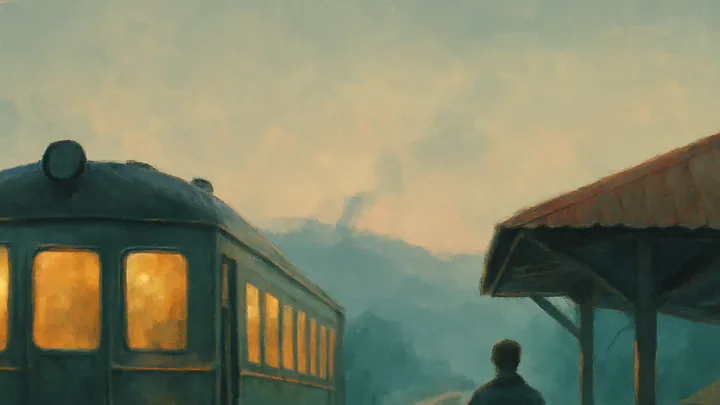
The platform clock read 11:46 when Mira realized she had not chosen a destination. She had only chosen to leave.
The ticket window had closed an hour ago, the agent's stool tipped sideways behind the glass like a small abandoned ship. Around her the station hummed with the low electric loneliness of places designed for waiting. A vending machine offered six kinds of crackers and one kind of regret. The departures board flickered through cities she'd been to and cities she hadn't, and none of them, she discovered with mild alarm, felt like answers.
The train arrived in a long sigh of brakes. It was older than she expected — green-paneled, the windows warm and yellow as kitchen lamps. A conductor stepped down onto the platform, a small woman with iron-gray hair pinned under a cap two sizes too big, and looked directly at Mira as though they had agreed to meet.
"You're cutting it close," the conductor said.
"I don't have a ticket," Mira admitted.
"No," the conductor agreed pleasantly. "People rarely do, this late."
She produced a small leather book from her coat pocket and flipped it open. The pages, Mira noticed, were not printed but handwritten, in a careful slanting script that reminded her of her grandmother's recipe cards.
"Where are you going?" the conductor asked.
"I don't know."
"That's all right. Where are you leaving?"
Mira opened her mouth and found she had a whole inventory ready — the apartment with the broken radiator, the job that had begun, sometime in the last year, to feel like wearing wet shoes, the friend who had stopped returning her messages without ever announcing she had stopped. She had rehearsed these complaints so often they had grown smooth as river stones. But standing on the platform at 11:47, none of them seemed quite worth saying out loud.
"Somewhere louder than I wanted," she said finally.
The conductor nodded as if this were a perfectly reasonable address. She turned a page in the little book, ran her finger down a column, and stopped.
"How about Hesperin?" she said. "It's quieter. Most people find it suits."
"I've never heard of it."
"No," the conductor said again, and smiled. "But you might miss it anyway."
The carriage smelled of pencil shavings and old wool. Mira found a seat by the window across from a man in a brown coat who was reading a paperback with the cover folded back so she couldn't see the title. He nodded at her the way strangers do on trains, which is to say: I acknowledge that we are briefly sharing a small box hurtling through the dark, and I wish you well in it.
The train pulled away from the station with no announcement. Outside, the city's lights began to thin, then to scatter, then to become single porch lamps blinking past like slow fireflies. Mira pressed her forehead to the cool glass and let her breath fog a small grey country onto it.
"First time to Hesperin?" the man asked.
She looked up, surprised. "How did you know?"
"You're still holding your bag like it might run off."
She looked down. She was, in fact, clutching the strap of her duffel with both hands as though it were a small unruly dog. She made herself let go, finger by finger, and set the bag on the floor.
"What's it like?" she asked. "Hesperin."
The man considered. He had the sort of face that arranged itself slowly, like a town settling at dusk.
"It's the kind of place," he said, "where the baker knows what you want before you do, but waits for you to say it anyway. Out of politeness."
"That sounds invented."
"Most good places do, until you get there."
She laughed, surprising herself. The sound of it felt unfamiliar, like a coat she hadn't worn in a season.
The Long Middle of the Night
Somewhere past the second hour, the lights in the carriage dimmed without anyone touching them, and a hush settled in that wasn't sleep exactly but its gentler cousin. The man in the brown coat had closed his book and was watching the window the way some people watch fires. Mira realized she had been crying a little, very quietly, the way you cry when you finally stop holding something you didn't know you'd been holding.
The conductor came through, punching tickets with a small silver tool that made a sound like a cricket. When she reached Mira, she paused.
"You'll need this," she said, and handed her a slip of paper. It wasn't a ticket. It was a list, written in the same slanting hand as the leather book.
Hesperin, things to know:
1. The river runs east, which confuses everyone at first.
2. The library is open whenever the librarian feels like opening it, which is most days.
3. You are allowed to stay as long as you like. You are also allowed to leave.
"That's a strange welcome," Mira said.
"It's not a welcome," the conductor said. "It's just a list. The welcome happens later, and you do it yourself."
She moved on down the carriage, cricket-clicking softly into the dark.
Mira must have slept, because when she opened her eyes the sky outside had gone the pale, hopeful color of the inside of a shell. The train was slowing. The man in the brown coat was gone; in his seat lay his folded paperback, and on top of it a pencil, as though he'd left them there on purpose for someone.
The station at Hesperin was a single platform under a tin roof, with a hand-painted sign and a bench. A woman in a yellow scarf was sweeping leaves off the boards, and she looked up as Mira stepped down and smiled the unhurried smile of someone who has seen many trains arrive and is not yet tired of it.
"You're the new one," the woman said. It wasn't a question.
"I think so," Mira said.
"Bakery opens at seven. Library opens when Hari finds his keys. River's that way, but it runs east, which —"
"Confuses everyone at first," Mira finished.
The woman laughed, and the laugh sounded the way Mira's own had sounded on the train: like a coat remembered.
Mira shouldered her duffel, looser this time, and stepped off the platform onto a path that smelled of wet stone and woodsmoke and something faintly sweet she couldn't name. Behind her the train sighed once more and began to move again, off toward whatever quieter places it still had to deliver people to.
She did not turn to watch it go. She had the feeling, walking, that she was being met — not by anyone in particular, but by the morning itself, which had been holding a chair for her at its table all along.