The Chess Match in the Laundromat
On a rainy Tuesday, a girl looking for quarters finds a stranger who has been waiting six years for someone to move a pawn.
Drafted with AI and published automatically. Our editors set the standards and fix reported errors — how we work.
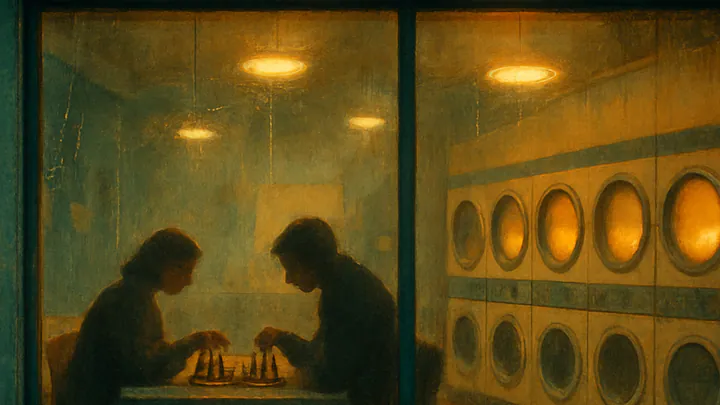
The chessboard was bolted to the table, which was the first thing Mira noticed, and the second thing was the man sitting behind it as if he had been waiting for her specifically.
She hadn't planned to come in. She'd only wanted quarters. The bank across the street had a machine that swallowed bills and spat out sleeves of coins, but the machine was broken, and the teller had shrugged with the tired kindness of someone who had shrugged all afternoon. Try the laundromat, she'd said. They'll break a five.
So Mira ducked in from the rain, hair flattened to her forehead, and stood dripping onto a mat that said WELCOM, the E long since worn away. The place smelled of warm lint and something floral and chemical. A row of front-loading dryers turned in slow amber circles like small suns setting on their sides. And in the back corner, at a Formica table pocked with cigarette burns, sat a man in a wool cardigan the color of wet bark, one hand curled around a paper cup, the other resting near a white pawn.
He looked up. He did not look surprised.
“You play?” he said.
“I need quarters.”
“The change machine's by the folding table. It works if you press the button twice.” He nodded toward it without taking his eyes off her. “You play, though.”
“How could you possibly know that.”
“You looked at the board before you looked at me.”
Mira felt caught, which was ridiculous. She was twenty-six years old and had done nothing wrong. She went to the change machine, pressed the button twice, and a small avalanche of quarters clattered into the tray. She scooped them into her pocket. They were heavier than she remembered quarters being.
She should have left. Her laundry was not here; her laundry was in a basket on her kitchen floor, waiting for a Saturday she kept postponing. She had no reason to stay. Outside, the rain thickened, drumming on the awning like impatient fingers.
“One game,” the man said. “I've been white for six years. I'd like to lose.”
“Six years?”
He gestured at the empty chair.
The Opening
She sat. She did not know why she sat. Later she would tell her sister it was the rain, and her sister would say the rain does not make people sit down at chessboards with strangers, Mira, and Mira would say this rain did.
The board was scratched but clean. The pieces were the cheap plastic kind, weighted with something that felt like sand. A white pawn had already been advanced to e4. She studied it.
“My name is Emil,” the man said.
“Mira.”
She moved a pawn to e5. Standard. Safe. The kind of move her grandfather had taught her when she was eight and he was still alive and their kitchen still smelled of the black bread he baked on Sundays. She had not played chess since he died. Her fingers remembered anyway.
Emil's knight came out. Then hers. They traded the polite early moves of two people feeling for the shape of each other.
“Why six years,” she said, after a while.
He considered his bishop. “My wife and I opened this place in 1994. She ran the counter; I fixed the machines. She put the board here so people would stay a little longer. She said a laundromat should feel like somebody's living room, not a bus station.”
“And?”
“And she died. Six years ago in March. I kept the laundromat because I didn't know what else to do with it. I kept the board because she'd bolted it down and I didn't own a wrench that fit.” He smiled without lifting his eyes from the pieces. “That's a lie. I own the wrench. I just didn't want to unbolt it.”
Mira moved her bishop. The rain on the windows made the light inside seem underwater, and the dryers thumped softly, and somewhere a phone rang three times and stopped.
“Nobody plays?” she said.
“People play. Kids mostly. They move the pieces around and set them back wrong. I fix it after they leave. But nobody sits down like she used to sit down. Nobody stays for a whole game.”
“Because you scare them.”
He laughed, surprised. “I don't scare them.”
“You sit there staring at the board like a man guarding a tomb. Of course you scare them.”
“And you?”
“I need something to do with my hands.”
The Middle Game
They played. He was better than her, but only by a little, and only because she was rusty. She felt her grandfather at her shoulder, tapping the queenside, suggesting things. Watch his rook, Mira. He's setting a trap with the rook, he always sets traps with the rook. Which was not true, Emil did not always set traps with the rook, but her grandfather had always said this about every opponent, and it had always worked out.
She took his rook.
Emil made a small sound like a pleased cough. “There she is.”
An older woman came in with a duffel bag, loaded a machine, glanced at them, and settled into a plastic chair with a paperback. A teenager came in for change, got it, left. The dryers turned. Mira's coat dried on the back of her chair, and steam rose faintly from the shoulders.
She had come for quarters. She had, she remembered dimly, been on her way to somewhere. She had been on her way to somewhere for a long time. Ever since her grandfather died, and then her mother, and then the job she had thought she'd wanted, she had been on her way to somewhere with the vague and constant urgency of a person who suspects the somewhere doesn't exist.
Here, in this laundromat that smelled of lint and rain, on a Tuesday she had not planned, she was not on her way anywhere.
She moved her queen.
“Ah,” Emil said. “That's the move.”
“Is it?”
“Three moves from now, yes. You'll see.”
She did see, three moves later. Checkmate arrived like the punchline of a joke she'd been telling all afternoon without knowing it. Emil looked at his cornered king and nodded, slow and grateful.
“Thank you,” he said.
“For beating you?”
“For finishing.”
She understood, then, what six years had meant. It was not that no one had played. It was that no one had stayed to the end.
She stood up. Her coat was warm. The rain had thinned to a drizzle, and the sidewalk beyond the window shone like something newly poured.
“Same time next week?” Emil said. He was already resetting the pieces, careful as a man laying a table for guests.
Mira hesitated at the door. She thought about her laundry, and the somewhere she had not been going to, and the weight of quarters in her pocket. She thought about her grandfather, and the black bread, and how he had once told her that the point of chess was not to win but to sit across from somebody and take them seriously for an hour.
“Tuesday,” she said.
The bell above the door rang softly as she stepped out into the cooling air, and behind her, through the glass, she could see Emil placing the last white pawn exactly where it belonged.