The Postmistress of Undelivered Winters
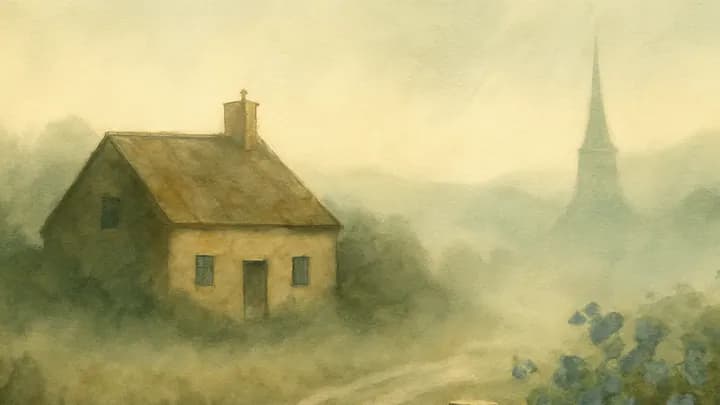
In a snowbound village where letters sometimes arrive decades late, one postmistress must decide whether to deliver a message that was never meant for its recipient.
Drafted with AI and published automatically. Our editors set the standards and fix reported errors — how we work.
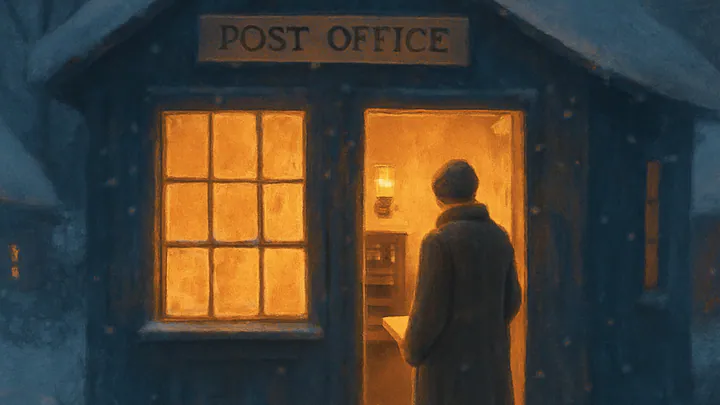
The letter came in on the Tuesday mail sled, tucked between a seed catalog and a birthday card, and the postmark read February 1983. It was February 2024.
Ines held it up to the window of the post office and squinted, the way her mother used to squint at eggs to see if they were fresh. The stamp was the old kind, the one with the winter hare, and the ink of the address had gone the soft brown of tea left too long in the pot. But the name was clear enough: Mr. Halden Vry, 14 Orchard Lane, Kesselmark.
Halden Vry had been dead nineteen years.
Ines set the letter on the counter and looked at it the way you look at a stray dog that has followed you home. In Kesselmark, mail arrived late sometimes. This was known. The mountain pass kept its own weather, and the village kept its own patience, and every so often a postcard would surface from a decade you'd stopped thinking about. Her predecessor, old Mr. Ostri, had kept a whole drawer of what he called slow letters — envelopes that had wandered off into some quieter current of the world and washed up years later, still sealed, still hopeful.
She had inherited the drawer along with the pigeonholes and the brass lamp and the cat, whose name was Postage and who was, at that moment, asleep on the parcel scale.
The Drawer
Ines opened the slow-letters drawer and slid the envelope in with the others. There were seven now. A birthday card for a girl who had since become a grandmother. A wedding invitation for a ceremony that had happened in 1971. A note from a soldier to his mother, written in pencil, which Ines had read once and then not again because reading it had made her sit down on the floor and stay there for an hour.
The rule, insofar as there was one, was that slow letters were delivered when their recipient could still be found. When they could not, they were kept. Not thrown away — Kesselmark did not throw away letters — but kept, in the drawer, in case some future postmistress figured out what to do with them.
Ines had not figured it out.
She closed the drawer. Then she opened it again and took the letter back out.
Halden Vry had no children. His wife, Mira, had left the village long before he died, and no one had heard from her in decades. There was no one to deliver to. But Ines turned the envelope over and saw, on the back flap, in a careful looping hand: From M.
She sat down on the stool behind the counter. Postage opened one eye, considered her, and closed it again.
She did not open it that day. She was not the sort of postmistress who opened other people's mail, and forty-one years of delay did not, in her view, change what a letter was. A letter was a private country between two people. You did not walk into it uninvited just because the border guards had gone home.
But she carried it in her coat pocket for a week.
She carried it to the bakery, where Ilva sold her a loaf of dark bread and asked why she looked like she was doing arithmetic in her sleep. She carried it up the hill to feed the winter birds, and the letter sat against her ribs like a second, slower heart. She carried it to the churchyard, where Halden Vry's stone had gone mossy in a companionable way, and she stood there for a long time in the pale afternoon light and said, out loud, “Well. What do you want me to do?”
Halden Vry, being dead, did not answer.
But on the way home, Ines passed the house at 14 Orchard Lane, which had been sold twice since Halden's death and now belonged to a young couple with a baby and a red door. And she thought: the letter is not for the house. The letter is for the man. And the man is not here.
Which meant, perhaps, that the letter was hers to answer.
The Reply
That evening she made tea and sat at the little desk in the back room of the post office, where the account books lived, and she took out a fresh sheet of paper. She did not open Mira's letter. She wrote, instead, to Mira — to the last address the village had for her, forty years stale, in a city three trains away.
“Dear Mrs. Vry,” she wrote, and then crossed it out, because she did not know if Mira was still a Vry, or still a Mrs., or still anything. She began again.
“Dear Mira,
My name is Ines Karel. I am the postmistress of Kesselmark. A letter has arrived at my office, addressed to Halden, in what I believe to be your hand. It is dated February of 1983. I do not know where it has been. In this village we accept that some letters travel by longer roads than others, and we do not ask them where they slept.
Halden passed away in 2005. He is buried in the churchyard here, under the yew, and the stone is well kept. I want you to know that.
The letter is sealed. I have not read it, and I will not. But it is yours — it left your hand, and by any reckoning I understand, that means it can return to it. If you would like me to send it back to you, I will. If you would like me to leave it at his grave, I will do that instead. If you would like me to burn it, I will, and I will do so without opening it, and I will send you the ashes if you wish.
You do not owe me an answer quickly. In Kesselmark, we are used to waiting.
With respect,
Ines Karel, Postmistress”
She read it twice, folded it, and addressed it to the old city street. She walked it to the outgoing box herself, even though the outgoing box was three feet from her desk, because some letters wanted to be carried a little way by hand.
The reply came in April, which, in the arithmetic of Kesselmark's post, was almost suspiciously prompt.
Mira was still Mira, and still alive, and eighty-two, and she wrote in the same looping hand, though slower now, the loops a little wider. She asked Ines to take the letter to the grave, unopened, and to leave it there. She asked, also, if Ines would be so kind as to tell her what flowers grew near the stone in summer. She said she would like to imagine them.
Ines walked up to the churchyard on a bright thawing afternoon, when the snow was going soft at the edges and the first green was starting somewhere under everything. She knelt by the yew. She tucked the letter under a flat stone at the base of the marker, where the wind would not take it and the rain would take it only slowly, as rain does everything in Kesselmark.
She sat for a while. She noted, for later, the crocuses beginning at the wall, and the moss like a green coin on the north side of the stone, and a single early bee bumbling in the grass.
Then she walked back down to the post office, where Postage was waiting on the scale, and the drawer of slow letters sat with one fewer envelope in it, and the winter, at last, began to let go.