The Hot Air Balloonist of Quiet Fields
Every September, a balloon rises over the harvested fields of Ardley Bend — and every September, a stranger named Pell offers one ride to whoever needs it most.

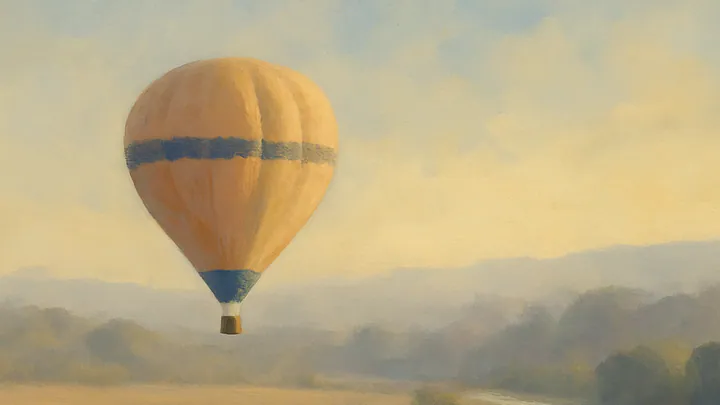
The balloon came up over the stubble fields the way the moon comes up over a pond — quietly, and as if it had always meant to. Marin saw it from her kitchen window while the kettle was still deciding whether to whistle.
It was the color of a faded apricot, with a single navy stripe running its seam, and it hung above Pell's far pasture as though tethered to a thought rather than a rope. She had lived in Ardley Bend long enough to know that every September a balloon arrived, and every September someone in town climbed into it and came back changed in some small, unspectacular way. The Hensley boy had come back able to whistle. Old Doris had come back willing, finally, to sell her husband's truck. None of it was dramatic. None of it made the county paper. But it was the kind of thing a town kept track of without saying so.
Marin had never gone up. Twelve Septembers she had stayed indoors with the curtains half-drawn, and twelve Septembers the balloon had drifted on without her.
This year she was already wearing her coat.
The walk to the pasture took her past the silo, past the row of mailboxes leaning in their companionable way, past the dog that always barked and never bit. The grass was the color of weak tea. Somewhere a tractor was making the patient, grinding noise tractors make when no one is in a hurry.
The basket sat in the grass like a wicker boat run aground. A woman in a canvas jacket was checking a knot — tall, thin, hair the gray of river stones, an age Marin could not quite settle on. She looked up as Marin approached and did not seem surprised.
"Morning," the woman said. "I'm Pell."
"I know," Marin said, though she didn't, not exactly. Everyone called the balloonist Pell, the way everyone called the post office the post office. "I'd like to go up."
Pell studied her for a moment. Not unkindly. The way you might study a kettle to see whether it had decided.
"All right," she said. "Step in."
The basket was deeper than Marin expected, and smelled of old rope and pipe tobacco, though Pell did not seem to be a smoker. There was a small wooden stool in one corner, and a thermos, and a folded wool blanket the color of plums. Pell pulled a cord, the burner roared like a brief lion, and the ground let go of them without ceremony.
Marin had braced for a lurch. What she got instead was the quiet feeling of a room slowly becoming a different room. The fence posts shrank. The dog kept barking, smaller. Her own house arrived in the picture — the green roof, the gutter she had been meaning to clean since April — and then her house was just one of many houses, and then the houses were dominoes someone had set out and forgotten.
"Most people scream a little," Pell said.
"I used up my screaming," Marin said, surprising herself. "A while back."
Pell nodded as if this were a perfectly normal kind of inventory to keep.
What the Wind Was Saying
They drifted east, because that was where the wind was going. Marin had always pictured ballooning as a thing one steered, but Pell explained, almost apologetically, that you mostly agreed with the sky and the sky mostly agreed back.
"You can go up, you can come down," she said. "Otherwise, you listen."
"Listen to what?"
Pell tilted her head. "To whatever's been trying to tell you something while you were busy not hearing it."
Marin almost laughed. It sounded like the kind of thing the woman who ran the yarn shop would say, with too much meaning and not enough tea. But up here, with the fields turning into a quilt and the river suddenly visible as a long silver sentence she had never read all the way through, it did not seem foolish.
She thought of Tom. She had been thinking of Tom for twelve years, so this was not new. What was new was the angle. From up here she could see the road he used to drive home on, and the bend where the deer had stepped out, and the field beyond it where the ambulance had pulled over, and beyond that, the orchard he had planted the spring before, which she had not visited in a decade because the apples felt like a question she could not answer.
The orchard, from above, was still there. Smaller than she remembered. Tidier. Someone had been pruning it.
"Who looks after the Halloway orchard?" she asked.
Pell glanced down. "Couldn't say. But somebody does. You can tell by the rows."
Marin watched it pass beneath them. The trees had the shaggy patient look of trees that had been given up on and then unexpectedly forgiven. She felt something in her chest do a small, careful thing — not break, not heal, just move, the way furniture moves when you finally decide a room can be arranged a different way.
"I planted those with my husband," she said.
"They look well," Pell said.
"They look better than I left them."
"Things often do, when you come back to them."
They floated for what might have been an hour or three. Time in the basket behaved oddly; the sun did not seem in any rush. Pell poured tea from the thermos into two enamel cups and they drank it standing up, the way people drink tea at funerals and weddings, leaning slightly on the rail.
Marin thought she might cry, and didn't. She thought she might say something important, and didn't. Instead she said, "I've been keeping his coat in the front closet. I don't know why."
"Coats are patient," Pell said. "They wait for whoever the house needs them to wait for."
"It isn't waiting for him."
"No."
"It might be waiting for me to give it away."
Pell smiled, not at her exactly, but at the horizon, as if the horizon had said something clever. "That sounds like the kind of thing the wind would mention, if you let it."
The burner roared softly. They began to come down.
The landing was gentler than the takeoff, which seemed backward, but everything about the morning had been a little backward. The basket settled in a pasture Marin did not recognize at first, until she did: it was the field beside the orchard. Pell had not steered them there. The wind, apparently, had.
Marin climbed out. Her knees worked. Her coat was buttoned wrong; she had not noticed.
"Thank you," she said.
Pell only tipped her head. "Walk home the long way," she said. "Through the trees, if you don't mind."
Marin minded, and went anyway.
The orchard smelled of cider and cold bark. The apples were small this year, freckled, honest. Someone had left a wooden ladder leaning against the third tree in the second row, as if expecting her. She put her hand on the trunk Tom had planted first, the one he had called the stubborn one, and stood there a long time without saying anything, because there was nothing the tree did not already know.
When she got home, the kettle was still warm. The balloon was already a small apricot dot above the next county, drifting east, agreeing with the sky.
She opened the front closet and took down the coat, and folded it, and set it by the door for the morning.
Frequently asked questions
Why does the story keep the balloonist Pell so mysterious?
Pell functions less as a character than as a permission slip. By leaving her history unexplained, the story lets her stand in for whatever quiet invitation a person needs at the right moment in their life.
What is the significance of the orchard appearing only from the air?
Marin has avoided the orchard on the ground for twelve years because it is too close to her grief. Seeing it from above gives her a vantage where the place becomes survivable again — distance, in this story, is a form of mercy.
How does the story use the wind as a thematic device?
The wind is the story's quiet metaphor for grief and time: you cannot steer either, you can only choose to go up, to come down, or to listen. Pell's small sermon about agreement with the sky is really about agreement with one's own life.
Why does the story end with the coat by the door rather than a clear farewell?
A dramatic goodbye would overstate Marin's progress. Setting the coat out is a small, reversible gesture — exactly the scale of change the story trusts, and the scale at which most real grieving actually shifts.