What the River Returned to Mira Cole
Every spring the river by Mira's cottage gives something back. This year, it gives her something she didn't know she had lost.

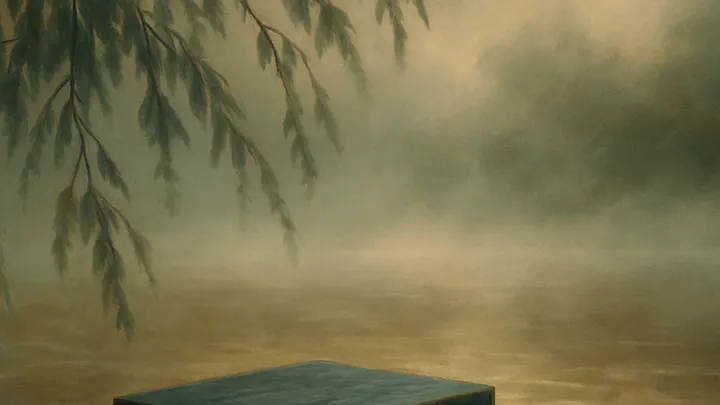
The river always returned things in April, and Mira Cole had learned, after thirty-one springs in the cottage, to walk the bank slowly. Last year it had given her a tin spoon, a child's mitten, and a glass bottle still corked, half-full of rainwater that tasted, when she finally dared, faintly of cardamom.
This year the thaw came late. The willows along the bend stayed grey until the second week of the month, and the river ran high and brown, dragging the winter out of the hills. Mira put on her father's old rubber boots — too big, always too big — and went down to look.
She found the box on the third morning.
It was no larger than a loaf of bread, dark wood gone soft at the corners, and it had wedged itself between two stones at the lip of the shallows. There was no lock. There was a brass hinge, green with age, and a small initial burned into the lid: a curled M, like the start of her own name, or like a wave deciding which way to fall.
She carried it back to the kitchen and set it on a tea towel, because that was what her mother would have done. Then she put the kettle on, because that was what her mother would have done next, and she stood at the window watching the river while the water boiled, because some things you do not open immediately. Some things you let sit on the table and acclimate, the way you let a guest take off their coat.
What Was Inside
The hinge gave easily. Inside, wrapped in waxed paper soft as old skin, were four objects.
The first was a thimble, silver, dented on one side. The second was a small key with a square head, the kind that opened a wind-up toy or a music box. The third was a folded square of paper, brittle but intact. The fourth was a pressed flower — a forget-me-not, of course, because the river had a sense of humor and was not above being obvious.
Mira turned the thimble over in her palm. It was warm, which made no sense; the box had been in cold water for who-knew-how-long. She set it down. She unfolded the paper.
The handwriting was her own.
Not the handwriting she had now — careful, slanted, the script of a woman who signed forms and wrote shopping lists — but the handwriting of a child. The looping ys. The capital Is drawn like little pillars. She knew it the way you know your own face in a darkened window.
If you find this, the note said, please remember the orchard. Please remember Bea. Please remember that you promised.
Mira sat down.
She did not remember an orchard. She did not remember a Bea. She did not remember a promise. She remembered her childhood the way most people remember theirs, in soft uneven patches — the smell of her grandmother's coat, the sting of nettles behind the shed, a song about a magpie her father used to whistle off-key. But there were rooms in her memory she had not visited in a long time, and she understood, suddenly and without panic, that one of those rooms had a door, and the door had been locked, and here was the key.
She walked into the village that afternoon, because the cottage had begun to feel too quiet to think in. The bakery woman, Annetta, was sweeping the step.
"Did there used to be an orchard around here?" Mira asked. "Before my time, maybe. Apples, perhaps."
Annetta leaned on her broom. "Plum," she said. "Up past the Cole place — your place — on the slope. Belonged to the Halloran family. They sold up the year after the flood. Would have been, oh. You'd have been seven or eight."
"And was there a girl. A Bea."
Annetta's face did something complicated. "Beatrice Halloran," she said softly. "She and you were thick as thieves that summer. You don't remember?"
"No," Mira said. "I don't."
Annetta looked at her for a long moment, the way people look at a window when they're deciding whether to open it. "She moved away after," she said. "After the flood. Her family lost the orchard and a good deal else. I think they went south. Your mother — you were both so small — your mother thought it kinder, perhaps, not to keep reminding you. You cried for weeks." She paused. "Some things, when children lose them, the adults try to tuck away. They don't always tuck them back out again."
Mira nodded. She thanked Annetta. She walked home along the road instead of the river, because she needed the long way.
The Promise
That night she sat at the kitchen table with the four objects laid out in a row, and she tried.
The thimble: nothing, at first. Then, slowly, a memory of a girl with dark braids teaching her to sew a button onto a doll's coat, the thimble too big for either of their fingers, both of them laughing.
The key: a music box on a windowsill, painted with plums. A tune neither of them could whistle properly.
The flower: a hand pressing it into a book, saying, So we don't forget.
The note. Oh, the note. The promise was that they would write. The promise was that one of them would bury a box at the edge of the river, where the water sometimes took things and sometimes gave them back, and the other would dig it up when she was grown, and they would meet again at the bend in the willows, and they would remember together what it had felt like to be small and certain and loved.
The river had simply taken it early. Or kept it longer than expected. Rivers are not exact.
Mira sat with this for a long time. She was fifty-three. Beatrice Halloran, wherever she was, would be fifty-three also, give or take a season. The orchard was a housing estate now. The music box was probably dust.
But the thimble was warm in her hand.
In the morning, she walked down to the bend in the willows. She did not expect anyone to be there, and no one was. She stood for a while and watched the river, brown and high and busy with its own errands.
Then she went back inside and wrote a letter. She did not know the address. She wrote it anyway, because some promises are kept in the writing, and the river, she had come to understand, was only one way of sending things.
She signed it with the looping y of a child she was, at last, beginning to remember.
Frequently asked questions
Why does the river only return things in spring?
The seasonal framing suggests that revelation has its own timing — that some truths can only surface when conditions soften enough to release them. Winter holds; spring offers. The river is less a magical object than a metaphor for memory's slow thaw.
What do you make of Mira's mother choosing not to remind her of Bea?
It's a quietly painful gesture of love, the kind that protects a child in the short term and costs her something in the long term. The story doesn't condemn the choice, but it does ask what we owe the people we used to be.
Why does Mira write the letter at the end if she has no address?
The act of writing restores her to herself before it reaches anyone else. The story argues that some correspondence is addressed first to our own forgotten interior, and only second to the world that might carry it onward.
How does the story use small objects to do emotional work?
The thimble, key, flower, and note each unlock a layer of buried feeling without ever being explained outright. Magical realism trusts ordinary objects to carry weight, and the reader to feel what the character can't yet articulate.