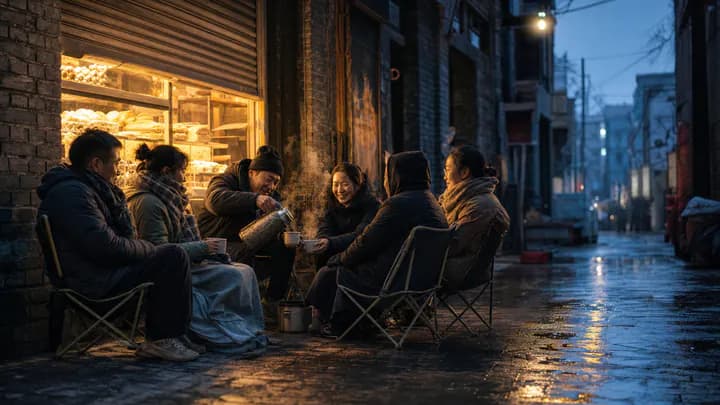
The Bookbinder Who Stitched Tomorrow
When a quiet bookbinder begins finding pages she hasn't written yet tucked inside her latest commission, she must decide whether to read ahead — or finish the book the slow, honest way.

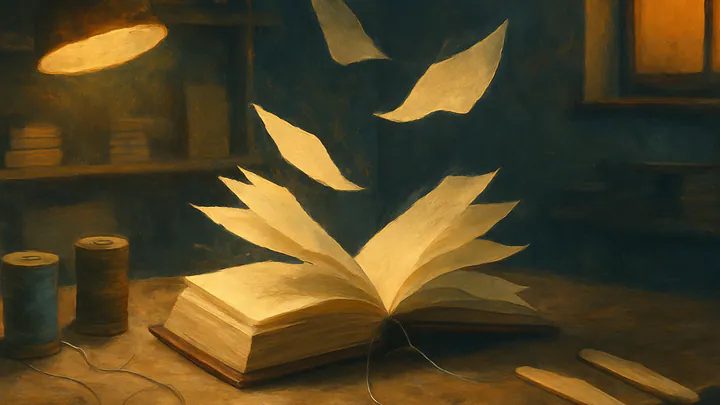
The first page Edith hadn't written yet appeared between signature six and signature seven, folded along the grain as neatly as if she'd done it herself. She found it on a Tuesday, which felt important only because Tuesdays were the days she let herself drink the good tea.
The workshop smelled, as always, of beeswax, linen thread, and the faint vegetal sweetness of paste drying on muslin. Rain ticked against the high window. Edith had been binding a commission for a Mrs. Auberon — a slim journal in oxblood goatskin, blind-tooled, no title — and had stopped to align the folios before sewing them onto the cords. She was humming. She wasn't expecting anything.
The page slid out when she lifted the textblock. It was the right paper, that was the strange thing first. Cream laid, deckle edge, exactly the stock she'd cut down that morning from a parent sheet stored under the bench. But it bore handwriting, and the handwriting was hers — her looping g, her stubborn refusal to dot her i's — and it said:
Tell him yes. The umbrella is in the cupboard under the stairs, behind the boots you keep meaning to mend.
Edith read it twice. Then she set it on the bench, weighted it with a bone folder, and made fresh tea while she waited for it to stop being there. It did not stop being there.
She had lived alone for eleven years above her shop on Cobbet Lane. There was no him. There was, admittedly, a cupboard under the stairs, and there were, admittedly, boots in it that she kept meaning to mend.
The second page appeared on Thursday.
This time Edith was paying attention. She had stitched three signatures onto the cords and was tightening the kettle stitch when she felt — and there was no other word for it — a small give in the textblock, the way a deck of cards gives when you slip a new card into the middle. She loosened the sewing frame and went through the folios one by one.
It was tucked into signature nine.
He'll come in about a watch fob. He won't really want a watch fob. Be kind anyway.
Edith sat down on her stool and considered the ceiling, which had a water stain shaped, she'd always thought, like Portugal.
She had inherited the workshop from her grandfather, who had inherited it from his aunt, who, according to a single sepia photograph, had bound a Bible for somebody important and never spoken of it again. Edith had grown up among the quiet superstitions of the trade: never sew on a Sunday, never use red thread for a book of poems, never bind in haste a thing the author has not finished thinking. Pages appearing where they hadn't been put was not on the list, but Edith felt instinctively that it ought to be.
She did not, that Thursday, mend the boots. She did, however, look in the cupboard under the stairs. There was an umbrella behind them. She didn't remember owning an umbrella.
The Visitor
He came in on Friday at twenty past three, smelling faintly of wet wool and apology. He was perhaps fifty, with the sort of face that had been handsome once and was now interesting, which Edith privately considered an upgrade.
"I was told," he said, "that you do small repairs. I have — well." He produced from his coat pocket a watch fob, snapped at the loop. "It's silly. It was my mother's."
Edith took it from him. The chain was pewter, easily mended; she could have done it with her eyes closed. She did not say so.
"Sit," she said. "The kettle's just on."
He sat. He looked around at the spools and the awls and the presses with the soft amazement of someone who had forgotten such places existed. He told her his name was Tobin. He told her he was a translator of dull contracts and that he was here, really, because his sister had said go somewhere quiet, you've been a ghost, and the bookbinder's shop on Cobbet Lane had a sign in the window that said OPEN in a hand he liked.
He stayed forty minutes. He drank two cups of tea. He didn't ask about the watch fob again until he was leaving, and when he did, Edith handed it back mended and refused his coins.
"Come tomorrow," she said, surprising herself, "if you'd like. I'm binding a book. It's quiet work, but you could sit."
He looked at her for a long moment. Then he said yes.
When the door closed Edith went straight to the bench and turned out every signature of Mrs. Auberon's journal. There was a third page now, in signature twelve.
Don't read the rest. Bind the book slowly. Let the days come.
She thought about it all evening. She thought about it while she ate bread and cheese standing up at the window. She thought about it while the rain stopped and the gutters dripped and a cat she didn't own crossed the lane like it was being paid by the hour.
It would have been easy to look. She was the binder; the textblock was on her bench; she could have laid the folios out flat and read forward as far as her future self had bothered to write. She could have known what Tobin would say in a month, in a year. She could have known whether the boots got mended.
Instead she sat down at the sewing frame.
It occurred to her, as she drew the linen thread through the kettle stitch and pulled it taut, that her grandfather had once told her the only honest way to bind a book was to trust the order the pages came in. You don't read ahead, Edie. You sew, and the story holds. She had thought he meant something practical about tension and alignment. She wasn't sure, now, that he had.
She finished sewing on Sunday, against the old rule, and felt the workshop forgive her. She glued the spine. She rounded and backed. She pared the leather thin as a held breath and laid it over the boards. When she pressed the book closed for the final time under the standing press, she did not open it again to check.
Mrs. Auberon collected it on a Wednesday and was delighted. She paid in cash and in compliments and went away cradling the journal like a small warm animal.
Tobin came back, as it happened. Not every day, and not on any schedule Edith could have predicted, which she found she preferred. He brought, variously: a cracked spectacle case, a postcard he wanted laminated against time, a question about whether one could bind letters from a person who was no longer writing them. To the last she said yes, and they did, together, over a winter.
The pages stopped appearing. Edith never found out where they had gone, or whether her future self, having said what needed saying, had simply put down the pen.
She mended the boots eventually. She kept the umbrella by the door. And when, much later, someone asked her how she'd known to be kind that Friday afternoon to a stranger with a watch fob he didn't really want, she only smiled and said that bookbinders learn early to trust the order the pages come in.
Frequently asked questions
Why do you think Edith chooses not to read the future pages?
Reading ahead would collapse the difference between living a life and auditing one. Her refusal isn't fear — it's a craftsperson's faith that meaning accumulates in the making, not in the knowing.
What role does the workshop itself play in the story?
The workshop functions almost as a second character: patient, ritualistic, governed by old rules. It models a kind of attention the modern world rarely rewards, and it shapes Edith's response to the uncanny long before the uncanny arrives.
How does the story treat fate versus choice?
The pages suggest a future already partially written, yet Edith's kindness to Tobin still feels chosen. The story implies fate and choice may not be opposites so much as two stitches in the same binding.
What does the grandfather's advice — 'trust the order the pages come in' — mean beyond bookbinding?
It's a quiet philosophy of patience: that lives, like books, lose something essential when read out of sequence. The line reframes the whole story as an argument for living forward, even when shortcuts are offered.