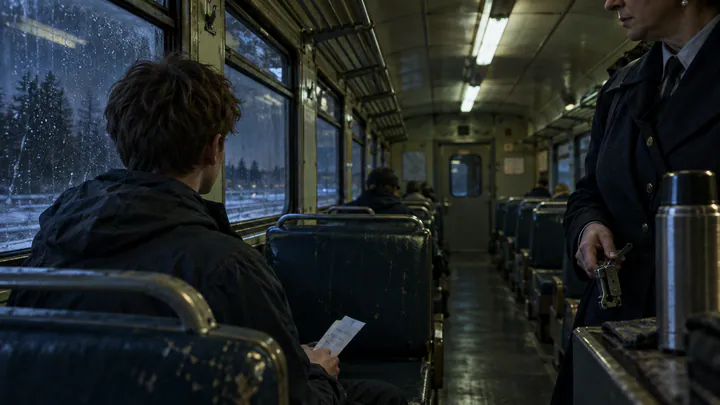
The Cellist on the Northbound Train
When a cellist boards the last northbound train of the season, a tired conductor discovers that some passengers are only ever traveling toward one particular silence.
Drafted with AI. This version has not been reviewed by an editor, so it carries no ads — how we work.
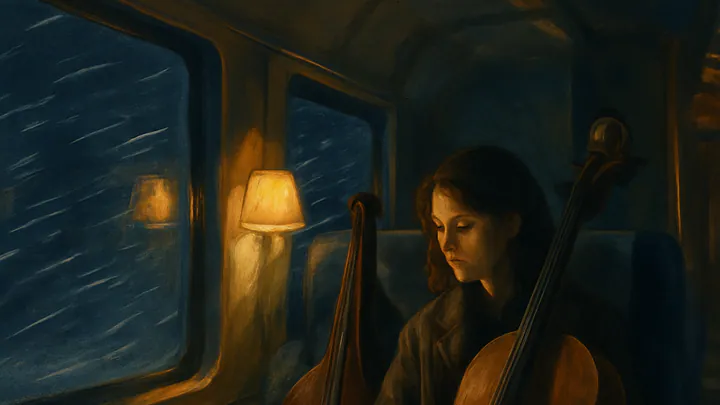
The cellist boarded at Halverston with snow still on her shoulders and a case taller than she was. It was the 10:47 northbound, the last of the season, and I was already counting the hours until I could take my boots off.
I had been a conductor on this route for twenty-two years. I knew every passenger type — the businessmen who slept with their mouths open, the students who wept quietly into hoods, the old couples who held hands across the aisle as if the train might pull them apart. The cellist was none of these. She walked the length of car three like she was looking for someone she already knew was not there.
She chose the window seat across from a man in a grey coat. I watched her wrestle the cello upright into the seat beside her, buckle the lap belt around its waist as if it were a child, and then sit very straight, hands folded, looking at the dark glass.
"Ticket, please," I said.
She produced it without looking at me. Single, one way, Halverston to End-of-Line. Not many people bought that ticket. End-of-Line was a request stop now, a wooden platform in a clearing where the rails stopped because somebody, a century ago, had simply run out of money to keep laying them.
"Long ride," I said. "Six hours."
"I know," she said. Her voice was the voice of someone who had been practicing not crying for a while.
The Middle Hours
By midnight the snow had thickened. The train rocked through pine country in that hushed way trains do when the world outside has gone soft and white. Most of the passengers were asleep. I made my rounds, refilled the water dispenser, picked up a child's mitten and pinned it to the lost-and-found board.
When I passed car three again, the cellist had unbuckled her instrument. She held it between her knees, bow in her right hand, the way a person might hold a sleeping animal they did not want to wake.
"You can play, if you like," I said quietly. "There's nobody to mind."
She looked up. Her eyes were grey, the same grey as the coat of the man across from her, who, I noticed now, was not breathing in the rhythm of sleep. He was not breathing at all. He sat perfectly composed, hands on his knees, eyes closed, like a portrait of a man waiting for a train that had already arrived.
I have worked this route long enough to know there are some things you do not say out loud. I had seen, once or twice, passengers who were not entirely passengers. Old Bremmer, the conductor who trained me, called them the carry-ons. He said the northbound takes them as far as End-of-Line and no further, and that our job was simply not to make a fuss.
"He's my father," the cellist said, following my gaze. "He died on Tuesday. He always said he wanted to go up to the cabin one more time. The cabin's near End-of-Line."
I sat down across the aisle. The rules said don't, but the rules were written by people who had never worked a night train in February.
"I'm sorry," I said.
"He taught me the cello," she said. "He used to say a cello is the only instrument that sounds like a person thinking. I haven't played since he got sick. I thought maybe — " She stopped. "I thought maybe on the way up."
"Play," I said. "I'll stand at the door so nobody comes through."
What She Played
I don't know the name of the piece. I am not a music man. I know diesel engines and signal lights and how to talk down a drunk at three in the morning. But I stood at the vestibule door of car three with my back to her, watching the snow blur past the window in the next car, and I listened.
It was slow at first. Searching. Like someone walking through a dark house they had grown up in, touching the walls to remember where the rooms were. Then it found something. A small bright phrase, repeated, the way you might say a name to yourself just to hear it. Then it opened wider, and for a moment the whole train seemed to lean into the curve of the music, and I swear — I will swear this until I am the one in the grey coat — that the lights in the cars dimmed, just slightly, the way they do when something draws a great deal of power all at once.
When she stopped, the silence afterwards was a different shape than the silence before.
I turned around. The seat across from her was empty. His coat was folded neatly on the cushion. There was no fuss. There rarely is.
She was looking at the coat. Her cheeks were wet but her hands were steady, which is, in my experience, the bravest a person can be.
"Will you keep it?" she asked. "The coat. I don't — I don't want to leave it on the train, but I can't carry it and the cello and — "
"I'll keep it in the lost-and-found," I said. "As long as you like."
She nodded. She buckled the cello back into its seat. She closed her eyes, and this time her breathing was the breathing of someone who would, eventually, sleep.
At End-of-Line I lowered the steps myself. The snow had stopped. The wooden platform was lit by a single bulb, and beyond it a path went off into the pines, already broken by somebody's footprints, though no one had come down from the cabin to meet her that I could see.
"Will you be all right?" I asked.
"Yes," she said, and I believed her. "Thank you for letting me play."
"Thank you for playing," I said.
She walked off into the trees with the cello on her back, and I watched until the dark closed around her.
The coat is still in the lost-and-found cupboard at the Halverston depot. Grey wool, good buttons, a train schedule in the inside pocket from a line that hasn't run since 1974. Sometimes, on slow nights, I take it out and sit with it across my knees, and I try to remember the small bright phrase she played, the one that sounded like a name.
I never quite have it. But I am always close.