The Night Baker and the Missing Recipe
When a beloved bakery's founding recipe vanishes the night before its centennial, a young baker must decide whether some things are meant to be reinvented rather than remembered.
Drafted with AI. This version has not been reviewed by an editor, so it carries no ads — how we work.
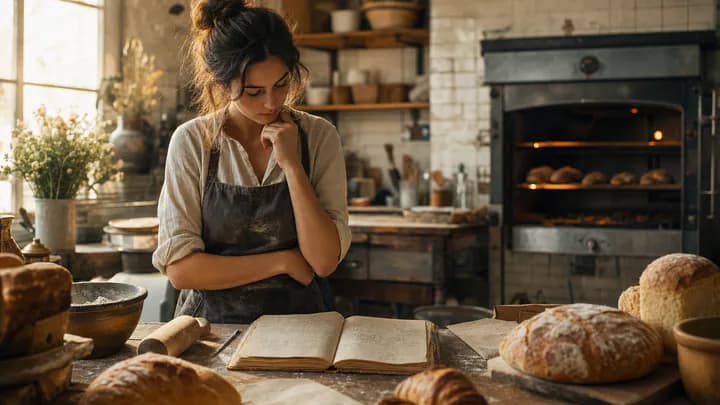
The recipe was gone, and the oven was already hot.
Ines noticed the empty page at 2:47 a.m., which she remembered exactly because the wall clock ticked louder in the moment right after, as if it too had inhaled. She was standing at the worktable in her grandmother's apron — the one with the burn mark shaped like Portugal — and the leather book was open to page one, and page one was a jagged margin where paper used to be.
“No,” she said, quietly, to the flour. “No, no, no.”
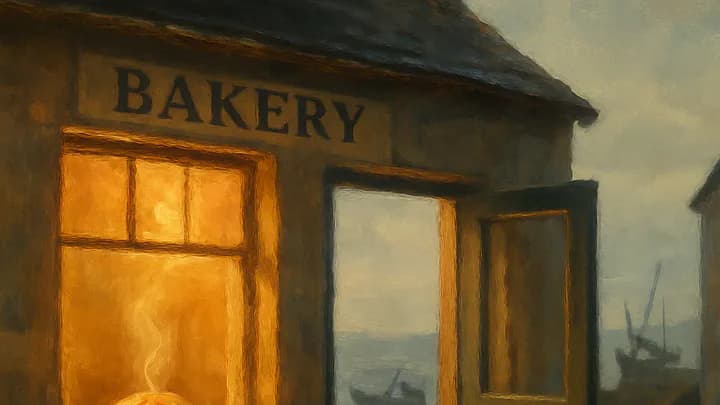
Tomorrow — today, technically, in seven hours — the bakery would turn one hundred. The mayor had ordered a banner. The regional paper had sent someone to photograph the ovens. Ines had promised, on the phone, on the flyer, on the chalkboard out front, that she would bake her great-grandmother's original sourdough, the one that started everything in 1924, the one whose recipe had never left this room.
And now it had.
She checked the obvious places first, the way you check your pockets for keys you know are not in your pockets. Under the book. Behind the book. Inside the tin of bay leaves where her grandmother used to hide receipts. Nothing.
The back door was locked. The front door was locked. The window above the proofing shelf was cracked open two fingers, the way it always was, because the starter liked a draft. A moth was doing slow circles under the pendant lamp.
Ines sat on the stool and pressed her palms flat to the wood. The table was older than she was, older than her mother, scarred by a hundred years of knives and elbows and the small dents left by a rolling pin thumped down in frustration. She'd inherited the bakery eight months ago, along with the mortgage, the mixer that shrieked in second gear, and a note from her grandmother that read only: Trust the book. It knows more than I did.
She trusted the book. The book was gone.
“Okay,” she said aloud, because the kitchen listened better when you spoke to it. “Think.”
Who had been in the shop yesterday? Everyone. The whole town, practically. Mrs. Alvear with her two grandchildren. The florist with the centennial arrangement. That young reporter with the notebook and the too-eager smile. The plumber, briefly, about the sink. Her cousin Beto, who’d come to help hang the banner and had lingered near the counter longer than a banner required.
Beto.
Ines stood, then sat again. No. Beto wouldn’t. Beto had grown up eating heels of bread off this very table, had cried at the funeral louder than she had. Beto believed in the bakery the way some people believed in saints.
Still.
She reached for her phone, then stopped. It was almost three in the morning. Whatever this was, it wasn’t a phone-call thing.
The Starter Speaks
Ines went to the crock instead. The sourdough starter lived in a ceramic jar the color of river stones, on a shelf above the flour bins, and had been alive — fed, folded, coaxed — since her great-grandmother was twenty-two. It bubbled softly, the way it always did when it was hungry.
She lifted the lid. The smell rose up, yeasty and sour and faintly sweet, and something in her chest loosened the way it always did in the presence of that smell. Her grandmother used to say the starter remembered. Every loaf that had ever risen from it was, in some small way, still inside it. A hundred years of Sunday mornings, folded into one jar.
“What do I do,” Ines whispered.
The starter did not answer, because it was a jar of fermented flour and water. But Ines found herself, without deciding to, reaching for the scale.
She knew the proportions. Of course she knew them. She had watched her grandmother make this bread every Saturday of her childhood, standing on a wooden crate to see over the edge of the table. She knew the way the dough should feel at the first fold — like an earlobe, her grandmother had said, tugging Ines’s own ear to demonstrate. She knew the second rise took longer in winter. She knew you scored the top with three cuts, not four, because four was for weddings and three was for every day.
She did not need the page.
The realization landed slowly, the way flour settles.
She had been so afraid of getting it wrong — of failing the centennial, of failing her grandmother, of failing the hundred years pressed into this room — that she had forgotten she already knew. Her hands knew. Her nose knew. The starter, hungry on the shelf, knew.
Ines exhaled and began to weigh the flour.
She was halfway through the first fold when the bell over the front door jingled.
She froze. The front door had been locked. She was sure of it. She wiped her hands on the apron and crossed the shop floor barefoot, and there in the doorway, holding a small folded square of paper, stood Beto.
“I couldn’t sleep,” he said. He would not look at her.
“Beto.”
“I took it,” he said. “Yesterday. I’m so sorry, Ines, I just — I wanted a copy. Just one. For me. I thought if something happened to the shop, or to you, or if — I don’t know. I wanted to have it. And then I got home and I looked at it and I felt like a thief, which I am, so I came to put it back, and the light was on, and —”
He held out the paper. His hand shook a little.
Ines took it. Unfolded it. There, in her great-grandmother’s slanted pencil, was page one. Flour, water, salt, starter. The proportions she had just, without it, remembered.
She looked at Beto. He was thirty-four years old and looked, in that moment, about nine.
“Come inside,” she said. “The dough is on its first fold.”
He blinked. “You’re not — you’re not angry?”
“I’m tired,” she said. “And I need someone to weigh the salt.”
They worked side by side until dawn. Beto weighed. Ines folded. The starter went into the bowl with a soft plop, and the dough came together the way dough does when it has been made ten thousand times by the same family in the same room.
Just before sunrise, Ines slid the page back into the book. Then, after a moment, she took a pencil from the drawer and wrote, underneath the original recipe, in her own handwriting: The book knows. But so do you. — I., 2024.
She closed the book and set it on the shelf.
Outside, the first customers were beginning to gather, drawn by the smell of something a hundred years old and still, somehow, brand new.