The Crossword Setter of Marlow Street
An aging puzzle constructor receives an envelope of clues she didn't write. The answers, when filled in, begin spelling a stranger's confession.
Drafted with AI and published automatically. Our editors set the standards and fix reported errors — how we work.
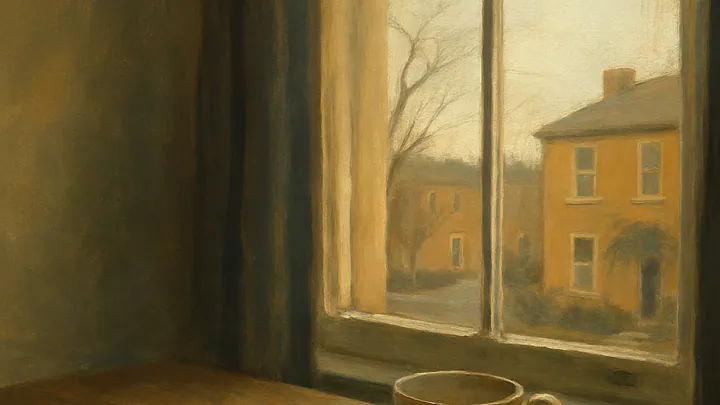
The envelope arrived on a Tuesday, slipped under the door before Edith had finished her first cup of tea. There was no stamp, no name, only her address written in pencil in the careful block capitals of someone trying very hard not to be recognized.
Edith Wren was seventy-three years old and had spent fifty-one of those years constructing crossword puzzles for the regional paper. She had set clues for prime ministers, for the woman who later became her dentist, for a man on a submarine who wrote her a thank-you letter in 1986. She knew the weight of a good envelope. This one was light, and the paper inside was lined, torn from a school exercise book.
It was a crossword grid. Hand-drawn. The squares were a little crooked, the black squares filled in with biro. Beneath it, twenty-two clues, numbered, in the same pencil capitals.
She put on her reading glasses.
1 across. What the kettle does when no one is listening (5).
Edith smiled despite herself. Sings. She wrote it in.
4 across. A small brown bird, or a woman who notices things (4).
She paused. Then, slowly: Wren.
I.
By lunchtime she had filled in fourteen answers. They were not difficult clues, exactly, but they were strange. They had a private quality, as if the setter were speaking to one specific person and had simply chosen to do it in a public form.
7 down. The street where the postbox leans (6). Marlow.
9 across. What you do not say at the funeral (5). Sorry.
Edith set down her pencil. She looked out the sash window onto Marlow Street, where the postbox did indeed lean slightly to the left, as it had since a delivery van clipped it in the spring of 2004. Whoever had drawn this grid knew the street. Knew her name. Knew, perhaps, more than they ought to.
She thought about ringing her niece, Pippa, who lived in the city and worried about her in the loud, busy way that younger relatives worry. But what would she say? Someone has sent me a crossword. Pippa would laugh and say, Aunt Edie, that's the least alarming sentence in the English language.
So Edith made another cup of tea and kept solving.
The answers, when arranged along the top row, read: I have been meaning to tell you.
The second envelope arrived on Friday. The same paper, the same careful capitals. This grid was larger. The clues were sharper, more particular.
2 down. The boy who broke your kitchen window in 1979 and ran (5).
Edith stared at the clue for a long time. She remembered the window — the crack like a spider's leg across the glass, the sound of trainers on the path, a flash of red anorak disappearing round the corner. She had never known who it was. The neighbours had shrugged. The window had been replaced for nineteen pounds.
She wrote, tentatively: Danny.
Danny Hollis. The boy from number forty-one. He would have been eight then. He had grown up and moved away and, she thought, become something respectable — a surveyor, perhaps. His mother had died last winter. She had taken a casserole to the wake and not stayed long.
The next clue:
5 across. What he meant to bring you the next morning but didn't (7).
She thought. Flowers? Sorries? She tried apology. Seven letters. It fit.
By the end of the grid, the top row read: I am sorry about the window.
Edith sat very still in her armchair. The radiator clicked. Outside, a child on a scooter rattled past, and somewhere a dog barked at nothing in particular.
Danny Hollis was sixty-one years old, she calculated, and he had been carrying a broken window for fifty-two years.
II.
The third envelope did not come for nearly two weeks. Edith began to wonder if she had imagined the whole thing, if perhaps her mind, which she had always trusted like a reliable lamp, was beginning to flicker. She told no one. She did, however, find herself walking past number forty-one on her way to the shops, glancing at the front step, the curtains, the small blue car in the drive with city plates.
When the envelope finally arrived, it was thicker.
This grid had no clues. Only the empty squares, and at the bottom, a single sentence in pencil: I don't know how to finish this one. Could you?
Edith sat down at her desk and looked at the blank grid for a long while.
She had set puzzles all her life. She had constructed them around birthdays, around national tragedies, around the small private griefs of editors who never told her what they were grieving for. She knew how a crossword worked. You started with the long answers — the spine of the thing — and built outwards from what was certain.
She picked up her pencil.
Along the top row, she wrote: The window is forgiven.
Underneath, in shorter answers spiralling out, she added the small true things she could think of. Tea. Wren. Marlow. Sings. Home. She built clues for them, kind clues, the sort that did not punish a solver for not knowing. She filled the grid in pencil, then went over it in ink, then folded it neatly and slid it into a fresh envelope.
She wrote on the front, in her own careful capitals: Number 41.
That evening she walked the four houses down Marlow Street, posted the envelope through the brass slot, and walked back without turning round. The leaves on the pavement smelled of rain and something older, something like woodsmoke from a fire she could not see.
She did not expect a reply, and none came in the usual sense. But the following Sunday, when she opened her front door to fetch the milk, she found a small terracotta pot on the step. Inside it was a single primrose, already in bloom, its yellow startling against the grey morning.
There was no note. There did not need to be.
Edith carried the pot inside and set it on the kitchen windowsill, where the light was best. Then she sat down at her desk, took out a fresh sheet of squared paper, and began, as she had done every morning for fifty-one years, to draw a grid.
This one, she decided, would be easier than most. Some puzzles, she had come to understand, were not meant to be difficult. They were only meant to be finished.