The Elevator Operator of Floor Thirteen
In a building that officially has no thirteenth floor, an elevator operator keeps a quiet appointment with the people who need one anyway.
Drafted with AI. This version has not been reviewed by an editor, so it carries no ads — how we work.
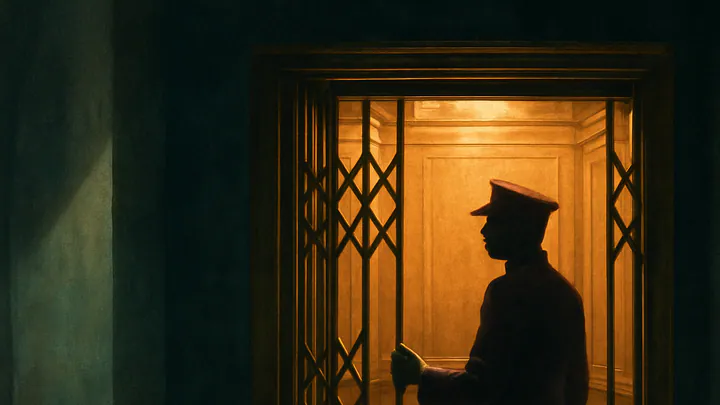
The building had no thirteenth floor, which is why Amara had been hired to operate it.
She wore a plum-colored uniform with brass buttons that no one else in the tower wore anymore. The other elevators were mirrored boxes that spoke in soft, apologetic voices and did their own arithmetic. Hers was older: a cage of scrolled iron and a lever polished by seventy years of gloved hands. It ran only after seven in the evening, and only in the service shaft on the north side, and its call button was hidden behind a fire extinguisher on the mezzanine.
She had been told, on her first day, three things.
One: the floor did exist.
Two: she must never take a passenger there who had not asked for it by name.
Three: she must never go up alone.
The Passengers
The first rider on Tuesday was a woman in a wet raincoat holding a paper bag with grease blooming through the bottom. She stepped into the cage and stood as far from Amara as the small space allowed.
“Lobby?” Amara asked, hand already on the lever.
The woman didn’t look up. “Thirteen.”
Amara studied her. Mascara had run and been wiped and run again. The paper bag was warm; Amara could smell garlic and something sweet, maybe plantains. There was a receipt stapled to the bag with two names on it. Only one of the names was going to eat the food.
“Thirteen,” Amara confirmed, and pulled the lever down instead of up.
The cage sank past the lobby, past the parking levels, past the boiler room, and then, with a small courteous shudder, began to rise. This was how it worked. To reach the floor that wasn’t there, you had to first agree to go somewhere else.
The doors opened onto a corridor that smelled like rain on hot pavement, though it hadn’t rained in the city in weeks. The woman stepped out. The doors did not close until she had walked entirely out of sight.
Amara had never seen the corridor beyond three steps in. She had been told that was mercy, not policy.
The second rider was a man in his sixties who came every Thursday and had come every Thursday for the eleven months Amara had worked there. He wore a good coat that had once been better. He carried nothing.
“Evening, Mr. Oyelaran.”
“Evening, Amara.”
“Thirteen?”
“Please.”
She pulled the lever. As they descended in order to ascend, he spoke, as he sometimes did, to the brass grate rather than to her.
“She used to laugh at my knock,” he said. “Three short, one long. Every time. Even when she was angry with me. She couldn’t help it.”
“That’s a good sound to be remembered by,” Amara said.
“It is.” He smoothed his lapel. “I only get an hour, you know.”
“I know.”
“It’s enough. Some weeks it’s enough.”
The doors opened. Tonight the corridor smelled like a kitchen at Sunday noon. He walked toward it without looking back, and Amara watched his shoulders lift, which was the part she was paid, she thought, to witness.
The third rider she did not know.
He was young, maybe twenty, in a jacket too thin for October. He stepped into the cage with the wrong kind of quiet. His hands were empty in a way that felt like they shouldn’t have been.
“Where to?” Amara asked.
“Thirteen,” he said.
She did not pull the lever.
“Whose thirteen?” she asked, gently.
He blinked. “What?”
“Who’s waiting?”
He looked at the floor. His mouth moved and did not produce a name. After a long moment he said, “I just heard. Downstairs. From a guy at the desk. He said if you ask for thirteen, you can see—you can see whoever. Whoever you need.”
“Sometimes,” Amara said. “Sometimes that’s true.”
“So take me up.”
She let the silence sit. She had been told, in her first week, that the floor was not cruel but it was exact. It gave you what you asked for by name. If you did not know the name, it gave you the shape of not knowing, which was worse than the lobby you came in from.
“What’s your name?” she asked.
“Deji.”
“Deji. Who did you lose?”
He laughed, once, without humor. “Who didn’t I.”
“Pick one.”
He looked at her then, really looked, and she saw that he was not much younger than her brother had been. She kept her hand off the lever.
“My mother,” he said finally. “Two years.”
“What did she call you?”
His face did something complicated. “Small king. Even when I was taller than her.”
Amara nodded. She pulled the lever.
The cage sank, then rose. When the doors opened, the corridor smelled like shea butter and cold weather coming in through an open window. Deji did not move.
“It’s an hour,” she said. “No longer. And you can’t bring anything back except what’s in your chest already. Do you understand?”
“Yes.”
“Go on, then, small king.”
He stepped out. The doors closed behind him with the soft click of a latch on a familiar door.
The Rule
Amara sat on the little wooden stool bolted to the corner of the cage and waited. This was most of the job: waiting, and being the shape at the far end of a hallway that a person could walk back toward when the hour was up.
She thought, as she sometimes did, about the third rule. Never go up alone. She had asked, once, what would happen if she did. Her supervisor, a woman with kind eyes and a lanyard of keys that shouldn’t have fit any lock in the building, had said only: “The floor doesn’t want you yet. Don’t insult it by asking early.”
Amara had a name of her own she had not yet spoken into the cage. Her brother, Tomi, who had taught her to whistle with a blade of grass and who had died on a Wednesday when she was nineteen and unprepared for Wednesdays to be able to do such things.
She had been waiting, she realized, to be sure she could come back down.
The doors opened. Deji stepped in, red-eyed, upright. He nodded at her, and she nodded at him, and she took him to the lobby without either of them speaking, because the cage understood that some silences were full and did not need filling.
At the lobby he paused with one foot out.
“Will it work again?” he asked. “If I come back?”
“Once a week,” she said. “Thursdays are quieter.”
“Thank you.”
He walked out into the ordinary lobby with its ordinary lights, and the revolving door took him and gave him back to the street.
Amara closed the cage. She stood a moment with her gloved hand on the lever, feeling the small warmth of everyone who had touched it before her.
Then she pushed the lever down, because down was the only way she was going tonight, and somewhere above her, unbuilt and patient, the floor that wasn’t there kept its lights on for whoever remembered to ask by name.