The Lantern Keeper of the Rooftop Garden
Every dusk, Mira climbs eleven flights to light the lanterns above a city that has forgotten to look up. Tonight, someone follows her.
Drafted with AI. This version has not been reviewed by an editor, so it is kept out of search results and carries no ads — how we work.
Mira climbed the eleven flights every evening at the hour when the city lost its color. By the time she reached the roof, her calves burned and the sky had gone the pale gray of pigeon feathers, and the lanterns were waiting for her like patient animals.
There were forty-two of them. She had counted them the first night, twenty-one years ago, when the old keeper had handed her a brass matchbox and said, Don't skip any. They notice. She had thought he was joking. She had been wrong about many things then.
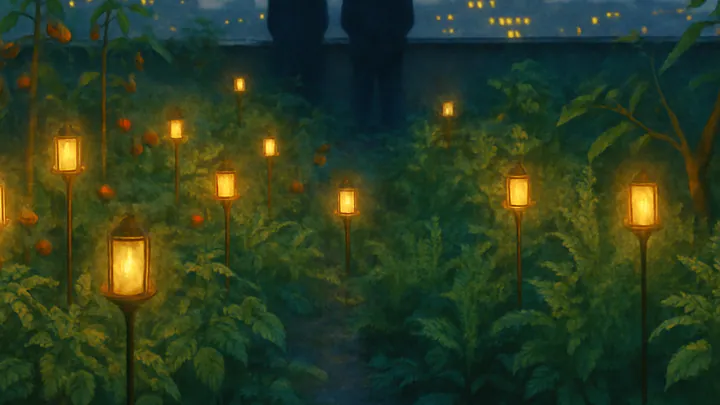
The rooftop garden covered the entire top of the building — a shaggy quilt of planters and trellises, tomato vines gone leggy, mint escaping its box, a fig tree that had no business surviving this far north but did anyway. Between the plants stood the lanterns: iron poles the height of a child, each topped with a glass cage and a wick that drank a particular oil the caretaker's association ordered by the barrel and asked no questions about.
Mira began at the eastern corner, where the fire escape emptied onto the tar. She struck a long match, cupped it against the wind, and touched the flame to the first wick. The lantern woke slowly, as lanterns do, throwing a small warm circle onto the gravel. She moved to the next.
She was on the seventh lantern when she heard the door.
The roof door groaned only for her — she had convinced herself of this over the years, the way a person living alone convinces themselves the floors creak with affection. But tonight it groaned for someone else. She turned, match still burning, and saw a man step onto the gravel with his hands in his coat pockets and mud on his shoes.
“I'm sorry,” he said immediately. “I followed you up. I know how that sounds.”
The match burned down to her thumb. She shook it out.
“How does it sound,” she said, “when you say it out loud?”
He laughed, one short surprised syllable, and then looked embarrassed by the laugh. He was maybe fifty, gray at the temples, wearing the kind of coat a person bought once and then wore until it disintegrated. “It sounds bad,” he admitted. “I've been trying to find this roof for a year.”
“It isn't hidden.”
“It is, a little.”
She couldn't argue with that. The building's directory did not list the garden. The elevator didn't go past the tenth floor. The stairwell above the tenth was painted a particular shade of gray that discouraged the eye. Mira had never asked who arranged these things. She suspected the arrangements had been made a long time before her.
“I have thirty-five lanterns left,” she said. “You can talk while I work, or you can go back down.”
He nodded and followed at a careful distance, stepping around the basil.
What He Was Looking For
“My mother lived in this building,” he said, as she lit the eighth lantern. “Apartment 4B. She died in the spring.”
“I'm sorry.”
“Thank you.” He watched the flame catch. “She used to tell me, when I was small, that there was a garden on the roof where a woman lit lamps every night so the migrating birds wouldn't lose their way over the city. I thought she made it up. She made up a lot of things. She was — she was that kind of mother.”
Mira moved to the ninth lantern. The wick was stubborn; she coaxed it.
“After she died,” he continued, “I found a notebook. She had drawn the garden. Every planter. The fig tree. Forty-two lanterns. She'd never been up here — she was afraid of the stairs, her whole life — but she'd drawn it exactly.”
Mira paused with the match unlit in her hand. She looked at him properly for the first time. He had his mother's eyebrows, she realized. She had known his mother for thirty years, in the way one knows a neighbor: waves in the lobby, a shared elevator, a borrowed cup of flour once during a blizzard. Ana. Fourth floor. Always with a scarf, even in summer.
“Ana never came up here,” Mira said quietly. “But she asked me about it, once. In the laundry room. She asked how many lanterns there were. I told her.”
He was quiet.
“She asked me what they were for,” Mira went on. “I told her I didn't entirely know. I told her the old keeper had said the birds. I told her I also thought — maybe — they were for the people in the building who couldn't sleep. That if you looked out your window at the right angle, you'd see a warm glow above you and know someone was awake, and tending something, on your behalf.”
“She wrote that down,” he said. “In the notebook. Word for word.”
Mira lit the ninth lantern. Her hand was not quite steady.
The Rest of the Night
They walked the rest of the roof together. She showed him how to hold the match low so the wind didn't take it. She let him light three of the lanterns himself — the twenty-second, the thirtieth, the last one on the western wall that looked out toward the river. He was careful with them, the way a person is careful with something they have been told, for their whole childhood, was imaginary.
“Do the birds actually come?” he asked, when the last wick had caught.
Mira considered the question honestly. In twenty-one years she had seen geese overhead in autumn, and once a heron so far off course she'd wept for it, and every spring a great confused muddle of small brown things she couldn't name that seemed to circle the building twice before continuing north.
“Something comes,” she said. “I'm not always sure what.”
He laughed again, less embarrassed this time. They stood together at the western wall. Below them the city was beginning its second life, the one lit from inside — windows going yellow one by one, a bus sighing at a stop, a dog on a balcony three roofs over barking at nothing.
“May I come back?” he asked.
Mira had not been asked that question in twenty-one years. The old keeper had not asked. He had simply stopped climbing, one winter, and she had climbed in his place, and no one had ever said anything about it out loud.
“The door will groan for you now,” she said. “That's how it works. Once it lets you up, it remembers.”
“That's a strange building.”
“It's a strange garden.”
He put his hands back in his pockets. The lanterns burned steadily behind them, forty-two small warmths against the enormous cooling dark. Somewhere far above, something with wings passed over the roof — she felt it more than saw it, a brief interruption of the stars.
Mira did not point it out. She thought Ana's son might have felt it too, and she wanted to leave him the pleasure of deciding, on his own, whether it had been real.