The Glassblower's Apprentice at Low Tide
On the morning the furnace refused to light, Ines learned that some things must be broken before they can hold what you pour into them.
Drafted with AI and published automatically. Our editors set the standards and fix reported errors — how we work.
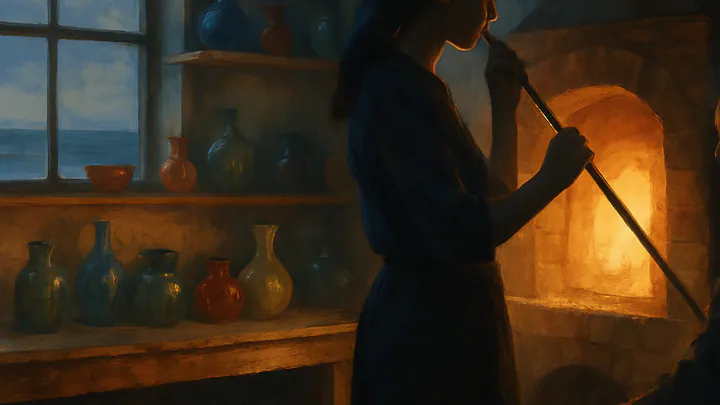
On the morning the furnace refused to light, Ines was already halfway through the door with her sleeves rolled and her hair tied back in the blue scarf her mother had left behind. The workshop smelled of cold iron and last night's ash, and that alone told her something was wrong.
Master Pell was sitting on the stool by the annealer, hands folded in his lap like a man at a funeral. He was not a man who sat. In the two years Ines had worked for him, she had seen him bend over the bench, lean against the marver, crouch to inspect a crack — but sit, no. Sitting was for tourists.
"It's out," he said, without turning. "Went out in the night. I've tried three times."
Ines set down her satchel. The furnace at the back of the shop was a squat brick beast that had, by local reckoning, not been fully cold in forty-one years. Pell's father had lit it. Pell had kept it. On the coast where they lived — a village of slate roofs and salt-eaten fences, where the tide went out so far at dawn that you could walk to the mussel beds and back before breakfast — the furnace was a kind of small sun. Fishermen set their watches by its glow through the shutters.
"Well," Ines said, trying for lightness, "then we light it again."
Pell looked at her. His eyes were the color of wet stones. "It isn't the fire, girl. It's me."
She didn't understand, and she said so.
The Tide Going Out
He told her, then, in the flat voice of a man reading a weather report, that the doctor in the next town had given him a number of months and that the number was not large. He told her that he had known for six weeks and had not said, because saying it made it a thing in the room, and he had wanted a little longer with it being only a thing in his chest.
Ines discovered that she was holding the edge of the bench very tightly. Outside, a gull was arguing with another gull about something urgent and probably foolish.
"So light it," she said.
"Ines —"
"Light it. We have the order for the chandler. We have the blue bottles for the inn. We have —"
"Ines." He said her name the way he said it when she was about to blow too hard into a bubble and burst it. "Sit down."
She did not sit down. She went to the furnace, opened the door, and looked into the black mouth of it. Cold. Truly cold. She could smell the difference — no under-scent of heat, no shimmer at the lip of the aperture. It was just a brick room with soot in it.
"I want you to break something," Pell said behind her.
She turned.
He was pointing at the shelf above the annealer — the shelf where he kept the pieces he would not sell. A pear-shaped vessel in green so dark it was nearly black. A little glass wren with one wing lifted. A tumbler with a thread of gold running through it like a vein. Twelve or fifteen pieces, arranged the way another man might arrange photographs.
"I can't," Ines said.
"Pick one."
"Master Pell —"
"Pick one, Ines. I am asking."
She looked at the shelf for a long time. She knew the story of each piece the way a child knows the story of each scar on her knees. The wren was from the year his wife died. The gold-threaded tumbler was from the winter the harbor froze. The dark pear was from — she didn't know what the dark pear was from. He had never told her.
She reached for the tumbler.
"Good," he said quietly.
She held it in both hands. It was cool and heavier than it looked. The gold thread caught the grey light from the window and made a small warm sentence inside the glass.
"Now," said Pell, "on the floor."
Ines opened her hands.
The sound was not loud. Glass, when it breaks properly, sounds almost polite — a bright quick clatter, and then the little afterthought of the smaller shards settling. She stared down at what she had done. Her ears were ringing in the way they do when you have held your breath too long.
Pell got up from his stool. It took him longer than it used to. He crossed the workshop, knelt beside her — knelt, he who had complained for a decade about his knees — and began to gather the pieces into a tin scoop.
"When my father was dying," he said, "he made me break a bowl he'd kept for thirty years. I hated him for it. I hated him for a week. Then I understood."
"Understood what?" Ines whispered.
"That the shelf isn't the point. The making is the point. If I leave you a shelf, you'll dust it. If I leave you an empty shelf, you'll fill it." He looked up at her, and she saw, for the first time, that he was frightened, which frightened her more than anything else had. "I need to know you can fill it, Ines. Before I go."
The Furnace
They lit the furnace together that afternoon. It took four tries. On the fourth, the flame caught with a soft, indignant whump, and the brick began, slowly, to remember what it was for. Ines fed it kindling and then the harder wood and then, at last, the coke, and by evening the mouth of it glowed the color of a winter sunrise.
Pell sat on his stool and watched her gather the first gob of molten glass on the end of the pipe. He did not correct her grip. He did not tell her to turn the pipe faster. He only watched.
She blew a bubble into the glass and it swelled, obedient, orange-gold, alive. She shaped it on the marver. She thought, without meaning to, of the tumbler on the floor, of the gold thread it had held, of the winter the harbor froze — a winter she had not lived through, a winter that was now, in some quiet way, her inheritance.
The piece she made that evening was a small round vessel with a lip that turned outward like a listening ear. It was not a good piece. The wall was uneven. The base sat a little crooked. When she set it in the annealer to cool slowly through the night, Pell made a sound that might have been a laugh and might have been something else.
"Put it on the shelf," he said, "when it's done."
"It's ugly," she said.
"It's first," he said. "That's different."
Outside, the tide was coming back in. She could hear it under the wind — that long slow breath of the sea returning to the mussel beds, covering the walked-across floor of the morning, making the world briefly whole again. Ines wiped her hands on her apron and stood beside her master in the red light of the furnace, and neither of them spoke, because there was, for the moment, nothing that needed saying.
In the morning, she would come back. She would light the fire herself.