
Screen-Free Activities for Kids That Actually Hold Attention
Screen-free play only works if the activity matches your child's age, their energy level, and how much adult attention you can actually spare. Here are ideas sorted on all three axes — plus the transition trick that prevents the post-screen meltdown.
Rewritten with AI and republished automatically. Our editors set the standards and fix reported errors — how we work.
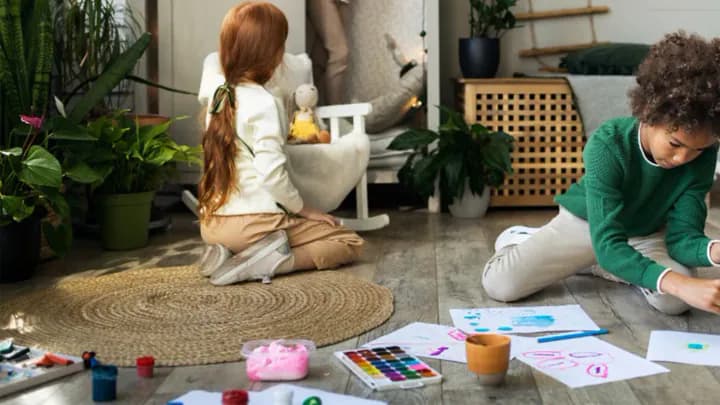
TL;DR: Screen-free play works when the activity matches three things — your child's age, their current energy level, and how much adult attention you can genuinely spare. Expect a rough 15-to-20-minute boredom gap right after the screen goes off. Push through it, keep open-ended materials within reach, and most kids take over from there.
Screen-free activities for kids are structured or open-ended play options that hold a child's attention without a display — outdoors, in the kitchen, on the floor, or at a table. They are not a punishment or a substitute babysitter. Done well, they are simply the default setting that screens interrupt.
The reason most lists of these ideas fail isn't the ideas. It's that they ignore logistics. A gorgeous salt-dough project is useless at 5:45 p.m. when dinner isn't started. Our goal here is to sort the options by when they actually fit.
How much screen time is too much, and what does the research really say?
Major pediatric guidance broadly converges on this: avoid screen media other than video chat before roughly 18 to 24 months, keep ages 2 to 5 to about an hour a day of high-quality content with an adult watching alongside, and set consistent, family-wide limits after that. Research generally associates heavy screen use with poorer sleep and less time spent on language-rich interaction — but the strongest finding is about displacement: what the screen crowds out matters more than the screen itself.
That distinction is the useful one. A video call with grandparents, a communication device, a recipe watched together, or assigned homework are not the problem. Passive, solitary, late-evening scrolling is. If you're worried about your child's sleep, attention or mood, consult your pediatrician rather than relying on minute-counting alone.
Adults are not exempt, either. If you want the household rule to hold, it helps to run a digital declutter of your own devices first — children calibrate to what they see, not what they're told.
Which screen-free activities work best at each age?
Match the activity to the attention span you actually have in the room. A four-year-old will abandon a 300-piece puzzle in ninety seconds; a ten-year-old will find a shape sorter insulting. Use this as a starting grid, then adjust for your own child.
| Age | Realistic solo attention | Activities that land | Adult involvement |
|---|---|---|---|
| 2–4 | 5–15 minutes | Sensory bins (dry pasta, water, rice), stacking, big crayons, sticker books, digging | High — stay in the room, especially with small parts |
| 5–7 | 15–30 minutes | Fort building, dress-up, scavenger hunts, simple board games, paper bag puppets, bottle-cap cars | Medium — set it up, then step back |
| 8–10 | 30–60 minutes | Jigsaw puzzles, origami, kite making, gardening beds, cooking with supervision, journals | Low — occasional check-ins |
| 11–13 | 45–90 minutes | Strategy games, sewing or woodworking, letter writing and pen pals, photography on paper, real recipes | Minimal — mostly logistics and safety |
One caveat worth naming: developmental age beats calendar age. If your child is neurodivergent, anxious, or simply tired, slide down a row without guilt.
How do you survive the first twenty minutes after the screen goes off?
Assume a boredom gap of roughly 15 to 20 minutes and plan for it deliberately. A child coming off a screen has just lost a system that was generating novelty on their behalf; self-directed play asks them to generate it themselves, and that switch is uncomfortable. The complaints in that window are transition cost, not evidence that your idea is bad.
Three things make it shorter:
- Warn before you end. A five-minute and a one-minute countdown, every time, reduces the conflict far more than any negotiation afterward.
- Have the next thing physically present. Not described — present. The tape and cardboard already on the floor. The dough already on the counter.
- Don't rescue. If you fill the silence with a rapid-fire list of suggestions, you teach your child that boredom is your problem to solve.
If the worst friction happens at bedtime, the issue may be accumulated tiredness rather than the activity.
What can kids do outside with no equipment at all?
You need a patch of ground and a prompt — that's it. The best outdoor prompts are constraints, not instructions, because constraints leave room for invention.
- Color scavenger hunt: find something red, something rough, something tiny, something alive. Works in a yard, a park strip, or a sidewalk walk.
- Bug bingo or a birdwatching journal: a folded sheet of paper with six boxes to sketch into.
- Fairy or dinosaur gardens: a shallow tray, moss, pebbles, twigs. Rebuilt endlessly.
- Stick engineering: build the tallest freestanding structure with only what's on the ground.
- Gardening: herbs on a windowsill, sunflowers in a pot, a compost jar experiment. Slow payoff, unusually durable interest.
Outdoor time also does quiet work on sleep timing. Getting kids outside early has the same circadian logic behind the ten-minute morning sunlight habit we've written about for adults.
Which indoor activities burn real energy on a rainy day?
Indoor movement needs a course, not a command. "Go run around" produces nothing; a marked route produces twenty minutes.
- Pillows as stepping stones — the floor is lava, and the route changes each round.
- A yarn or crepe-paper "laser maze" taped across a hallway. Ten minutes to build, surprisingly long to exhaust.
- Jump rope, hula hoop or balloon volleyball with a keep-it-off-the-floor rule.
- Sock basketball into a laundry basket, with scoring zones marked in tape.
A useful safety note: the tape maze is fine, the laundry-basket hoop is fine, but check that your route doesn't run past stair edges, glass doors or a hard-cornered coffee table.
What holds attention when you're working or making dinner?
Choose activities with a high setup-to-supervision ratio: two minutes of your time buying forty minutes of theirs. These are the ones worth memorizing.
- A fort that stays up. Blankets, chairs, clips. Leave it standing for the weekend and it keeps regenerating play.
- A jigsaw left out on a side table. Kids drift back to an unfinished puzzle in a way they never do with a boxed one.
- A drawing station. Paper, pencils, one strange object to draw. Rotate the object weekly.
- Recycled toy making. Bottle-cap cars, sock puppets, paper kites, origami animals. Open-ended and free.
- Audiobooks. Not screen-free purists' favorite, but it is audio-only, and it pairs beautifully with building or coloring.
Resist the urge to hover. Independent play usually ends the moment an adult joins and starts improving it.
How do you cook with kids without losing the whole evening?
Give the child one contained job inside a meal you were already making, rather than building a separate "kids' cooking project." Peeling, whisking, tearing lettuce, arranging toppings, and pressing a cookie cutter are all genuine contributions that don't slow you down much.
Good entry points: fruit skewers, mini pizzas on split muffins, no-bake oat cookies, sandwich face art. Older children can take a whole component — the dressing, the seasoning of a tray. Cooking together builds measuring math, sequencing, and a real sense of contribution.
The practical trick is picking recipes with few simultaneous steps. Sheet-pan dinners work especially well here, because a child can toss and arrange everything while you handle the oven.
Safety, briefly: keep knife work to a butter knife or a nylon kid's knife until a child can reliably use a claw grip; keep hot pans on back burners; and wash hands after handling raw ingredients.
What are the most expensive mistakes parents make going screen-free?
Three patterns cost the most time and money, and all three are avoidable.
- Buying kits instead of materials. A craft kit produces one predetermined object, once, and requires adult setup. A bin of cardboard, tape, string, corks and fabric scraps gets rebuilt every week and costs nothing. If you want structure, buy materials and add a prompt.
- Treating all toys as available all the time. Thirty visible toys read as noise. Pack two-thirds into closed bins, rotate every few weeks, and a "boring" toy comes back as a novelty.
- Going cold turkey on a weeknight. Announcing a total ban at 6 p.m. on a Tuesday sets up a fight you'll lose. Shrink screen windows gradually, and start on a day with slack in it.
A decision rule we keep coming back to: before proposing anything, ask whether the child is over-energized or under-energized, and whether you have hands free or not. High energy plus free hands means an obstacle course or the yard. High energy and no free hands means a movement game with a clear rule set. Low energy and free hands means reading aloud or a puzzle together. Low energy and no free hands means an audiobook and a coloring page. That single check prevents most failed suggestions.
What does a realistic screen-free Saturday actually look like?
Here is a worked example for a family with a six-year-old and a nine-year-old, assuming rain and one working parent.
- 8:00 — Breakfast, and the jigsaw goes out on the side table where it stays all day.
- 9:00 — Fort built in the living room. Eight minutes of adult help, then they own it.
- 10:30 — Boredom gap. Expect complaints. Put masking tape and a stack of paper cups on the floor and say nothing.
- 12:00 — Lunch, with both kids assembling their own plates.
- 1:30 — Hallway laser maze, twenty minutes of shrieking, energy discharged.
- 3:00 — Quiet block: letter to a grandparent, decorated envelope, gratitude line at the bottom.
- 5:00 — Optional screen window, announced in advance, ended with a five-minute warning.
- 6:30 — Cooking job each, then a board game if the mood holds.
Notice that there's a screen in it. A plan that pretends otherwise tends to collapse by the second weekend. Holding a predictable structure — the same way a dependable morning routine works for adults — matters more than purity.
When does this advice not apply?
It doesn't apply to assistive or communication technology, which is not "screen time" in any meaningful sense. It doesn't apply cleanly to children with sensory processing differences, for whom a loud obstacle course may be the opposite of regulating. And it doesn't apply to families in crisis weeks — illness, moving, a new baby — where a tablet is a legitimate tool and no one needs to feel bad about it.
Screen-free play is a default worth defending, not a standard to fail against.
Key takeaways
- Sort activities by three axes — age, energy level, and how much adult attention you can spare — before you sort them by how fun they sound.
- Plan for a 15-to-20-minute boredom gap after screens end; it's a transition cost, not a failure of the alternative.
- Open-ended materials beat kits, and rotating toys beats buying new ones.
- Have the next activity physically present in the room, not described out loud.
- Give kids one real job in the meal you were already cooking instead of staging a separate project.
- If you're concerned about your child's sleep, attention or development, talk to a qualified pediatric professional rather than relying on screen-time totals alone.
Frequently asked questions
How much screen time is appropriate for children?
Major pediatric bodies generally advise avoiding screen media other than video chat before roughly 18 to 24 months, limiting children aged 2 to 5 to about an hour a day of high-quality programming with an adult co-viewing, and setting consistent family limits after that. These are starting points, not verdicts — talk to your pediatrician about your child's sleep, behavior and development rather than tracking minutes alone.
Why do kids say they're bored the moment the screen goes off?
Because their attention has been running on a system that supplied novelty for them, and self-directed play requires them to generate it. That gap typically lasts 15 to 20 minutes. It is a transition cost, not proof that the alternative activity failed — if you can hold the line through it, most children start playing on their own.
What screen-free activity can I set up in under five minutes?
A pillow-and-tape obstacle course, a color scavenger hunt around the house, a sock puppet, or a bowl of dry pasta and a scoop for a toddler. The rule we use: if setup takes longer than the play will last, pick something simpler.
Are craft subscription boxes worth it?
Usually less than a rotating supply of open-ended materials. Kits produce one predetermined object in one sitting, then end. Cardboard, tape, string, fabric scraps and recycled containers get rebuilt into something different every week, and they cost nothing.
Is all screen time equally worth replacing?
No. A video call with a grandparent, a speech or accessibility device, a shared recipe video, or assigned schoolwork are not the same as passive solo scrolling. The goal is displacing the passive, isolating hours — not declaring every pixel off-limits.
What if my child refuses every suggestion I make?
Stop suggesting and start staging. Leave an unusual material out on the table with no instructions — a roll of masking tape, a box of corks, a stack of paper cups — and walk away. Refusal is often about resisting direction rather than disliking the activity.
How do I keep screen-free play going when I have to work?
Pick activities with a long setup-to-supervision ratio: a sensory bin, a jigsaw left out on a table, a fort that stays up all weekend, or a dedicated drawing station. Give a two-minute demonstration, then leave — hovering ends independent play faster than boredom does.