The Auctioneer of Borrowed Voices
In a dusty hall where bidders trade in the timbre of forgotten voices, an auctioneer finds one lot she cannot bring herself to sell.

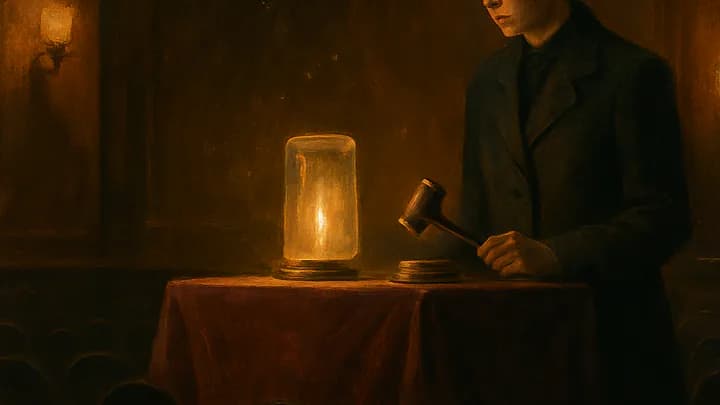
The first lot of the evening was a laugh, and Odette Marchand sold it in under a minute. She raised her gavel, brought it down on the velvet block, and the laugh — bright, slightly crooked, with the hiccup of someone surprised by their own joy — left the glass cylinder on the podium and settled, like pollen, into the throat of a tired man in the third row.
He covered his mouth. When he lowered his hand, he was smiling differently than he had smiled in years.
"Sold," Odette said, gentle as a librarian. "Lot one. Mind the warranty card."
The hall at Bellweather's was small and creaky, the kind of place where the radiators clanked in counterpoint to the bidding. Voices, by their nature, did not photograph well, so the catalogs printed only descriptions. Lot 14: A grandmother's lullaby, Eastern European inflection, traces of cigarette smoke. Lot 27: A boy's first word, repeated thrice, provenance unverified. Each cylinder on the podium glowed faintly when Odette lifted it, the trapped voice flickering inside like a moth made of breath.
She had been the house auctioneer for eleven years. She was good at it because she did not flinch. A voice was only a voice, she told herself, and what people bought was not a person but a sound — the shape of a person, the rind. The person themselves had moved on to wherever people moved on to. The cylinders were what remained when families cleaned out attics and could not bear to throw away the answering machine, the wedding tape, the voicemail saved across four phones.
Bellweather's gave those families a small check and a clean conscience. Odette gave the voices new homes.
The Lot That Would Not Sell
Lot 43 was the last of the night. The card read simply: A woman, mid-forties, reading aloud. Title of book unknown. Duration: four minutes, twelve seconds. Provenance: estate of M. Marchand.
Odette did not remember placing it in the catalog.
She remembered, of course, the estate. Her mother had died in late autumn, and Odette had spent three weekends in the house she'd grown up in, sorting porcelain birds and tax returns into boxes labeled keep, donate, and decide later. The cassette had been in a shoebox under the stairs, unlabeled, the kind of thing a child wouldn't know to look for. She had brought it to Bellweather's only to have it transferred to a cylinder for her own keeping. She had not authorized a sale.
And yet here it was, numbered, catalogued, glowing faintly on the podium beneath her hand.
The bidders were waiting. They were always patient with Odette; she had a reputation for honoring the dignity of a lot, for not rushing.
"Lot forty-three," she said. Her voice came out steady, which surprised her. "A woman reading aloud. Four minutes and twelve seconds. We'll open at thirty."
A paddle went up at the back. Then another near the aisle. The price climbed in even steps — forty, fifty, sixty-five — and Odette watched it climb the way one watches a kite drift toward a power line.
"Eighty," said the woman in the green coat.
"Eighty-five," said the man with the briefcase, who collected maternal voices and kept them, Odette had heard, in a glass cabinet beside his bed.
She thought of her mother in the kitchen, reading from whatever book was nearest while the soup thickened. She thought of how her mother had read everything aloud — recipes, junk mail, the warning labels on cleaning bottles — as if a sentence wasn't real until it had been spoken. She thought of how, for the last two years of her mother's life, Odette had visited only at holidays, and how during one of those visits her mother had asked, Do you want me to read you something, ducks? and Odette had said, I'm tired, Mum. Maybe tomorrow.
There had been no tomorrow worth speaking of.
"Ninety," said the green coat.
Odette lifted the gavel. Her hand did not shake; that was the worst part. Her hand was a professional, even when the rest of her was not.
"Going once," she said.
The cylinder hummed faintly beneath her palm. She could feel the voice in there, the way one feels a cat breathing through a closed door.
"Going twice."
And then — because she had spent eleven years selling the shapes of other people's mothers, and because something in her had been quietly saving up for this exact moment without her noticing — Odette set the gavel down.
"Withdrawn," she said.
A murmur moved through the hall, soft as a page turning.
"I beg your pardon?" said the green coat.
"The lot is withdrawn," Odette said. "With apologies. It was catalogued in error. The house will refund all paddle fees for the evening as compensation."
She lifted the cylinder from the velvet block. It was warm. It had perhaps always been warm, and she had not allowed herself to notice.
After
Mr. Bellweather caught her in the corridor afterward, his bowtie crooked the way it always was at the end of a sale. He was not angry, only puzzled, the way a man might be puzzled by a clock that had begun to run backward but kept correct time anyway.
"Odette," he said. "In eleven years."
"I know."
"You've never."
"I know, Henry."
He studied her. He had known her mother slightly, in the way that auction-house men know everyone slightly. He sighed, and the sigh meant fine, and also I would have done the same, and also don't make a habit of it.
"Go home," he said. "Lock up tomorrow."
She went home. She lived above a florist's, in a flat that smelled permanently of eucalyptus and damp paper. She set the cylinder on the kitchen table and looked at it for a long time without touching it.
To play a cylinder, one only had to speak its number aloud. Forty-three would do it. The voice would rise from the glass like steam from tea, and fill the room, and last exactly four minutes and twelve seconds, and then be gone again until summoned.
Odette made tea. She put on her mother's cardigan, which she had not yet been able to wash. She sat in the armchair by the window, where the streetlight came through in a long warm bar.
She did not say forty-three. Not that night.
It was enough, for now, to know that she could. That somewhere in the room with her, behind glass, her mother was reading. The book was unknown. The soup was thickening. The kitchen was warm. And whenever Odette was ready — tomorrow, next week, ten years from now — there would be a tomorrow worth speaking of, waiting patiently to be called.
She drank her tea. Outside, the radiators of the city clanked their counterpoint, and somewhere a stranger laughed a laugh he had bought that evening, surprised all over again by his own joy.
Frequently asked questions
What does the auction of voices suggest about how we commodify memory?
The story presents memory as something both intimate and tradable, raising the unsettling possibility that grief can be outsourced. Yet it also suggests that some inheritances refuse to be liquidated — that certain voices belong only to certain ears.
Why is it significant that Odette withdraws the lot rather than buying it herself?
Buying it would have placed her mother in the same economy as every other voice she had sold. Withdrawal is a refusal of that frame — an insistence that this particular sound is not currency but kin.
How does the story treat the regret of the missed 'maybe tomorrow'?
Rather than resolving the regret, the story offers a fragile second chance: a tomorrow that can be summoned at will. The grace is not erasure of the original failure, but the possibility of finally accepting what was offered.
Why might Odette choose not to play the cylinder on the first night?
Anticipation can be its own form of presence. By postponing, Odette transforms the recording from a finite resource into an ongoing companionship, and reclaims a sense of agency over when grief arrives.