The Locksmith Who Kept Other People's Keys
In a narrow shop wedged between a bakery and a shoe repair, an aging locksmith discovers that the keys customers forget to collect carry more than metal.
Drafted with AI and published automatically. Our editors set the standards and fix reported errors — how we work.
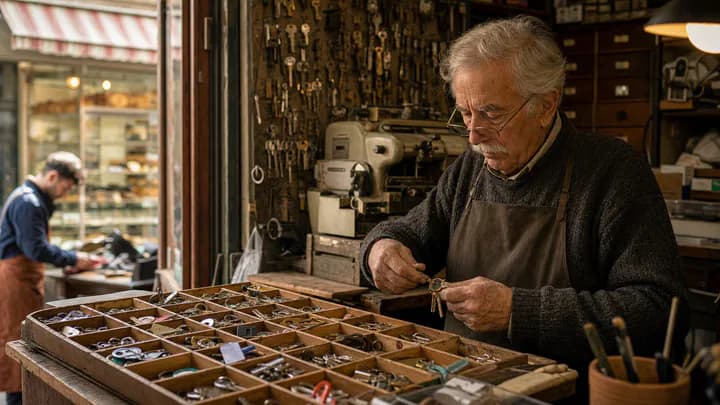
Ernest Vale had cut keys for forty-one years, and in all that time he had never learned to throw one away. They hung on the back wall of his shop in loose brass constellations, each on its own nail, each with a paper tag curling like a dried leaf. Mrs. Ordy, 14 Hollam Street, spare. Boy in the green coat, blue door. The woman who cried, Tuesday.
The shop was narrow enough that two customers had to take turns breathing. On the left, through the wall, the bakery kneaded its dough at four in the morning and filled Ernest's dreams with yeast. On the right, the shoe repair tapped its small hammer all afternoon. Between these two sounds, Ernest filed brass and did not think of his wife, who had been gone six years, or his daughter, who called on Sundays from a city he had never visited.
The keys on the back wall were the ones nobody had come back for. Some had been there so long the tags had faded to the color of weak tea. Ernest could not say why he kept them. It was not sentiment, he told himself. It was simply that a key without a door was still a key, and keys were not the sort of thing one threw in a bin.
On the morning the trouble began, a young woman came in holding a padlock.
“I've lost the key,” she said. “It was my grandmother's diary. I don't want to break the lock. Can you—?”
“I can try,” Ernest said.
He took the padlock to his bench, and while he worked, the young woman drifted along the back wall, reading the tags aloud under her breath the way people do in museums. Ernest paid no attention until she said, “This one has my name on it.”
He looked up. She was holding a small brass key with a tag that read, in his own careful handwriting, Iris Denby, front door, do not lose.
“My name is Iris Denby,” she said. “But I've never been in this shop before.”
Ernest set down his file. He came over and took the key from her. The tag was old—years old, judging by the yellow of the paper—and the handwriting was certainly his. He remembered every key he had ever cut, or thought he did. He did not remember this one.
“Perhaps a relative,” he said. “A mother, an aunt.”
“My mother's name was Clare. My aunts are Beth and Margaret.” She turned the key over. “May I try it? On my door, I mean. I live just up on Ashcombe Row.”
Ernest hesitated. It was against a locksmith's code, in a way, to give out a key that did not belong to the person asking. But the tag said her name. He had written it himself, apparently, in a year he could not place.
“Bring it back if it doesn't fit,” he said.
She did not bring it back.
Two
Over the following weeks, Ernest began to notice things he had been trained by long habit not to notice. The keys on the back wall were not quite the same each morning. A tag he was certain had said Blue door, Marlow Lane now said Blue door, Marlow Lane, third try. A key he remembered as a simple pin tumbler had grown a second set of teeth overnight, delicate as a fish's spine.
He told no one. Who was there to tell? The baker on his left was a young man with headphones. The shoe repairman on his right had died in the spring, and the new tenant sold vintage postcards and kept to herself.
Instead, Ernest began, cautiously, to read the tags again. Really read them, the way Iris Denby had.
He found tags he had no memory of writing. The man who will come in October, brown hat. Small girl, cannot yet reach the letterbox. Anyone who needs to go home.
He found a tag that said Ernest Vale, back door, in case.
He did not have a back door. His shop had one exit, onto the street. And yet the key was there, hanging on its nail, warm to the touch when he took it down, as if someone had been holding it a moment before.
Three
The man in the brown hat came in October, as promised.
He was perhaps sixty, with the tired eyes of someone who had been driving a long time. He did not ask for a cut key. He looked at the back wall as if he had been looking for it his whole life, and he said, “Is one of those mine?”
Ernest, who had been half-expecting him, took down the tag that said brown hat and handed him the key.
“What door does it open?” the man asked.
“I don't know,” Ernest said. “I only know it's yours.”
The man turned the key in his palm as though weighing it. Then he began, quietly and without drama, to cry. He apologized. He said he had not cried in eleven years. He said his brother had stopped speaking to him in a kitchen in Doncaster, and he had spent every October since driving vaguely north with no plan.
“Try it on his door,” Ernest said, because it seemed the thing to say.
The man nodded. He put the key in his coat pocket, thanked Ernest with a handshake that lasted longer than handshakes usually do, and left.
Ernest stood for a long time at the back wall after he had gone. He understood now, or thought he understood, what the shop had been doing all these years without telling him. The keys were not to doors, exactly. They were to the moments when doors might open again, if someone was brave enough to try.
He wondered how long it had been happening. He wondered whether his wife, in the last months, had come into some other shop like his, in some other town, and been handed a small brass key with his name on the tag. He hoped so. He hoped she had used it.
Four
On a Sunday in November, when the shop was closed and the bakery silent, Ernest took down the key marked Ernest Vale, back door, in case.
He walked to the rear of the shop, where the wall was blank plaster and had always been blank plaster. He put the key against the wall at about the height a keyhole would be. He felt, quite distinctly, the small resistance of a lock.
He turned it.
He did not go through. Not that Sunday. He only opened the door a crack, enough to see a hallway on the other side that smelled faintly of the sea, and to hear a voice he had not heard in six years call, from somewhere further in, “Ernest? Is that you at last?”
He closed the door gently. He locked it. He put the key back on its nail.
He was not ready yet. But he knew now where the key was kept, and who had kept it for him, and that, when the time came, he would only need to reach up and take it down.
He turned off the shop light and went home the ordinary way, past the bakery, past the postcard shop, whistling something his wife had liked, keeping every promise he had not yet made.