The Detective of Misfiled Afternoons
When a city clerk reports a missing Tuesday, a tired detective discovers that lost afternoons leave fingerprints, and some people misplace time on purpose.
Drafted with AI and published automatically. Our editors set the standards and fix reported errors — how we work.
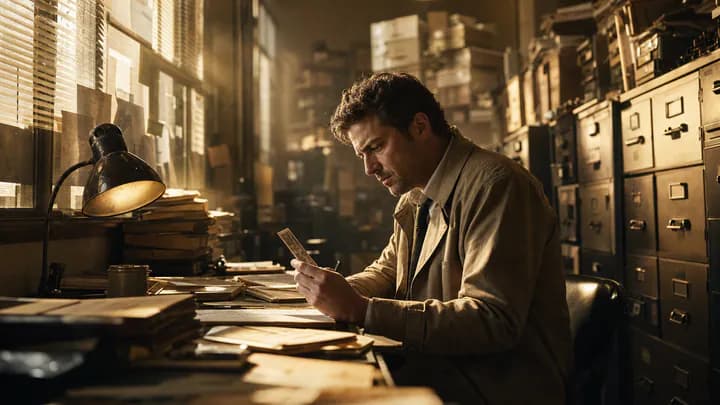
The complaint arrived in a brown envelope marked URGENT in pencil that had been pressed too hard, and Inspector Halloran knew before he opened it that the case would be the sort that gave him a headache behind the left eye. The envelope contained one form, neatly typed, reporting the loss of a Tuesday afternoon between the hours of two and five.
"Whose Tuesday?" he asked the desk sergeant.
"A Mr. Edwin Pell. Clerk, Bureau of Weights. Says he had it that morning and now he doesn't."
Halloran rubbed his eye. The Department of Misplaced Hours occupied two rooms above a stationer's on Lindlow Street, and it received, on average, eleven reports a week. Most were easily solved. People misplaced Sunday mornings in church pews, lost Wednesday evenings in the bottom of teacups, surrendered whole Fridays to the slow ticking of waiting rooms. Halloran walked the city with a notebook and a pair of soft shoes, and he returned the time, when he could, by finding where it had slipped.
A whole afternoon, though. That was different.
I.
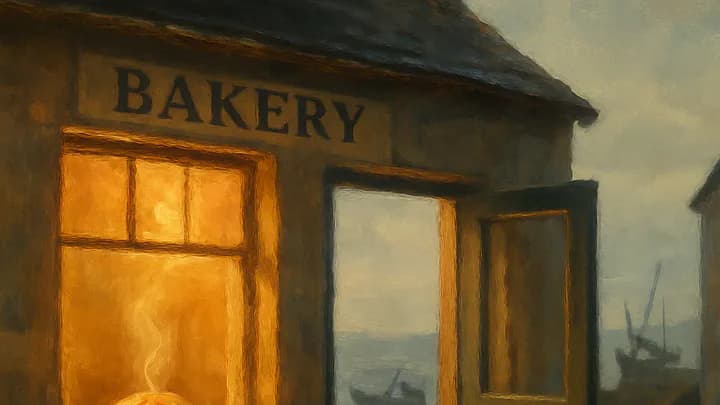
Edwin Pell lived in a narrow flat above a bakery, and he opened the door wearing a cardigan the color of weak tea. He was perhaps fifty, with the kind of face that apologized for itself before speaking.
"You came," he said, as if he hadn't believed anyone would.
The flat smelled of yeast and old paper. Halloran sat in the offered chair and took out his notebook.
"Tell me about the Tuesday."
"I left the Bureau at one-thirty, as I always do on Tuesdays. I walked to the corner of Marlow and Pence. I remember the corner — there was a woman selling pears. And then —" He spread his hands. "It was five o'clock. I was on a bench in Hartwell Square. My shoes were dusty. My hat was on the wrong way."
"Anything in your pockets that wasn't there before?"
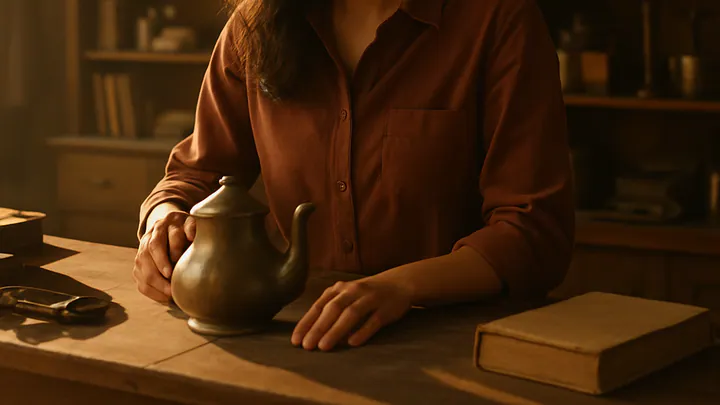
Pell hesitated. From his cardigan he produced a ticket stub, a small smooth river stone, and a leaf that had been pressed flat as if between the pages of a book.
Halloran turned the ticket stub over. It was from a place he didn't recognize: Halverson's, Admit One. The river stone was warm. The leaf was from a kind of tree that didn't grow within the city limits.
"Mr. Pell," he said carefully, "are you certain you want this afternoon back?"
Pell blinked. "I — yes. Of course. It's mine. I'm meant to account for it."
"To whom?"
"To — well. To myself."
Halloran wrote nothing in his notebook. He had learned, over twenty years, when to write and when to listen to what wasn't being said.
II.
Halverson's, it turned out, was a small concert hall on the far side of the river, in a neighborhood Halloran rarely visited. The man at the box office was elderly and had a parrot on his shoulder that watched Halloran with cold amber attention.
"Tuesday afternoon," the man said, consulting a ledger. "Yes. The pianist. Madame Orlovich. A small audience. Quite small."
"Was a Mr. Edwin Pell in attendance?"
The man ran his finger down a column. "Pell. Pell. No Pell. But there was a Mr. Halverson."
"You?"
The man smiled. "My grandfather. The hall is named for him. But he died in 1912, so it wasn't him on Tuesday. Someone signed in under the name. They do that, sometimes. People who don't wish to be themselves for an afternoon."
The parrot shifted. Halloran thanked the man and went back across the river on foot, taking the long bridge so he could think.
People who don't wish to be themselves for an afternoon. He knew the type. He had, on occasion, been the type. There was a stretch of months, after his wife had gone, when he had borrowed names from train timetables and worn them like coats for an hour at a time.
III.
He found Edwin Pell again the next morning, this time at the Bureau of Weights, hunched over a brass scale on which he was measuring something so small Halloran couldn't see it.
"Mr. Pell. I've located your afternoon."
Pell's hands stilled. "Oh."
"You attended a piano recital across the river. You signed in under another name. You walked along the canal afterward — that's where the river stone is from. The leaf is from a sycamore in the courtyard of the hall. The ticket is yours."
Pell was quiet for a long moment. He set down his tweezers very carefully, as though they were also made of time.
"I see," he said.
"You knew," Halloran said gently. "Didn't you?"
"I —" Pell looked at his hands. "I suspected. I have a — I have a habit, sometimes, of going somewhere. And not remembering, afterward, that I went. It's as if I lend the afternoon to someone else. Someone who lives inside me but doesn't come out often."
"And does he enjoy himself, this other fellow?"
Pell almost smiled. "I think he must. He brings back stones."
Halloran closed his notebook. He looked, for a long moment, at the small careful man in the cardigan, at the scale and the tweezers and the very tidy desk, and at the river stone now sitting beside the inkwell where Pell had placed it that morning, like a small smooth promise.
"Mr. Pell," he said, "I'm prepared to file this as solved. The afternoon has been located, accounted for, and returned. But I won't write down where it went, if you'd rather I didn't."
Pell looked up. His eyes were wet but not unhappy.
"That," he said, "would be very kind."
"On one condition."
"Yes?"
"The next time he goes," Halloran said, "let him stay a little longer. The Bureau will manage. Tuesdays are quiet."
Pell laughed — a small, surprised sound, like a coin dropped on a wooden floor.
IV.
Halloran filed the report that evening. Under Resolution, he wrote only: Afternoon recovered intact. Owner has reclaimed possession. He locked the cabinet and put on his coat.
Outside, the city was doing its slow blue evening thing, lamps coming on one by one along Lindlow Street like a careful sentence being written. Halloran stood for a moment on the pavement and considered the hours ahead of him — his own, unaccounted for, entirely his.
He thought he might walk the long way home, and see what he found in his pockets when he got there.