The Small Hours at Ambrose & Finch
A night clerk at a shabby residential hotel keeps a careful ledger of the guests who never quite check out. Then, on a rainy Tuesday, someone new asks for a room.
Drafted with AI and published automatically. Our editors set the standards and fix reported errors — how we work.
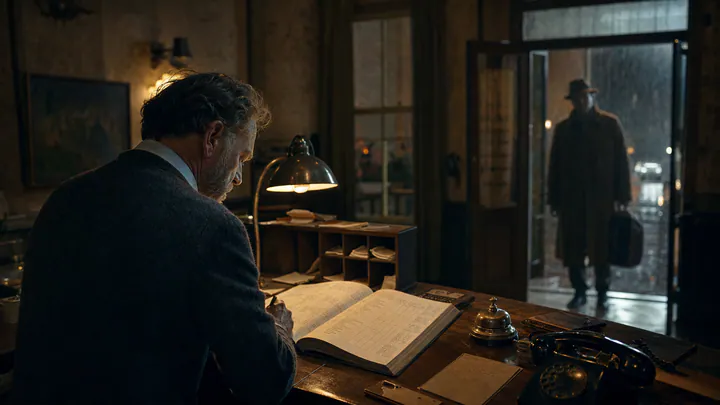
The hotel had four floors, six working radiators, and a front door that sighed when the wind pushed against it. Iris had been the night clerk for eleven years, and she still hadn't decided if the building was breathing or complaining.
At Ambrose & Finch, the small hours belonged to her. From ten at night until six in the morning, she sat behind a desk of scarred oak with a green banker's lamp and a ledger the size of a paving stone. The ledger had been kept, in one hand or another, since 1911. Iris had inherited it from a man named Peder who wore two cardigans at once and left her a note that said only: Be gentle with the margins.
She had learned what that meant.
The margins were where she wrote down the guests who were not, strictly, checked in. Mrs. Ovenden, who had died in room 214 in 1978 and still came down some evenings to complain about the drafts. The boy in the corduroy jacket who hummed on the stairs between two and three a.m., though no one remembered his name or when he'd arrived. The woman in room 402 whose door was always locked, whose rent was paid every month by a lawyer's office in another city, and whose footsteps Iris heard but whose face she had never seen.
Iris did not consider these things ghosts. She considered them tenants of a slightly different kind. She left fresh flowers by the elevator on Sundays. She kept the lobby lamp burning. She wrote, in the margins of the ledger, small notes: Mrs. O. asked after her son again. Told her he was well. Corduroy boy skipped the fourth stair tonight; something has cheered him.
I.
On a Tuesday in October, rain came sideways down Bellwether Street, and a man in a wet coat pushed through the sighing door at ten past midnight.
He was perhaps forty. His coat was too thin for the season, and he carried a canvas bag stitched at the handle with fishing line. He looked at the lobby the way people look at rooms they have dreamed about — with a small, private recognition.
"I'd like a room," he said. His voice was hoarse, as though he hadn't used it in a day or two. "Just for tonight."
Iris opened the ledger. The pages were soft as old money. "Name?"
"Teodor Wick."
She wrote it in her steady hand. "How did you find us, Mr. Wick? We don't advertise."
He smiled, but it was the tired smile of someone who no longer knew whether he was being asked a real question. "My mother stayed here once. A long time ago. She used to tell me about it — the green lamp, the man in two cardigans. I was in the neighborhood, and the rain came, and I remembered."
Iris kept her face still. She turned the key card in its little envelope. "Room 305. The radiator knocks. Consider it company."
He laughed, softly, and it was the first sound she'd heard in the lobby all night that had any warmth in it.
When he had gone up, she opened the ledger to the margins and wrote: T. Wick, 305. Says his mother stayed here. Look.
II.
She kept the margins in the back of the ledger, arranged by year. Peder's handwriting slanted right; hers slanted a little left. Before Peder, a woman named Constance had kept them in violet ink. Before Constance, someone had used pencil so faint you had to hold the page toward the lamp.
Iris turned back forty years. Rain drummed the windows. The lobby smelled of wet wool and radiator dust.
She found her: Mrs. Alenka Wick, 305. Stayed three weeks. Left a canvas bag behind, stitched at the handle. Held for pickup. Never claimed.
Iris sat very still.
Peder had told her, in his slow way, about the storeroom under the stairs. Every hotel accumulated such a room — umbrellas, single gloves, a paperback with someone's grocery list tucked inside. Iris had inventoried it three times in eleven years. She knew, without looking, that there was a canvas bag on the third shelf from the top, its handle stitched with fishing line, its contents unexamined because Peder had believed that some things were not for the living clerk to open.
She went and got it.
It weighed almost nothing. She set it on the desk beside the ledger and waited.
III.
Teodor Wick came down at a quarter to two. He had changed his shirt but not his expression. He stopped when he saw the bag.
"That's — " he began.
"It was left here," Iris said. "Forty years ago. By a Mrs. Alenka Wick."
He sat down on the little settee opposite the desk, the one no one ever sat on, and put a hand over his mouth.
"I couldn't sleep," he said, after a while. "I came down to ask you something. I was going to ask if you had any record of her. My mother. She died last spring, and there were — things she never explained. Places she'd been. I thought maybe someone here would remember."
"I wasn't here then," Iris said. "But the ledger was."
She turned the book toward him and showed him the entry. He read it twice. He touched the canvas bag as if it might not hold up under a full hand.
"May I?" he asked.
"It's yours," Iris said. "I think it always was."
He opened it slowly. Inside were a folded blouse, a comb, a small tin of buttons, and a bundle of letters tied with brown string. He did not read the letters. He held the bundle in both hands the way you hold something warm.
"She used to say she left a piece of herself somewhere," he said, "and couldn't remember where. I thought it was just — a thing people say."
"People say a lot of true things by accident," Iris said.
He looked up. His eyes were very tired, and very bright. "How did you know to look?"
Iris considered the margins of the ledger, and the corduroy boy on the stairs, and Mrs. Ovenden's drafts, and the locked door of 402, and eleven years of small hours during which she had learned that a building can hold on to what people leave behind, and hand it back only when someone comes to receive it.
"It's my job," she said, "to know where things are being kept."
He nodded as though this made a kind of sense he could not yet name. He stayed on the settee a long time, one hand on the bundle of letters, the other flat against the canvas bag, while the rain slowed and the radiator knocked its old, companionable code.
When he finally went upstairs, Iris opened the ledger to the current page. She wrote, in the margin, in her small left-leaning hand: T. Wick, 305. Came for what was waiting. Received it.
She closed the book. The green lamp hummed. Somewhere on the fourth floor, a door that had been locked for a very long time opened, quietly, and then quietly closed, and Iris smiled without looking up, because at Ambrose & Finch the small hours were her hours, and she knew, now more than ever, exactly what they were for.