The Locksmith Who Opened Mondays
When a small-town locksmith discovers a key that fits the start of every week, she has to decide which doors are worth walking through twice.
Drafted with AI. This version has not been reviewed by an editor, so it is kept out of search results and carries no ads — how we work.
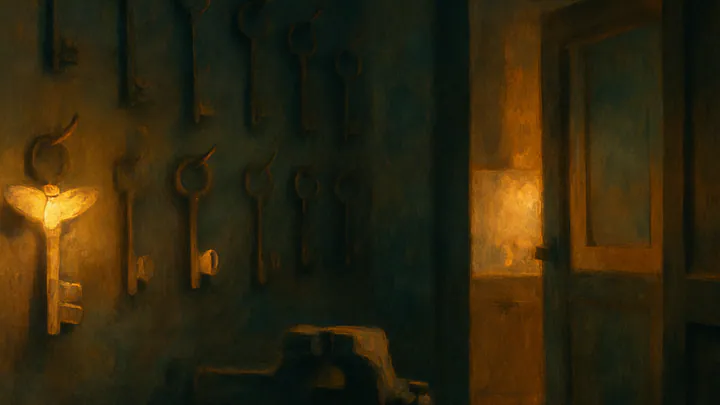
The key did not look like much — a stubby brass thing, the bow shaped like a sleeping moth — but when Ines held it up to the workshop lamp, the teeth caught the light in a way that made her thumb tingle. It had come tumbled in a bucket of orphan keys from old Mr. Aldea's estate, sold to her by the pound.
Ines ran the only locksmith shop in Cabreda, a town small enough that everyone knew which front door stuck in the rain. She was forty-one, unmarried, and pleasantly invisible to most of her neighbors, which suited her. The shop smelled of graphite and oranges, because she ate one every morning at the bench while she sorted the previous day's work.
The moth key was Monday's problem. Literally. She found it at 7:14 a.m. on a Monday, and the moment she turned it idly in her fingers, the bell above the door rang — though no one had come in.
She crossed the shop and opened the door. The street outside was wrong.
Not dramatically wrong. The bakery was still across the way, the plane tree still shedding its early leaves. But the light was Sunday-evening light, gold and unhurried, and the bakery's chalkboard read Saturday Special: Quince Tart. A delivery boy she hadn't seen in a year cycled past whistling.
Ines closed the door. Opened it again. Monday returned, grey and ordinary, with Mrs. Polop already complaining her way up the street toward the shop.
She put the moth key in a velvet pouch and did not touch it for three days.
What the Key Opened
It was Thursday before she tried it again, and only because she had been thinking, against her will, about her mother.
Her mother had died on a Tuesday in March, four years ago. The Monday before had been an ordinary Monday: a phone call about nothing in particular, a conversation about whether the kitchen tap needed a new washer. Ines had been distracted. She had said I'll come Saturday, all right? and her mother had said all right, love, and that was the last full sentence they shared. By Saturday there had been a hospital and a hush and other people's hands on her arm.
She thought about the moth key sitting in its pouch. She thought about Mondays.
That night, after closing, she locked the shop's back door from the inside and slid the moth key into the deadbolt instead of her own. The teeth fit with a small, satisfied click, as if the lock had been waiting decades to meet them.
She turned the key.
She opened the door onto her mother's kitchen.
The tap was dripping. Her mother was at the table in the blue cardigan with the missing button, doing the crossword in pen, which she always did because she said pencils were for cowards. A radio murmured the farm report.
“You're early,” her mother said, not looking up. “I haven't put the kettle on.”
Ines could not speak. She stood in the doorway with one hand on the frame, smelling toast and laundry soap and the particular dust of that house, and she understood, with the calm certainty one has in dreams, that she could step through. She could sit down. She could say all the things.
She could also, she understood, not come back. The moth key was Monday's key. Mondays began things. Mondays did not necessarily end them.
“Mama,” she said.
Her mother looked up. Her face did the small reorganizing it always did when she shifted attention — eyebrows first, then mouth. “What's the matter? You look like you walked through a window.”
“The tap needs a new washer,” Ines said. Her voice came out steady, which surprised her. “I can do it Saturday. I'll bring the part.”
“All right, love.”
Ines stood there another moment. Then she stepped back and pulled the door shut and turned the moth key the other way, and the deadbolt of her own back room clicked open onto the smell of graphite and oranges and the sodium glow of the alley.
She sat down on the floor and cried for a long time, but not in the way she had expected. It was not grief, exactly. It was the feeling of having been given a small, undeserved mercy and choosing to spend it carefully.
The Doors She Did Not Walk Through
After that, Ines used the moth key sparingly, and never for herself.
When Mrs. Polop's grandson missed his train to the capital and lost a job interview, Ines stayed late at the shop and let him in through the back, and the boy stepped out onto a Monday platform with the train just pulling in. He never asked how. People in Cabreda had a gift for not asking.
When the bakery burned its Saturday quince tart and the baker, who had loved his wife badly and was trying to do better, wanted to try again — Ines opened the door onto the right Monday and let him buy better quinces.
She did not open the door to her mother's kitchen a second time. She thought about it often, on slow afternoons, the way one thinks about a book left on a train: with fondness, and a small clean ache, and no real wish to chase it down.
One Monday in autumn, a young woman she didn't recognize came into the shop. She had a duplicate to cut, an ordinary house key, nothing remarkable. While Ines worked the grinder, the woman wandered the wall of orphan keys and stopped.
“That one's pretty,” she said, pointing at the moth, which Ines had hung among the others because hiding a thing too well is its own kind of mistake. “What does it open?”
Ines looked at her — really looked. The woman had tired eyes and a wedding ring she kept turning. The kind of face that was carrying a Monday somewhere inside it.
“Whatever you need it to,” Ines said. “Once. Bring it back after.”
The woman laughed, because she thought it was a joke, and Ines smiled, because it wasn't, and the bell above the door rang as someone else came in needing something ordinary.
Outside, the plane tree shed another leaf. Inside, the moth key swung gently on its hook, waiting for the next door worth opening.