The Locksmith Who Kept the Wrong Keys
For thirty years, Idris Vale has kept a drawer of keys that belong to no lock he can remember. One afternoon, a stranger walks in claiming one of them.
Drafted with AI; reviewed by Azka Shahid on . How we work.
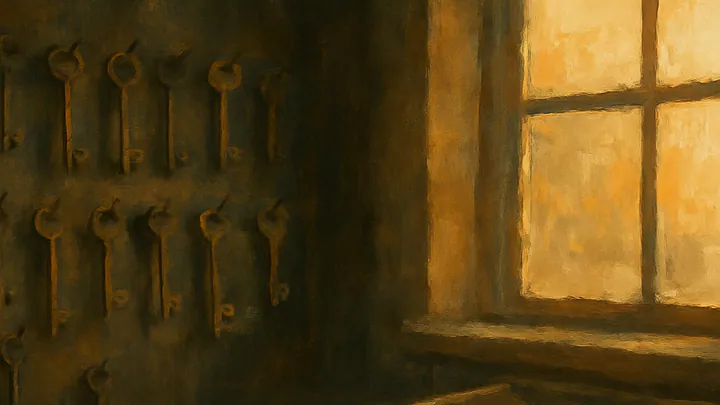
Idris Vale had been a locksmith for thirty-one years, and in that time he had collected two hundred and forty-six keys that fit nothing he owned. They lived in a shallow drawer beneath his workbench, in a nest of soft cloth, like sleeping mice.
He couldn't say where most of them had come from. A few, he remembered: the little brass one shaped like a clover, left in a coat pocket he had mended for a customer who never returned; the long iron skeleton he'd found under the floorboards of the shop the week he inherited it from his uncle. But the rest had simply arrived, the way lint arrives in pockets, the way certain songs arrive in the head at three in the morning.
His wife, when she was alive, had called the drawer his "orphanage." She used to sit on the stool by the window and pick keys out one by one, holding them to the light. This one belongs to a garden gate, she would say. This one to a music box. This one to a house where somebody is waiting up. She had made a game of it. Idris had loved her for the game, and for many other reasons, and now she had been gone four years and the drawer had only grown heavier.
On the Tuesday the stranger came in, it was raining the sort of rain that isn't quite committed to falling. The bell over the door gave its tired chirp. Idris looked up from a padlock whose tumblers he was coaxing back into agreement.
The woman was perhaps sixty, in a coat the color of wet slate. Her hair was pinned up hastily, as though she had left somewhere in a hurry a long time ago and never quite arrived anywhere else. She carried no bag, no umbrella. Just her two hands, held in front of her like a person about to receive something.
"I'm looking for a key," she said.
"That's the right shop," said Idris, and smiled the small professional smile he had been perfecting since he was nineteen.
"No," she said. "I mean I'm looking for a particular one. I think you might have it."
He set down his tools.
"It's green," she said. "The head is green. Enamel, I think. About this long." She measured a space between her thumb and forefinger. "There's a chip out of one corner. Shaped like a crescent."
Idris felt the small hairs rise on the back of his neck, which was a thing he had not felt in a great many years and had almost forgotten was possible.
He knew the key. He had known it the moment she said green. It lived in the back left corner of the drawer, wrapped in a scrap of blue felt, and he could not have told anyone, under oath, where it had come from.
The Drawer
"May I ask," he said carefully, "what it opens?"
The woman looked at him for a long moment. Her eyes were the pale gray of pond ice.
"A door," she said. "In a house I used to live in. My mother's house. She died in the spring and left it to me, and I've been trying to go inside for eight weeks."
"You've lost your key."
"I never had one. She kept the green key, always. She used to say she'd give it to me when I was ready." The woman's mouth moved in a way that was not quite a smile. "She died before deciding I was."
Idris opened the drawer.
He did not have to search. His fingers found the felt bundle the way a tongue finds a loose tooth. He unwrapped it on the workbench between them. The green key sat there, small and stubborn, its enamel scuffed, the crescent chip exactly where she had said.
The woman made a sound. It was not a word.
"How," she said, when she could. "How do you have this."
"I don't know," said Idris, honestly. "I don't remember taking it. I don't remember anyone leaving it. I've had it — I want to say a long time. I couldn't tell you how long."
She reached out. Then she stopped, her hand hovering, as though the key might be too warm to touch.
"May I?" she said.
"It was never mine," said Idris.
She picked it up. She held it in her palm and closed her fingers and closed her eyes, and Idris looked away, because there are certain private weathers a person deserves to have alone.
When he looked back she was crying, quietly and without apology, the way people cry when a thing they had given up on turns out to have been waiting for them the whole time.
What He Kept
"Let me pay you," she said, at the door.
"For what," said Idris.
"For keeping it."
He thought about this. Outside the rain had made up its mind at last and was falling in earnest, silvering the cobbles, blurring the shape of the mailbox on the corner.
"No charge," he said. "But — if you don't mind — would you tell me what's inside? The house. Once you're in."
She tilted her head. "You want to know what the key was for."
"I've been wondering," he said, "about a lot of them."
She promised she would come back. Idris didn't know whether to believe her; people promise a great many things in doorways. But three weeks later a postcard arrived with no return address, showing a photograph of a garden gone to seed and, in the middle of it, a stone bench under an apple tree. On the back, in careful blue ink: The door opened. Inside was a kitchen with the clock still running. She had wound it the morning she died. Thank you for keeping her waiting for me. — R.
Idris pinned the postcard above the workbench.
He did not, as he had half-expected, feel the drawer grow lighter. The keys were still there, all two hundred and forty-five of them now, still sleeping in their cloth. But he began, in the evenings, to take them out one at a time. He held each to the light. He tried to guess.
This one, he would say to no one, in the voice he used to use with his wife, belongs to a garden gate. This one to a music box. This one to a house where somebody is waiting up.
And sometimes, on the slow Tuesdays, the bell above the door would chirp, and someone would come in from the rain, and Idris Vale would look up from his work and think: Maybe this one. Maybe today.
He was in no hurry. He had, after all, been keeping the keys a long time. He could keep them a little longer.