The Clockmaker Who Fixed Silences
When a young woman brings a stopped pocket watch to a small shop on Fennel Street, she discovers the clockmaker repairs something stranger than time.
Drafted with AI; reviewed by Azka Shahid on . How we work.
The shop on Fennel Street had no sign, only a brass bell above the door that rang in a key Ines could not name. She pushed inside, holding her father's pocket watch in both hands the way one carries water without a cup.
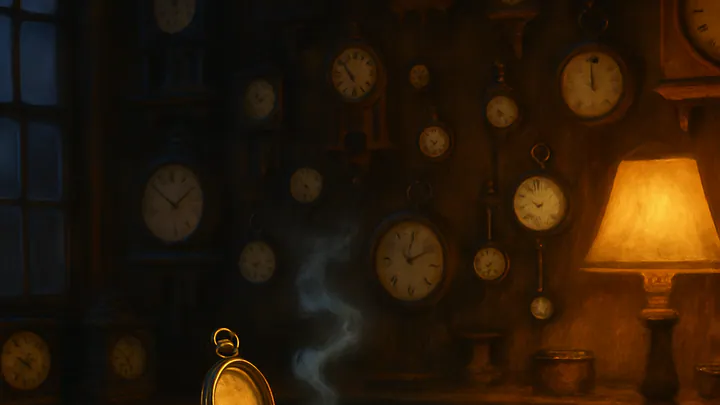
Inside smelled of oiled wood and cold tea. Every wall was clocks — not ticking together, not competing, but overlapping in a soft mechanical weather. Long-case clocks murmured near the floor. Cuckoos slept in their little houses. A wall of wristwatches blinked like a field of insects at dusk.
“You brought it,” said a voice, and Ines startled. The clockmaker was already at the counter, though she hadn't seen him cross the room. He was smaller than she expected, with round spectacles that made his eyes look kind and slightly astonished, as if the world kept surprising him in gentle ways.
“I didn't say I was coming,” she said.
“No,” he agreed. “But it stopped, didn't it. And people who bring stopped watches here usually mean to.”
She set the watch on the velvet pad he unrolled. It was her father's — brass, a little tarnished at the hinge, engraved on the inside cover with a date she had known by heart since she was seven. He had wound it every morning at the kitchen table. He had wound it the morning he died, too, and it had run for eleven days after that before finally, quietly, stopping.
“It ran too long,” she said. “That's the part I can't explain.”
The clockmaker didn't answer at first. He turned the watch over, opened its back with a tool so slim it looked like a splinter of moonlight, and peered inside. He hummed — not a tune, more the small, absent sound a person makes when reading.
“Ah,” he said.
“Ah what?”
“There's a silence stuck in the escapement.”
Ines waited for him to laugh, or to explain in the fluent nonsense some people used when they wanted to sell you something. He did neither. He turned the watch so she could look through his loupe, and she leaned close, and saw — she was almost certain she saw — a small dim place inside the gears, like a room with the lights out.
“Watches keep time,” the clockmaker said, mildly. “But time is only the front of the fabric. On the back are all the pauses. The held breaths. The things not said. Sometimes those get tangled in the mechanism, and the watch will run beautifully until the silence works itself loose. Then it stops.”
“What silence,” Ines said, and her voice came out drier than she meant.
He looked up at her. His astonished eyes were very gentle.
“That,” he said, “is what I need you for.”
The Back Room
He led her past a curtain into a smaller room, where a single armchair faced a workbench. He gestured for her to sit. On the bench he laid out the watch, a shallow porcelain dish, and a pair of tweezers so fine they seemed made of eyelash.
“When I remove it,” he said, “the silence will want somewhere to go. It has to be spoken into something. Otherwise it will simply climb into another clock and we haven't solved anything, only moved the problem.”
“Spoken,” Ines repeated.
“By the person it belongs to.”
She felt her throat tighten. Outside, on Fennel Street, a delivery cart rattled by. Somewhere in the shop a clock chimed the quarter hour, or perhaps the quarter of some other hour entirely.
“I don't know what it is,” she said.
“You do,” he said, not unkindly. “You've been carrying it for a year.”
He bent to the watch. The tweezers dipped inside the works with a surgeon's patience, and Ines watched him lift out something she could not properly see — a wisp, a held-breath, a shape the color of a room at four in the morning. He guided it toward the porcelain dish, but paused, holding it in the air between them.
“Whenever you're ready,” he said.
Ines opened her mouth. Closed it. The shop hummed with its soft mechanical weather. She thought of her father at the kitchen table, winding the watch, humming under his breath, and of the last conversation they had almost had — the one she had walked away from because she was twenty-four and angry and certain there would be more mornings.
“I never told him,” she said, and her voice was suddenly a child's voice, thin, embarrassed to be heard. “I never told him I forgave him. For the year he was gone. For coming back like nothing happened. I was going to. I was practicing what to say. And then he — ”
She could not finish. But the wisp between the tweezers had already begun to drift, uncoiling toward her voice like smoke toward a window. She kept talking. She said the small stupid things too — that she had kept his ugly sweater, that she hated the way he'd made coffee, that she missed the way he'd made coffee, that she'd been furious with him for dying before she was done being furious with him. She said it all into the porcelain dish, which was not really a dish but the shape a silence takes when it has finally been allowed to land.
When she was done she was crying, but quietly, the way you cry when something has been lifted rather than broken.
The clockmaker set the tweezers down. He closed the back of the watch with the same slim tool, wound the crown three careful turns, and held it to his ear.
“There,” he said, and smiled for the first time. “Listen.”
He passed it to her. The watch ticked — an ordinary, patient tick, the tick of a thing that intends to keep going.
“What do I owe you,” Ines said.
“Nothing today.” He was already tidying the bench. “You'll pay it forward, in the usual way. You'll be kinder to someone than you strictly have to be. That's how the shop stays open.”
“That's not a business model.”
“No,” he agreed cheerfully. “And yet.”
Outside, Fennel Street was doing its ordinary afternoon — a woman shaking out a rug, two boys arguing over a bicycle, the low copper light of a city easing toward evening. Ines stood for a moment on the step. The watch ticked against her palm, warm now, as if it had been held by someone else just before her.
She turned to look at the shop and found, without much surprise, that there was no shop — only a narrow gap between a bakery and a stationer's, wide enough for a cat, not wide enough for a door.
She walked home the long way. She wound the watch that night at the kitchen table, and again the next morning, and every morning after that, and for a long time she did not need to know how any of it worked. Only that it did. Only that some silences, once spoken, become the quiet, steady sound of a thing continuing.