The Baker Who Forgot the Salt on Purpose
In a coastal village where every loaf tastes faintly of grief, one baker decides to bake a bread that remembers nothing at all.
Drafted with AI. This version has not been reviewed by an editor, so it carries no ads — how we work.
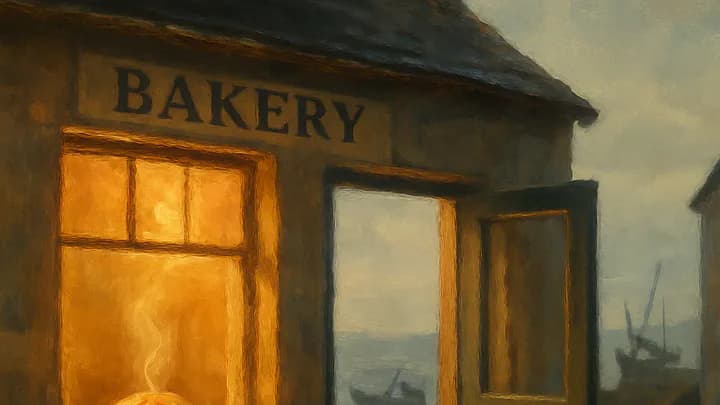
In the village of Tover-by-the-Spray, every loaf of bread tasted a little of grief, and no one could agree whose grief it was. Some said it was the sea's. Some said it was the flour's, milled from wheat that grew along the cliffs where the wind never quite stopped pulling at things.
Hesper, who had inherited her grandmother's oven and her grandmother's stubbornness, suspected it was the salt.
"You can't bake without salt," said Old Pell, who had come every morning for forty years to buy two rolls and complain about one of them. "It's not bread otherwise. It's just sad dough."
"All our bread is sad dough," Hesper said. She was kneading at the long marble counter, sleeves shoved past her elbows, a smear of flour on her temple like a thumbprint. "That's the problem."
Old Pell shrugged and tucked his rolls into a cloth. "Sad is just the flavor of being from here. You'd miss it if it were gone."
Hesper wasn't so sure. Her grandmother had died in the spring, and ever since, every loaf she pulled from the oven seemed to carry an extra weight, as though the crust were holding its breath. Customers ate, and sighed, and said it was the best she'd ever made. Then they went home and cried at small things — a chipped cup, a forgotten birthday, the way the light fell in the hallway in October.
It wasn't fair, Hesper thought, to send people home with something that made them cry over chipped cups. So one Tuesday, before the gulls were awake, she made a decision.
She would bake a loaf without salt.
The First Loaf
The dough rose unevenly. Without salt to discipline it, the yeast galloped, bubbling up the sides of the bowl like an over-excited child. Hesper punched it down twice and shaped it anyway. She slid it into the oven and waited.
The smell that came out was strange. Not bad — sweet, almost, with a faint grassy note, like a field after rain. She tore the heel off while it was still too hot and put it in her mouth.
She tasted nothing she could name. Not joy, not sorrow. Just bread. Warm, plain, ordinary bread.
She sat down on the stool by the cooling rack and, to her surprise, laughed.
The bell over the door jingled. It was Marra, the schoolteacher, who always came in before the other shops opened because she said she liked the quiet.
"You're laughing," Marra said, suspicious. "At what?"
"At bread." Hesper held out the torn loaf. "Try."
Marra took a piece, chewed thoughtfully, swallowed. Her face did something complicated. Then she said, in a careful voice, "I don't remember my mother."
"What?"
"I mean — I do, I know I do. But I can't feel it right now. The remembering. It's gone quiet." She touched her own cheek as if checking she was still there. "Hesper. What did you do?"
"I forgot the salt," Hesper said.
Marra stared at her. Then she tore off another piece and ate it slowly, eyes closed, like a woman drinking a glass of cold water in a desert.
The Quiet Week
Word traveled, as words do in a village where the longest street is shorter than most people's memories.
By Wednesday, Hesper had a line out the door. By Thursday, she had sold out by nine in the morning. By Friday, people were buying two loaves: one for themselves, and one for someone they loved who needed an afternoon of not-remembering.
Old Pell came in on Saturday. He did not buy the unsalted loaf. He stood at the counter with his usual two rolls and watched the line stretch past the window.
"You're going to regret this," he said.
"They're happy," Hesper said.
"They're empty." He paid his coins and nodded at the line. "There's a difference."
That night Hesper walked down to the harbor, because she always walked down to the harbor when she did not want to think. The tide was out. The boats sat tilted on the wet sand like sleeping animals. She had a slice of the unsalted bread in her pocket, and she ate it slowly, watching the dark water.
She tried to picture her grandmother. The image came easily — the white braid, the floury apron, the way she clicked her tongue at burnt crusts. But the feeling that usually came with it — the ache under the ribs, the small private collapse — did not arrive.
It was, Hesper realized, like remembering a song without being able to hear it.
She stood on the wet sand for a long time. Then she walked home and lit the oven.
The Salt
On Sunday morning, the line started forming before dawn. When Hesper unlocked the door, the first woman in line — a young mother with shadows under her eyes — said, "Please tell me you have more of the quiet bread."
"I have bread," Hesper said. "Come in."
She had baked all night. The loaves on the counter were golden and dimpled and smelled the way bread is supposed to smell — of warmth, of patience, of something a little like the sea. She had used the salt. All of it. A heavy hand, even.
The young mother bought a loaf and tore into it on the doorstep. Hesper watched her face change — first confusion, then something like betrayal, then, slowly, something softer. The young mother stood there a long time, chewing, with tears running down her face and a small, surprised smile underneath them.
"Oh," she said. "I missed her. I forgot I missed her."
"I know," Hesper said.
The line moved through. Some people were angry. Most were not. Marra came in last, the way she always did, and accepted her loaf without comment. At the door she paused.
"You could have kept going," she said. "With the other kind."
"I know."
"Why didn't you?"
Hesper thought about it. The bell hummed faintly above the door. Outside, the gulls had started their long argument with the morning.
"Because I want to remember her," she said. "Even if it hurts. Especially if it hurts. That's what the salt is for."
Marra nodded once, slowly, and went out into the bright cold street.
Old Pell came in at his usual time. He bought his two rolls. He bit into one at the counter — he never did this, he always waited until he got home — and chewed, and closed his eyes.
"There she is," he said quietly, to no one, and to Hesper, and to the bread. "There's my girl."
Hesper wiped her hands on her apron and reached for the next ball of dough.