Toy Storage Solutions That Actually Work for Real Kids
Most toy storage fails because the system asks more of a child than they can do. Here is how to choose bins, cubbies, rotation and vertical storage by age, space and budget — with the safety checks and sorting rules that make cleanup stick.
Rewritten with AI and republished automatically. Our editors set the standards and fix reported errors — how we work.
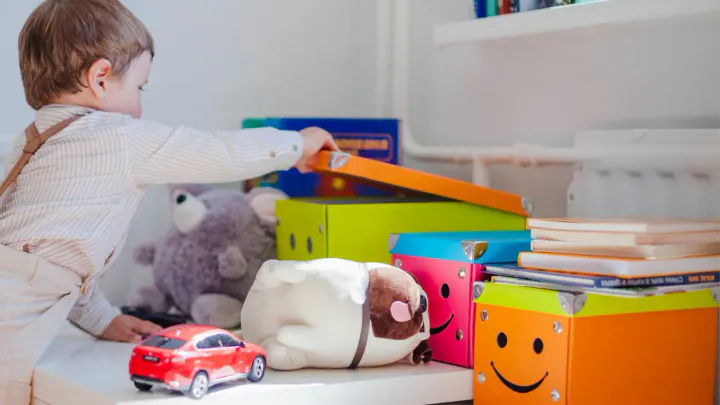
TL;DR: Good toy storage is not about buying more containers. Pick open, low, labeled storage the child can use without help, cap the number of categories at what they can name, rotate the surplus out of sight, and anchor anything tall. Do that and cleanup becomes a two-minute habit instead of a nightly argument.
A toy storage system is an organized set of containers, shelves and routines that gives every toy a fixed, reachable home so a child can both find it and return it independently. That last word does the heavy lifting. Most storage fails not because the bins are wrong but because the system quietly assumes an adult will be running it forever.
Why does toy storage keep failing in our house?
Toy storage usually fails for one of three reasons: the container is harder to open than the floor is to drop things on, the categories are too abstract for the child, or the storage sits above their reach. A four-year-old will not lift a heavy hinged lid, and they will not sort "pretend play" from "manipulatives."
Our rule of thumb is the one-motion test. If putting a toy away takes more than one motion — lift lid, hold lid, drop toy, lower lid — the child will skip it. Open baskets, tilt bins and shallow drawers pass. Latching boxes on a high shelf do not.
The second failure is volume. Storage cannot solve a quantity problem. If the toys do not fit in the containers when everything is put away correctly, the system is over capacity and no amount of reorganizing will hold.
Which type of toy storage should I buy for my space?
Match the storage to the room and the child's age, not to a photo. Cube units work in dedicated playrooms, dual-purpose furniture works in shared living rooms, and vertical solutions work in rentals and small apartments where the floor is already spoken for.
| Storage type | Typical cost | Best for | Child can use alone | Main drawback |
|---|---|---|---|---|
| Clear stackable bins | Low | Small parts, craft supplies, closet storage | Yes, if unstacked and at floor level | Stacking blocks access to lower bins |
| Cube unit with fabric bins | Low to mid | Playrooms, bedrooms, mixed display and storage | Yes | Must be anchored; bins hide contents |
| Storage ottoman or bench | Mid | Living rooms and shared spaces | Only with a safe lid support | Becomes a junk pit fast |
| Under-bed rolling drawers | Low | Rotation stock, seasonal and bulky items | Yes, from about age four | Needs clearance and a hard floor or wheels |
| Over-the-door pocket organizer | Very low | Figures, cars, dolls, dress-up accessories | Top rows only for adults | Low weight limit; visual clutter |
| Wall pegboard or rail system | Mid | Renters with wall permission, art supplies | Yes | Installation time; not for heavy items |
| Bookcase with baskets | Mid | Books plus two or three toy categories | Yes on lower shelves | Tip-over risk if unanchored |
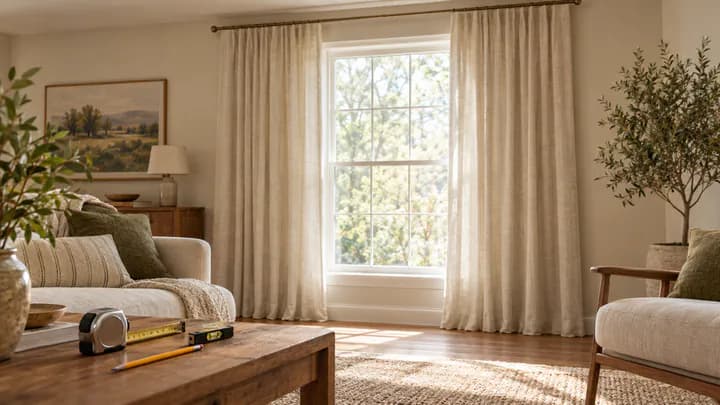
If you are furnishing a whole room rather than solving one corner, the same logic that drives a calm, functional bedroom refresh applies here: fewer, larger pieces that do more than one job beat a scatter of small accessories.
How do I decide what counts as a category?
Use categories your child would say out loud. "Cars," "animals," "blocks," "drawing stuff," "the dinosaur guys." Adult taxonomies like "fine motor" or "open-ended play" are invisible to a five-year-old and guarantee mis-sorts.
Cap the count at what they can list from memory. A toddler manages three or four bins. A preschooler handles five to eight. A seven-year-old can run a dozen if the labels are clear. Anything beyond that is storage for your benefit, not theirs.
One useful exception: give sets with many pieces their own dedicated closed container. Building bricks, magnetic tiles, train track and small doll accessories should never share a bin with anything else, because a single mixed bin is how a 200-piece set becomes unplayable.
How does a toy rotation system actually work?
Toy rotation means keeping only a portion of the collection accessible and storing the rest out of sight, swapping sets in and out on a schedule. In practice: divide toys into three or four roughly equal groups, put one group on the shelves, box the others, and swap every one to three weeks.
A worked example from a typical 900-square-foot apartment: forty-odd toys, four bins out at a time holding about twelve items, three labeled boxes on a closet shelf holding the rest. Sunday evening swap, five minutes. The mess shrinks because there is physically less to spill, and old toys come back looking new.
Three items stay out permanently regardless of rotation: the current comfort object, the child's favorite building set, and books. Rotating any of those three creates conflict that outweighs the tidiness gain.
This does not apply if your child builds long-running projects — an elaborate track layout, an ongoing doll-house narrative — or if predictable access to specific objects is part of how they self-regulate. For those kids, a stable open shelf beats rotation every time.
What safety checks matter with kids' storage furniture?
Two hazards dominate: tip-overs and lids. Anchor every bookcase, cube unit and dresser to a wall stud with the hardware supplied — children climb open shelving, and a loaded unit can come down fast. Anchoring takes about ten minutes and is the single highest-value thing on this list.
For lidded chests, look for a slow-close lid support that holds the lid at any position, plus ventilation gaps in case a child climbs inside. Safety guidance in the US has long pointed families toward exactly these features, and lidless bins or open baskets remain the simplest option for children under four.
Other checks worth a minute each:
- Keep small-parts sets on high shelves if a younger sibling is in the choking-hazard stage — mixed-age homes are where most sorting systems break down.
- Skip glass or hard-edged decorative containers at floor level.
- Check that rolling under-bed drawers cannot be pulled out and climbed on.
- Avoid hanging heavy organizers on hollow-core doors beyond their stated weight limit.
What are the most expensive toy storage mistakes?
The costliest mistake is buying storage before decluttering. Containers bought to fit a collection you were about to shrink become their own clutter, and matching sets are rarely returnable once assembled. Sort first, measure second, buy third.
The second is buying deep containers for shallow toys. A 14-inch-deep bin holding action figures turns into an archaeological dig; nothing below the top layer gets played with. Depth should roughly match the tallest item in the category.
The third is the single giant toy box. It looks tidy for about four minutes, guarantees every set gets mixed, and trains children that "cleanup" means "shove everything into a hole." If you already own one, retire it to rotation stock in a closet.
And the fourth is spending on storage before you have a budget line for it. A full playroom system can run into real money once you add shelving, bins and labels. If you plan to do it properly, treating it like any other planned household purchase beats buying it in impulsive pieces. Nothing here is financial advice; it is just cheaper to plan than to improvise.
How do I label bins for a child who cannot read yet?
Photograph the actual contents and tape the photo to the front of the bin. A real photo of your child's own blocks outperforms a generic clip-art icon because there is no interpretation step. Laminate or use clear packing tape so labels survive handling.
Add the written word underneath the picture. Pre-readers use the image, emerging readers start matching the text, and the label keeps working for years. For older kids, let them write the labels themselves — ownership of the label strongly predicts use of the bin.
Keep the labels honest. If the "animals" bin has quietly become the miscellaneous bin, relabel it or empty it. A label that lies is worse than no label.
How do we make cleanup an actual routine?
Anchor cleanup to an existing daily transition — before dinner, before bath, before the bedtime story — so it never needs to be negotiated. Two short resets a day beat one long one, because the pile never reaches the size that triggers overwhelm.
Give the instruction in categories, not in totals. "Put the cars away" is actionable; "clean your room" is not. For younger children, work alongside them and narrate what you are doing; parallel cleanup is far more effective than supervision from the doorway.
A few tactics that hold up over time:
- Timer sprints. Four minutes, everyone works, stop when the timer stops even if it is not finished.
- One-in, one-out at holidays. Before new toys arrive, the child chooses items to pass along. They choose, not you.
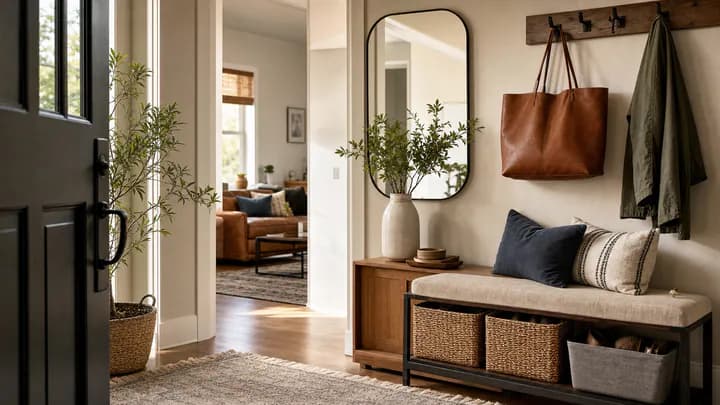
- A landing basket by the door. Toys migrate; a catch basket in the hallway stops the drift and gets emptied nightly. Our notes on making a small entryway work hard cover the same containment principle for shoes and bags.
- Quarterly audit. Broken, incomplete and outgrown items leave. Fifteen minutes, four times a year.
Key takeaways
- Storage only works if the child can use it unassisted: open containers, low shelves, one-motion returns.
- Cap categories at the number your child can name from memory, and give many-piece sets their own dedicated container.
- Rotate the surplus out of sight in labeled boxes — but skip rotation for comfort objects, favorite building sets and books.
- Anchor every tall unit to the wall and choose lidless bins or slow-close lid supports for young children.
- Declutter before you buy anything, and match container depth to the tallest item inside.
- Attach cleanup to an existing daily transition and give instructions by category, never "clean your room."
Frequently asked questions
What is the best toy storage for a small apartment?
Vertical and dual-purpose storage wins in small apartments: a storage ottoman or bench in the living room, an over-the-door pocket organizer for small figures, and two or three shallow under-bed drawers. Avoid deep toy chests, which eat floor space and hide toys so completely that kids stop using them.
How many toy bins should a child have?
Roughly one bin per toy category the child can name — usually five to eight for a preschooler. If you need more than about ten categories, the collection has outgrown the space and it is time to rotate or donate rather than buy more containers.
Does toy rotation actually help?
Toy rotation helps most families because fewer visible options reduce decision overload and make cleanup a two-minute job rather than a twenty-minute one. Parents commonly report longer, deeper play sessions, though children who build elaborate ongoing projects, or who are autistic and rely on predictable access, may do better with a stable open shelf.
Are toy chests safe for toddlers?
A toy chest is only safe if the lid has a slow-close support that holds it open at any angle and ventilation holes in case a child climbs inside. Lidless bins or open baskets are the safer default under age four, and any tall storage unit should be anchored to the wall.
How do I get my kids to actually put toys away?
Make the return trip easier than the mess: open bins instead of lids, picture labels instead of words, and storage placed at the child's shoulder height or below. Then run a short, predictable cleanup at the same point every day rather than one long reset on the weekend.
What should I do with toys my kids have outgrown?
Sort outgrown toys into donate, pass-along and recycle, and check that donated items are complete, clean and not under recall. Many shelters, preschools and community reuse groups accept sturdy plastic toys and complete puzzles, while stuffed animals and anything battery-powered are harder to rehome.