The Woman Who Ironed Other People's Shirts
In a laundromat above the river, Odile presses shirts for strangers and reads their week in the wrinkles. Then a shirt arrives with no name pinned to its collar.
Drafted with AI and published automatically. Our editors set the standards and fix reported errors — how we work.
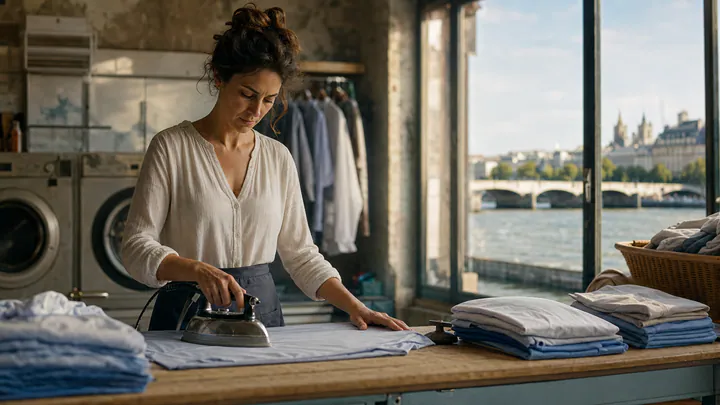
The first thing Odile did every morning, before she even filled the boiler, was press her palm flat against the ironing board and apologize to it for the day ahead. The board never answered, but she felt it warm slightly beneath her hand, the way a cat leans without turning its head.
Her shop sat on the second floor of a narrow building above the river, reached by a staircase that smelled of soap flakes and rain. A hand-lettered sign in the window read Odile — Shirts Pressed, Collars Turned, Cuffs Kept Honest. She had painted it herself the year her husband left, and she had never once considered painting it over.
People brought her their shirts the way other people brought priests their sins. A widower from the bakery downstairs left his Sunday oxford every Friday, folded so carefully it looked embarrassed. A young accountant with tired eyes dropped off five identical white shirts each Monday and never made small talk. A boy of about seventeen came with his father's dress shirts and stood in the doorway as if unsure whether he was tall enough yet to hand them over.
Odile took them all. She pinned a paper tag to each collar with the owner's name and the day it was needed, and then she began to read.
She had never told anyone she could do this. It was not the kind of thing you announced. But wrinkles, she had learned, were a language. A shirt worn to a difficult dinner creased differently than one worn to a promotion. Grief gathered under the arms. Hope stiffened the front placket. A shirt that had been slept in by accident had a soft, apologetic collapse across the shoulders, while a shirt slept in on purpose — after a long night, a lost argument, a phone call that changed a life — held its shape like a held breath.
She read them, and then she pressed them flat, and the week went out of them into the steam.
The Shirt With No Name
On a Tuesday in early autumn, a shirt arrived that had no tag.
Odile found it in the wicker basket by the door when she came up from buying bread. Pale blue, cotton, size medium, a small ink stain on the inside of the left cuff where a pen had leaked long ago. No note. No name pinned to the collar. No indication of when it was wanted back.
She held it up to the window. The light came through it the way light comes through a letter you have not yet decided to open.
She laid it on the board.
The wrinkles were unlike any she had read before. There was no grief in the shoulders, no triumph in the sleeves. Instead there was a strange, waiting quality across the whole garment, as if the shirt had been folded and unfolded many times by someone rehearsing a decision. Along the hem, a soft repeating crease, the kind made by hands smoothing the same spot again and again. Down the front, faint parallel lines where the shirt had been clutched, released, clutched again.
Odile set the iron down without turning it on.
She sat in the wooden chair by the window and looked at the shirt for a long time. Outside, the river carried its slow brown business past the bakery, past the bridge, past the bench where children fed ducks in defiance of a sign asking them not to.
Whoever owned this shirt had not brought it to be pressed. They had brought it to be considered.
The bell rang downstairs at four. Odile heard footsteps on the staircase, slower than the accountant's, heavier than the boy's. A man appeared in the doorway with his hat in his hand — a stranger, mid-fifties, the kind of face that had spent a great deal of its life being polite in rooms where politeness was not returned.
"I left a shirt this morning," he said. "Blue one. I didn't know if — I didn't fill out a tag."
"I have it," Odile said.
He nodded, relieved, and then did not move.
She waited. She had learned, over the years, that people who climbed her staircase often needed a pause at the top before they could say what they had come to say.
"I was going to wear it tomorrow," he said finally. "To see someone. Someone I haven't seen in a long time." He turned the hat in his hands. "I've been carrying the shirt around in a bag for six days. I keep taking it out and putting it back. I thought maybe if I left it with someone else for a night, I'd — I don't know. Decide."
Odile looked at him. He had the same waiting quality as the shirt.
"Would you like tea?" she said.
He blinked, then nodded. She put the kettle on the little burner by the sink and took down two cups that did not match. When she handed him his, she saw that his hands trembled slightly, and that he was ashamed of the tremble, and that the shame was older than the tremble by many years.
"My daughter," he said, without being asked. "She wrote to me. After — a long time. She said I could come, if I wanted. She didn't say I should."
"That's a hard word to be missing," Odile said.
"Yes."
They drank their tea. The iron cooled on the board. On the counter, the pale blue shirt lay with its cuffs open like a pair of listening ears.
After a while Odile stood up and plugged the iron in again. She did not ask his permission. She sprinkled the shirt with water from the little brass bottle she had used for thirty years, and she began to press.
She did not press the waiting out of it. She had never been able to do that, no matter what her neighbors sometimes imagined. What she could do was press the waiting flat — smooth it into something a person could put on without flinching, something that would not tell on him the moment his daughter opened the door.
The steam rose. The man watched, his cup empty, his hat forgotten on his knee.
When she finished, she slid the shirt onto a wooden hanger and held it out to him.
"It won't decide for you," she said.
"I know."
"But it will fit," she said, "either way."
He took it. At the top of the staircase he paused, the shirt over his arm, and looked back at her the way people look back at lighthouses when they are already at sea.
"What do I owe you?" he asked.
Odile considered. Outside, the river kept moving. Downstairs, the baker was pulling the last loaves. Somewhere in the town, a daughter was, or was not, setting an extra plate.
"Come back and tell me how it fit," she said.
He promised he would, in the careful voice of a man who had broken promises before and intended not to break this one. Then he went down the stairs, and the bell rang once, and the shop was quiet again.
Odile turned back to the board. She laid her palm flat against it and felt it warm, faintly, the way it always did. There were four shirts still waiting in the basket, each with a name pinned to its collar, each with a week folded into its sleeves.
She picked up the iron. There was, as always, more day than she had hands for, and she was grateful, as always, for the work.