The Radio Host Who Took Calls from Nowhere
On the graveyard shift at a small AM station, a lonely host answers a call that shouldn't exist. What follows is a strange, tender correspondence across the static.
Drafted with AI. This version has not been reviewed by an editor, so it carries no ads — how we work.
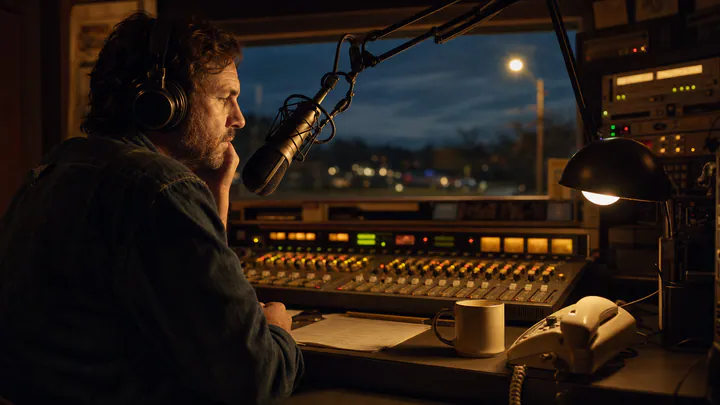
The call came in at 3:14 a.m., which was the exact minute Marisol had decided, once again, to quit her job. She had her thumb on the fader when line three lit up like a small green heart, and because she was a person who could not leave a phone unanswered, she picked up.
"KRSN overnight," she said, in the voice she used on air — softer than her real one, like a coat left on a chair. "You're on with Marisol. What's keeping you up?"
There was a hiss, a hum, a distant tin sound, as if the caller was standing inside a bell.
"Hello?" she said. "Take your time."
A woman's voice arrived, warm and slightly out of tune with itself, as though it had traveled a long way to get to the phone. "Is this the station on Ridge Road?"
"That's us," Marisol said. "Studio B. The one with the busted vending machine."
The woman laughed. It was such a real laugh, so unguarded, that Marisol felt her shoulders lower for the first time all night. "I used to work there," the woman said. "A long time ago. I wanted to tell you — you're doing fine."
"Oh," said Marisol, because she didn't know what else to say. Then, because the woman seemed to want more: "I don't feel fine."
"I know," the woman said. "That's why I called."
KRSN broadcast out of a squat brick building at the edge of a town that had been slowly leaving itself for thirty years. The signal reached farms, a truck stop, the parking lot of a hospital, and — on cold nights — a stretch of highway where drivers said the songs came in clearer than their own thoughts. Marisol had grown up listening to it under her pillow. Now she ran the graveyard shift alone, spinning a rotation of soft rock and reading community notices between commercials for feed stores that had closed.
She was twenty-nine and quietly heartbroken in the way people are when nothing dramatic has happened; the person she'd expected to marry had simply drifted, like a boat whose rope had frayed a fiber at a time. She had not told anyone. Overnight radio was a good place to not tell anyone anything.
The woman on line three said her name was Enid.
"Enid," Marisol repeated. "That's a pretty name. You don't hear it much anymore."
"You don't," Enid agreed, pleasantly. "Would you play something for me? I've been away a while."
"Anything you want."
Enid asked for a song Marisol had never heard of, by a singer whose name she also didn't recognize. She searched the digital library. Nothing. She checked the wall of old vinyl behind her — hundreds of records the station had inherited from previous eras — and there, on a shelf she had never bothered with, was the album, its sleeve soft with age.
"Found it," Marisol said, surprised.
"I knew you would," said Enid.
Marisol cued the record. When she came back on the line, Enid was gone. Just static, and the polite click of a phone hung up gently.
Line Three
The next night Enid called at 3:14 again.
"You're back," Marisol said, and was embarrassed by how relieved she sounded.
"I liked the way you introduced the song," Enid said. "You said, 'This one's for a friend.' I've never been called a friend on the radio before."
They talked for nine minutes between ad breaks. Enid asked what Marisol had eaten for dinner (a cold slice of pizza standing at the sink) and whether the maple out front still dropped its keys all over the parking lot in April (it did). She asked if the studio still smelled like carpet glue and cough drops. Marisol laughed and said yes, exactly that, how did she know.
"I told you," Enid said. "I worked there."
"When?"
There was a pause that was not quite static. "A while."
Marisol should have pressed. Instead she said, "Tell me something you learned here."
Enid thought about it. "I learned that people call the radio at night because they want a stranger to know they exist. And I learned that the person on the other end needs that too, even if she pretends she's just doing her job."
Marisol didn't answer for a long moment. On the board, the levels swayed. Somewhere out on the highway, someone was driving through her voice.
"Enid," she said. "Can I ask — where are you calling from?"
"Somewhere quiet," Enid said. "Play me another one, would you?"
It went on like that for eleven nights. Enid always called at 3:14. She requested songs Marisol had to hunt down in the vinyl stacks, and every time, the record was there, dusty and patient. Between songs they talked about small things: a recipe for lemon bars, a way to fold a fitted sheet, the trick of forgiving a person who had not asked to be forgiven.
On the twelfth night, Marisol brought a flashlight and went into the back office, where the station's history was stored in cardboard boxes labeled in three different people's handwriting. She was not sure what she was looking for until she found it: a staff photo from 1974, six people in wide collars standing in front of the same brick wall she leaned against every night to smoke the cigarettes she was trying to quit. On the back, in blue ballpoint, someone had written the names. The third from the left was Enid Marsh, overnight host.
Under the photo was a folded clipping. Enid Marsh had died in 1981, at forty-two, of something the obituary called a long illness in the delicate language of the time. She had, the paper said, hosted the overnight program at KRSN for eleven years, and was known for taking calls from anyone, at any hour, about anything at all.
Marisol sat on the floor of the back office and cried in a way she had not let herself cry in months. It was not fear. It was closer to being recognized.
That night, at 3:14, line three lit up.
"Enid," Marisol said, before the woman could speak. "I know."
The static softened, as if a hand had been laid on it.
"I thought you might," Enid said. "I hoped you would."
"How is this happening?"
"I don't entirely know," Enid said. "I think the signal keeps some of us. The nights are long and the tower is tall, and someone has to talk to the drivers." She paused. "Someone had to talk to you."
Marisol pressed her palm flat on the console. "I was going to quit," she said. "Tonight was going to be my last shift."
"I know."
"Should I?"
"Oh, sweetheart," Enid said, and the endearment was so unselfconscious it undid something. "That's not mine to say. But if you stay — even a little longer — I'd like to keep listening. I get very good reception on your voice."
Marisol laughed, wet and surprised. "That's the corniest thing anyone's ever said to me."
"I hosted overnight radio for eleven years," Enid said. "Corny is the whole job."
They talked until 3:59, when the automated news would cut in. Before she went, Enid asked Marisol to play one more song — not one of the old ones, this time. Something Marisol loved. Marisol chose a track she had been saving for a night that felt worth it.
"This one's for a friend," she said into the microphone, and out along the highway, and over the sleeping farms, and into whatever quiet place Enid was calling from, the music went.
She did not quit. Not that night. The vending machine stayed broken. The maple kept dropping its keys. And every so often, on the very late shift, line three would light up green as a small heart, and Marisol would smile before she picked it up, because she already knew who was there.