The Night Switchboard of Halden Street
On the third floor of a building nobody visits, an old switchboard still rings at 2 a.m. — and one exhausted operator has started answering.

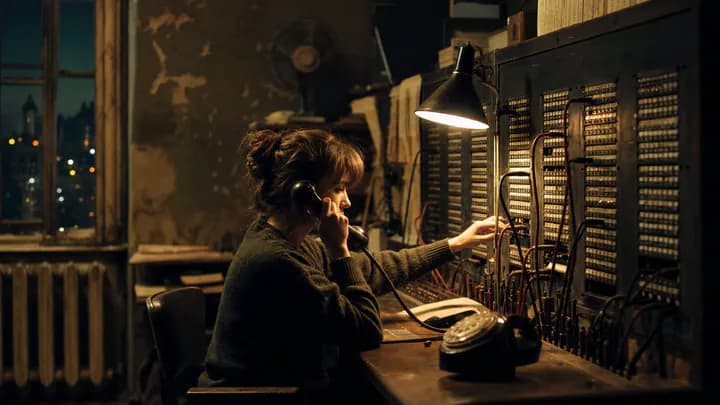
The switchboard rang at 2:04 a.m., which was a problem, because the switchboard had been disconnected in 1994. Mira looked up from her thermos and watched the small brass light blink above socket seven, patient as a heartbeat.
She was the only person on the third floor of the Halden Building. She was, most nights, the only person in the Halden Building. Her official job was to sit at the front desk downstairs and make sure the elevator didn't do anything alarming between midnight and six. She was not, technically, supposed to be up here at all.
But the switchboard had rung last Tuesday too. And the Tuesday before.
The first time, she'd assumed a mouse. The second time, a short in the wiring. The third time, she'd climbed onto the operator's stool, put on the headset that smelled like attic and lemon polish, and pushed the jack into socket seven before she could talk herself out of it.
“Halden exchange,” she'd said, because that was written on a laminated card taped above the panel, in handwriting older than she was.
A man had answered. “Oh, thank god. I've been trying for ages.”
She had hung up so fast the jack popped out of its own accord.
Tonight she was ready. She had a notebook. She had a pen that worked. She had told herself, on the walk from the bus stop, that she was a rational adult with a lease and a dentist and no time for a haunting.
The light blinked. Mira climbed the stool. She pushed the jack home.
“Halden exchange.”
“You came back.” The same voice. Warm, tired, faintly amused. A voice like someone who'd been reading in a chair too long. “I was worried I'd frightened you off.”
“Who is this?”
“Ambrose. I'm calling from — well, that's the difficult part, isn't it.”
“Try me.”
There was a pause. In it, Mira could hear a clock ticking on his end, and something else — the small sigh of a radiator, or the sea. She couldn't tell.
“I'm calling from a Thursday,” Ambrose said. “March, I think. 1962. Would that be a problem for you?”
Mira wrote 1962 in the notebook and underlined it, because she needed something to do with her hand.
“Not a problem,” she said carefully. “Just unusual.”
“For me too. The line's normally dead. I've been picking it up every night for months, just to hear the hiss. My wife says it's morbid.”
“Then why do it?”
“Because it used to ring,” he said. “And I miss the ringing.”
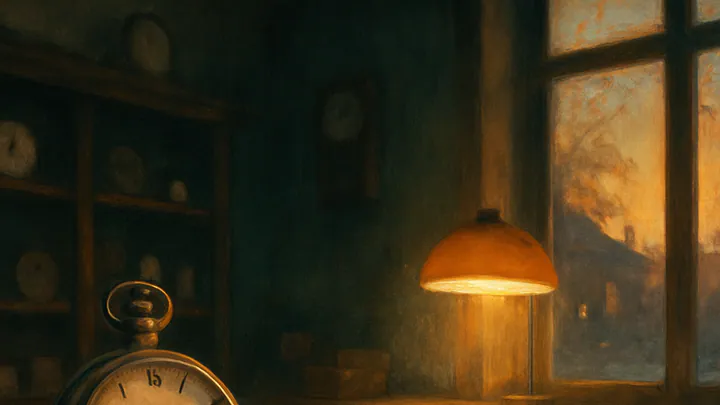
Mira looked around the empty room. Dust hung in the desk lamp's cone of light like something suspended in amber. The building above her groaned once, a settling sound, the way old buildings talked to themselves.
“What do you want me to say, Ambrose?”
“Nothing in particular. It's nice to have someone on the other end.”
They talked, that night, about small things. He was a bookkeeper for a wholesaler that sold ribbon by the mile. He had a daughter, Iris, who was learning the violin badly and with great commitment. His wife baked, but only when she was angry, so the house always smelled either wonderful or dangerous.
Mira told him about her apartment, which had one window that faced a wall, and about her sister in another city who kept sending her links to jobs that paid more but sounded worse. She did not tell him about the letter in her coat pocket, which offered her one such job, and which she had been carrying around for eleven days without answering.
“And you sit alone in a building all night,” Ambrose said. “On purpose.”
“It's peaceful.”
“It's hiding.”
“You've known me forty minutes.”
“I've known people my whole life who hide,” he said. “It's not a hard shape to recognize.”
She almost hung up again. Instead she said, “Tell me about Iris.”
So he did.
The Second Week
The board rang every night now, always at 2:04. Mira began bringing two thermoses. She learned that Ambrose whistled when he was thinking, and that he took his tea with too much milk, and that his favorite word in English was threshold, because it sounded like what it meant.
She learned that his wife's name was Edith, and that Edith knew about the phone calls, and did not mind them, which surprised Mira until Ambrose explained.
“She was sick last winter,” he said. “Very sick. She came back to us, but she says the world feels thinner now. She says of course the phone rings. Of course people call across. She's not troubled by it. She's troubled by the price of coal.”
“Ambrose,” Mira said, one night, “why do you think it's me? Why this line, why now?”
“I don't think it's anything,” he said. “I think a wire got lonely.”
“That's not an answer.”
“It's the only one I have.”
On the fourteenth night she brought the letter. She read it to him, the whole thing, the salary and the office tower and the title that sounded like a piece of furniture. When she was done, there was a long quiet, and then the sea-sound of his radiator.
“Do you want it?” Ambrose asked.
“I want to want it.”
“That's a different animal entirely.”
“Everyone I know would take it.”
“Everyone I know is dead,” Ambrose said mildly, “from where you're sitting. So I'd be careful about polling.”
She laughed, which she had not expected to.
“What did you want, at my age?” she asked. “When you were deciding things.”
He was quiet for a while. She could hear him tapping the receiver, the way people did when they were choosing.
“I wanted,” he said finally, “to be the sort of man someone would pick up the phone for. That was all. Everything else I did was in service of that, whether I knew it or not.”
“And are you?”
“You tell me. You're the one who answered.”
Mira did not take the job. She wrote back the next morning, a polite short letter, and put it in the mailbox on the corner before she could reconsider. Then she slept until three in the afternoon and woke feeling like a person again.
That night the switchboard did not ring at 2:04. She waited until 2:30, then 3:00, then dawn, the notebook open in her lap. Nothing. Only the building talking to itself, and the elevator humming its patient hum.
She thought, at first, that she had lost him. Then she thought about what Ambrose had said about wires getting lonely, and she understood, the way you understand a thing without being told: the line had rung because she'd needed it to. Now she didn't. Somewhere in a Thursday in 1962, a bookkeeper had put down the receiver and gone to hear his daughter murder a sonata, and it was all right.
Mira unplugged the headset and set it gently on its cradle. She climbed down from the stool. On the laminated card above the panel, in that old careful hand, someone had written the instructions for connecting a call, and at the bottom, almost as an afterthought: Always thank the caller.
“Thank you,” she said, to the empty room, and meant it, and went downstairs to start her shift.
Frequently asked questions
What do you think the switchboard actually represents in Mira's life?
The switchboard functions less as a supernatural object and more as a permission slip. It offers Mira contact without stakes, which paradoxically becomes the safe space where she can finally hear her own thinking clearly.
Why does the story never explain how the line works?
The refusal to explain is part of the story's argument. Ambrose's line — 'a wire got lonely' — insists that some connections don't require mechanism to be real, and demanding an explanation would flatten the tenderness the story is built on.
How does Edith's brief presence change the emotional weight of the story?
Edith grounds the magical premise in domestic reality. Her calm acceptance that 'the world feels thinner now' suggests that ordinary life already contains these openings, and that grief and recovery can widen them without making them frightening.
Do you read the ending as a loss, a gift, or both?
It reads as both, which is what makes it feel earned. Mira loses the nightly ritual that comforted her, but she loses it because she no longer needs it, and the story trusts the reader to sit with that mixed feeling rather than resolve it.