The Understudy at the Rialto Cinema
When the projectionist at a failing single-screen cinema falls ill, his teenage niece takes the booth for the night — and discovers the reels have opinions of their own.
Drafted with AI and published automatically. Our editors set the standards and fix reported errors — how we work.
The call came in during algebra, which was fitting, because algebra was already something Neve was failing to solve. Her uncle's voice on the other end was thin as tea. "Kid," he said, "I need you at the booth by seven. I'm on the bathroom floor and I am not, at present, planning to get up."
Uncle Rem ran the Rialto, the last single-screen cinema in a town that had stopped needing one. He had run it for thirty-one years, which was longer than Neve had been alive, longer than her mother had been dead, longer than most of the seats had held their springs. On Fridays he showed something old. On Saturdays he showed something older. Nobody came except the widow Halloran, who brought her own pillow, and a rotating cast of teenagers who wanted somewhere dark to hold hands.
"You want me to run the projector," Neve said. She was standing in the hallway now, phone pressed to her ear, backpack half open.
"I want you to feed the reels, keep the sound honest, and lock up at eleven," Rem said. "I've shown you a hundred times."
He had shown her twice. Neve had been fourteen and bored, and the second time she had burned her wrist on the lamp housing and decided cinema was not for her. She was sixteen now, which meant she had accumulated an extra two years of pretending things weren't scary.
"Fine," she said. "What's playing?"
There was a long pause on the line. Long enough that she thought he'd fainted.
"That," Rem said carefully, "is a conversation for when you get there."
The Booth
The Rialto smelled the way it always smelled: warm dust, old butter, and the faint mineral breath of a building that had learned to sweat through its plaster. Neve climbed the narrow stairs to the projection booth, which was smaller than her bedroom and hotter than an argument. The two projectors sat like sleeping horses. On the workbench, a note in her uncle's spidery hand:
Neve — Tonight is The Blue Hour, 1953. Reels are already loaded. DO NOT try to change what it wants to show. Just let it run. Lights down at 7:02. — R.
She read the note twice. She read it a third time, in case the second reading had been a hallucination brought on by the smell of ozone.
"Let it run," she said aloud. "Okay. Sure. Normal projectionist instructions."
At two minutes past seven she killed the house lights, thumbed the first switch, and heard the familiar clatter of a projector waking up. Down in the auditorium, six people had shown up — the widow Halloran with her pillow, a boy and a girl trying to look older than they were, and three men in identical grey coats sitting far apart from one another, as though they had been placed there by a stagehand.
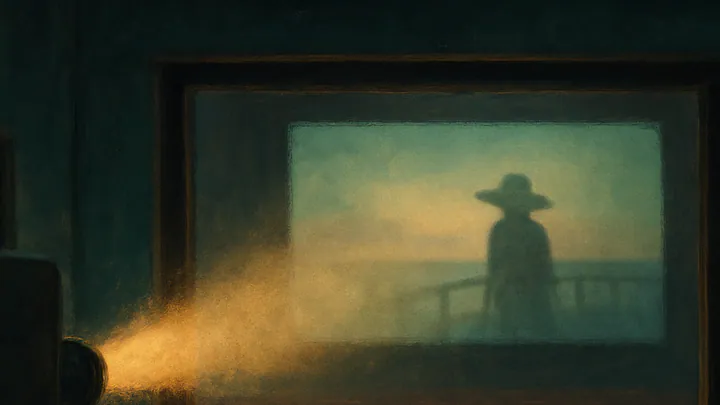
The film began. A woman in a wide hat walked along a pier. A gull crossed the frame. A title card read, in confident white script: The Blue Hour.
Neve exhaled. She had, apparently, not broken cinema.
Then, forty seconds in, the woman on the screen stopped walking. She turned, slowly, and looked directly out of the frame — not at the audience, exactly, but past them, toward the booth. Toward Neve.
"You're new," the woman said.
Neve's hand jerked toward the reel. She stopped herself. Do not try to change what it wants to show.
The woman on the screen tilted her head. "Rem's ill, then. It was going to happen. He's been tired a long while." She adjusted her hat. "Well. What shall we run tonight, dear?"
Neve looked at the reel spinning obediently. She looked at the six people in the audience, none of whom seemed alarmed. The widow Halloran was, if anything, nodding as though this were the part she came for.
"I," said Neve, "was told not to try to change what it wants to show."
"That's Rem being cautious," the woman said. "He never asks. He just runs the film I was made to be. Have you ever seen The Blue Hour?"
"No."
"Nobody has, in years. It isn't very good." The woman smiled, and it was a real smile, small and tired. "Ask me for something else. Anything you like. I have a lot of hours in me."
The Request
Neve leaned closer to the small square window that looked down into the auditorium. The projector hummed. The reel turned. On screen, the woman waited, patient as weather.
Neve thought about her mother, who had loved a film about a girl who ran away to join a travelling circus, and who had described it so many times, in such detail, that Neve had eventually stopped asking to actually see it, because she was sure the real thing could only disappoint. Her mother had died when Neve was nine. Neve did not remember the name of the film. She had spent a not-small part of her adolescence pretending she did not want to.
"There was a movie," Neve said, "about a girl and a circus. My mother loved it. I don't know what it's called."
"When did she see it?"
"I don't know. Before I was born. She was maybe twenty."
The woman on the screen closed her eyes. For a moment the film seemed to hold its breath — the gulls froze mid-cry, the pier stopped creaking. Then the woman opened her eyes and said, "I have it. It isn't the one she thought it was. She had mixed two together in her memory. Do you want the one she watched, or the one she remembered?"
Neve's throat did an inconvenient thing.
"The one she remembered," she said.
The woman nodded once, and stepped out of frame.
What played next, Neve could not later describe with any accuracy, which is how she knew it was true. There was a girl. There was a red tent. There was a man who juggled apples and gave one away at the end. There was a train that left at a station her mother had once mentioned by name — a station that did not, Neve was fairly certain, exist. The widow Halloran was crying softly into her pillow. The boy and the girl in the middle rows had forgotten to hold hands and were instead simply watching. The three grey-coated men sat very still, as though something they had been owed for a long time was finally being paid.
When the reel ran out, the auditorium lights came up on their own. Nobody clapped. Clapping would have been the wrong shape for it. The six people filed out into the lobby, and the widow Halloran paused at the foot of the booth stairs and called up, "Tell Rem the understudy did fine."
Neve locked up at eleven, exactly as instructed. On the workbench she found a second note, in handwriting that was not her uncle's — rounder, older, written in pencil that smelled faintly of the sea.
Thank you for asking. He never does. — B.H.
She folded it into her pocket and walked home under a sky the colour of an old screen just before the picture starts, and for the first time in a long time she did not mind not knowing what came next.