The Radio Host Who Broadcast to No One
For twelve years, Odalys hosted a graveyard-shift radio show she was certain nobody listened to. Then a letter arrived on onionskin paper, addressed only to the voice at 3 a.m.
Drafted with AI and published automatically. Our editors set the standards and fix reported errors — how we work.
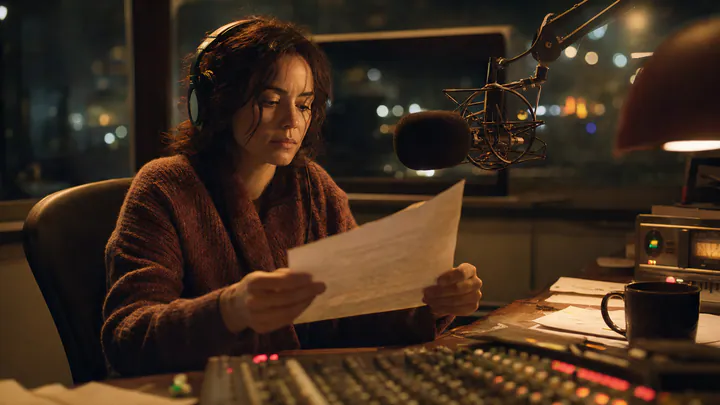
Odalys signed on at 1 a.m. the same way she had for twelve years: with a soft cough, a sip of yerba mate gone cold, and the sentence, Good morning to whoever is out there, if anyone is. The transmitter hummed its old dog hum, and the VU meter twitched once, politely, like it was humoring her.
The station sat above a shuttered pharmacy on a street that had lost its stoplights to budget cuts. From the booth window she could see the mountain, or the shape where the mountain would be if it weren't three in the morning and cloudy. She played a bolero. She read the weather. She said, without irony, Stay warm, wherever you're listening from, because the word wherever was easier than admitting she suspected the answer was nowhere.
The ratings company had stopped calling six years ago. The station manager, Beto, kept her on because her segment cost almost nothing and because his wife liked the theme music. Odalys knew this. She was fifty-eight years old and had made peace with being a lullaby for one insomniac accountant in a house she would never see.
That Tuesday, the envelope was already tucked under the studio door when she arrived.
The Letter
It was onionskin, the kind of paper she hadn't touched since her mother's aerograms from the coast. No stamp. No return address. Just her name — Odalys Herrán, Overnight — in a hand so careful it looked drawn rather than written.
She opened it in the booth while a ranchera played itself out.
Señora Herrán,
I have been listening for eleven years. On the night my brother did not come home from the quarry, you played the song about the paper boats, and I understood that someone in the world knew I was awake. I have wanted to write ever since. I do not want anything from you. I only wanted you to know the chair is not empty.
— A Listener
Odalys read it three times. Then she read it a fourth, because the fan on the transmitter had started to sound like a person breathing and she wanted to be sure she wasn't inventing things.
She set the letter on the console and, without meaning to, spoke into the microphone.
“To whoever left the note,” she said. “Thank you.”
Then, because the silence after felt enormous, she played the paper-boat song again.
She told no one. Beto would have made a whole promotion out of it — The Ghost Listener Speaks! — and she wanted the letter to belong to her, and to the writer, and to the twelve years of dark air she had been pouring into a bottle without a cork.
The next week, another envelope. Same paper.
The song about paper boats again. You should not have done that. Now I am crying at the kitchen table and the dog thinks I have gone soft. Please play something absurd next. A polka. A jingle for a soap that does not exist.
Odalys laughed out loud, alone, at 2:47 a.m. She rummaged through the vinyl closet until she found a scratched polka from a wedding compilation and cued it up. Halfway through, she leaned into the mic and improvised a commercial for a soap called Luna Blanca, which promised to wash away regrets but only the small ones, because the big ones were load-bearing.
The letter that came the following week said only: Sold out. Send more.
The Chair That Was Not Empty
They went on like this through the fall. Odalys began to plan her shows the way one plans a dinner for a friend with strong opinions and a good sense of humor. She read poems she had been embarrassed to like. She interviewed herself as a fictional beekeeper from a fictional town. She did a whole hour of songs that had the word almost in the title, and the letter that followed said, Cruel. Beautiful. Do it again in spring.
She never asked who the listener was. It seemed like the wrong question, the kind that would break the spell in the way opening the oven breaks a soufflé. But she found herself, in the daytime, looking at strangers differently. The man buying bread. The woman waiting for the bus with a thermos. Any of them might have been the one whose chair was not empty. Any of them might have been the reason she had kept showing up.
In February, the letters stopped.
Odalys told herself not to panic. People got busy. People moved. People, sometimes, simply decided they had said what they needed to say. She kept broadcasting. She played the paper-boat song on the first of every month, just in case.
In April, a different envelope arrived. Heavier paper. A woman's handwriting, unfamiliar.
Señora Herrán, my father passed in January. I found a box under his bed with your program schedule taped inside the lid, and a stack of letters he never sent. He said once that the radio was the only place where nobody expected him to be brave. I thought you should have these. He would have wanted you to know he was still listening at the end.
Folded inside were seven onionskin pages. Letters he hadn't mailed. One of them said, Tonight you told a joke about the moon and I laughed for the first time in a month. I think you saved a small piece of me. I do not know how to tell you this without sounding like a fool, so I will not tell you at all. I will just keep the chair warm.
Odalys sat in the booth for a long time. The transmitter hummed. The VU meter twitched.
At 3 a.m. she opened the microphone.
“Good morning to whoever is out there,” she said, and her voice did not shake, though her hands did. “Tonight's show is for a man I never met, who kept a chair warm for eleven years. And for the rest of you — and I know now there is a rest of you — I want to say something I should have said a long time ago.”
She paused. She thought of the paper boats, and of Luna Blanca soap, and of the mountain she couldn't see through the window.
“I hear you too,” she said. “I have always heard you.”
Then she played the song about the paper boats one more time, and somewhere in the dark valley below, in kitchens and bedrooms and idling trucks and rooms she would never enter, a small constellation of lamps stayed on a little longer than they had to.