The Piano Tuner Who Heard the River
When a piano tuner is summoned to a flooded valley town, she finds an instrument that refuses to forget the water. What it remembers will reshape her week, and possibly her life.
Drafted with AI and published automatically. Our editors set the standards and fix reported errors — how we work.
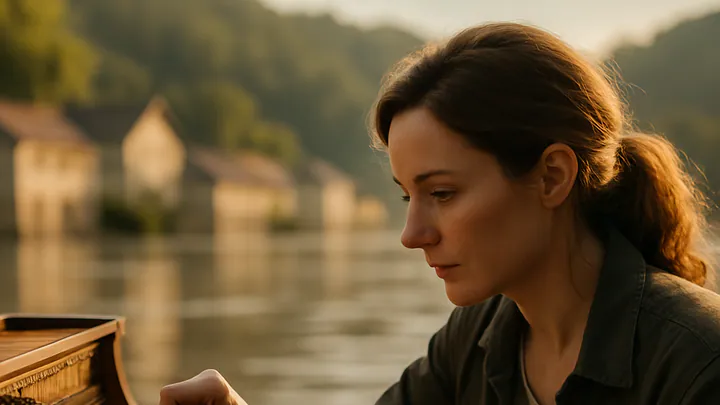
The piano had been underwater for nine days, and it still wanted to sing.
Mara knew this before she touched it. She knew it from the doorway of the parlor, where the wallpaper had blistered into pale islands and the floorboards sighed under her boots. The instrument stood against the far wall like a tired animal, its lacquer clouded, its pedals tarnished green. Around its feet, a faint ring of silt marked the high tide of the flood.
"You came," said the woman who had let her in. Her name was Iris, and she was perhaps seventy, perhaps older; her hair was the color of wet wheat, and she wore two cardigans against the river damp. "I wasn't sure anyone would."
"You said it was an emergency."
"I said it was urgent. There's a difference." Iris smiled, not unkindly. "Tea?"
Mara set down her case. She had driven three hours through valley roads still streaked with mud, past fence posts wearing tiaras of grass the water had braided on its way back to the river. The town — what was left of it after the levee gave — smelled of cold iron and wet books. She had expected the piano to be unsalvageable. Most of them were, after a flood. You pulled the action, salvaged the ivories if there were any, and let the rest go to firewood with as much dignity as you could manage.
But Iris had said, on the phone: It plays. That's the problem.
Mara lifted the fallboard. The keys were warped, several of them lifted at strange angles like teeth in an old jaw. She pressed middle C, gently, expecting a thud or nothing at all.
The note that came out was a chord. Not a struck chord — a remembered one. Soft, layered, and shaped like a question. Under it, almost too quiet to name, was the sound of moving water.
Mara took her hand back. She had been tuning pianos for twenty-two years. She had heard instruments that buzzed, instruments that howled, instruments that whispered when the heater kicked on. She had never heard one that listened.
"Ah," said Iris, behind her. "You hear it too. Good. I thought maybe it was only me, and that would have been worse."
"How long has it done this?"
"Since the water went down. My husband built it, you know. Not from scratch — he rebuilt it. Found it at an auction in 1974 and spent two winters on the soundboard alone." She paused. "He died in March."
Mara nodded. She did not say I'm sorry, because she had learned, over the years, that I'm sorry was a door people closed behind themselves. Instead she said, "What do you want me to do?"
Iris considered. "I want to know what it's saying. And then I want it to stop, so I can sell the house."
Mara stayed four days.
She worked the way she always worked: slowly, ear close to the strings, tools laid out on a folded towel. But this piano resisted ordinary diagnosis. When she tightened a pin, the note she set would hold for an hour and then drift, not sharp or flat but sideways, into some interval that wasn't on any chart she knew. When she pulled the action out to clean it, she found the felts still damp — not soaked, just damp, as though the instrument were sweating in its sleep.
And it kept playing the river.
Not loudly. You had to be quiet yourself to hear it. But under every test note there was current: the low gurgle of a culvert, the high silver of rain on a tin roof, once — Mara nearly dropped her tuning hammer — the unmistakable knock of a screen door swinging against its frame.
On the second evening, Iris brought her soup and sat in the wing chair by the window.
"He used to play in the mornings," Iris said. "Before coffee. He said the piano was honest before breakfast." She laughed, then stopped laughing. "The morning of the flood, he played for an hour. We knew it was coming. The sirens had started. He said, One more, Iris, and then we'll go."
Mara waited.
"He went up to the attic for the photo albums. The water came faster than the radio said it would. I was already on the porch with the dog. By the time I — " She stopped. "He'd been ill anyway. The doctors had given him until autumn. I tell myself the water only took what was already leaving."
Outside, a heron stepped through the yard on careful stilts.
"I think," Mara said, "the piano was listening too. That morning."
"Yes," Iris said. "I think so."
On the fourth morning, Mara understood what to do, though she could not have explained it to anyone who tuned for a living.
She did not tighten the pins. She loosened them, one by one, just slightly — the way you loosen a collar on a sleeping child. She wiped the strings with a soft cloth, not to clean them but to thank them. She set the dampers so they fell more gently. She left the warped keys warped.
Then she sat on the bench and played the only thing she could think of, which was a lullaby her mother had sung to her in a language Mara had mostly forgotten. The piano played it back to her in its own dialect — slower, deeper, threaded with water — and then, very softly, with something that was almost certainly a man's hands joining hers in the bass.
She did not turn her head. She let the duet finish.
When the last note faded, the river-sound faded with it. Not gone, exactly. Just settled, the way silt settles after a long rain, into something the instrument could carry without spilling.
Mara closed the fallboard.
Iris stood in the doorway with a dish towel pressed to her mouth. She lowered it slowly.
"Is it done?" she asked.
"It's done speaking," Mara said. "It will still sing, if you want it to. But it won't ask anything of you anymore."
Iris came and laid her hand on the lid. She stood there a long time. The heron was back in the yard, or perhaps it had never left.
"I don't think I'll sell the house," Iris said at last. "Not this year."
Mara packed her tools. At the door, Iris pressed an envelope into her hand and then, after a moment's thought, a small brass tuning fork worn smooth at the handle.
"He'd want you to have it," she said. "You listened."
Driving home through the valley, Mara kept the fork on the passenger seat. Once, cresting a hill, she thought she heard it hum on its own — a low, patient A, the note the orchestra tunes to before anything begins. She didn't check. She only rolled the window down, so the river, wherever it was now, would know she was passing through.