The Bread Baker Who Counted Storms
In a coastal village where the wind keeps its own ledger, an old baker discovers her sourdough has been recording the weather all along — and someone is finally listening.
Drafted with AI and published automatically. Our editors set the standards and fix reported errors — how we work.
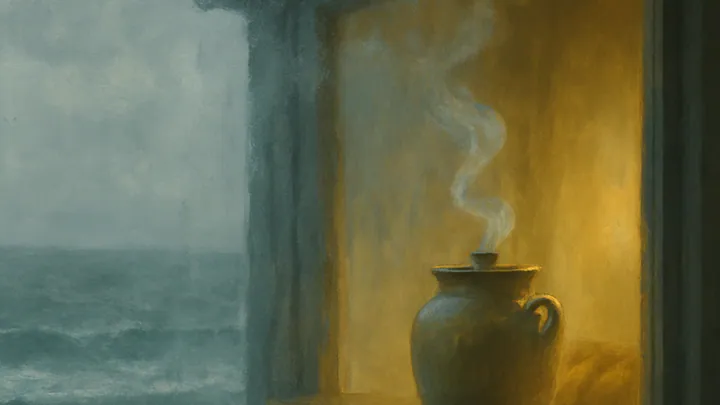
The morning the stranger arrived, Mira had already counted seventeen storms in her starter. She knew because the dough told her, the way it always did — a faint blue tang under the yeast, like wet slate, one bubble for each squall the harbor had endured since she was a girl.
She was eighty-one. The bakery was older.
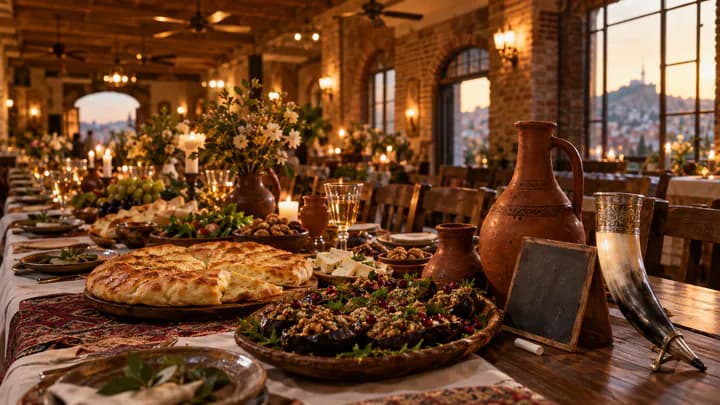
It sat at the bend of the road where the cobbles gave up and turned to packed sand, and its single front window had been washed by so many salt winds that the glass had gone soft at the edges, like a lozenge half-dissolved. Inside, the air smelled of flour and patience. Mira moved through it the way a fish moves through a familiar reef — without looking, without hurrying, knowing every shelf and crock by the press of the floorboards beneath her slippers.
The stranger came in at the eight o'clock bell. He was young and tall and had the careful posture of someone who had spent a long time on trains. He carried a leather satchel and a notebook, and his coat was the wrong weight for the coast — too thin, too tidy.
"Are you Mira Aller?" he asked.
"I am whoever is selling you bread," she said, not unkindly. "What do you want?"
He set the notebook on the counter. "My grandmother used to send your loaves north. She kept the crusts. All of them. In a tin."
Mira's hands paused inside the flour bin.
"Forty years of crusts," he said. "She labeled each one with the date. When she died last spring, I found the tin under her bed. I'm a meteorologist. I — " He stopped, embarrassed by his own sentence. "I matched the crusts to the storm records. The dark veins in the crumb. They line up. Every one."
Mira looked at him for a long moment. Then she pulled a stool out from behind the counter and pushed it toward him with her foot.
"Sit," she said. "You'll want tea for this."
His name was Tomas. His grandmother had been Aneli, and Mira remembered her — a slim, watchful woman who used to take the early ferry down once a month and buy two loaves and never small-talk. Aneli had paid in coins still warm from her pocket. She had never once said why she wanted the bread shipped back north in waxed paper, only that it must be the dark rye, the one with the long ferment.
"She told me," Tomas said, his tea cooling untouched, "that your bread remembered things."
"It does," said Mira.
He waited for her to laugh. She didn't.
"The starter is older than I am," she went on. "My mother carried it down from the hills in a clay jar wrapped in her shawl. Her mother carried it before her. It has been fed, in this building, through every weather the sea has thrown at us. It would be strange, wouldn't it, if it had learned nothing."
Tomas opened his notebook. He had drawn graphs in pencil — the kind of graphs Mira associated with school exams, neat and bristling with numbers. Beside each peak he had written a date and a single word: squall, gale, surge, calm, calm, gale.
"The crumb darkens with low pressure," he said. "The crust thickens with wind. The salt — the salt rises with the tide on the day of baking. I tested it. I tested everything."
"And what does the testing tell you?"
He looked up. His eyes were the grey of the cove on an overcast morning.
"That my grandmother wasn't lonely," he said. "That every loaf she ate was the coast writing her a letter."
The Long Ferment
Mira took him into the back room, where the starter lived in its glazed crock on a shelf above the oven. She lifted the cloth. The surface was webbed with fine pale bubbles, and beneath them, deeper down, a faint dark thread coiled — the memory of last week's wind, still settling.
"Put your ear to it," she said.
He hesitated, then bent. She watched his face change. It was the face she had seen, over sixty years, on perhaps a dozen people — the face of someone who had just heard the sea inside something that had no right to contain it.
"How — " he began.
"I don't know how. I know that it does." She replaced the cloth. "I know that when my mother died, the starter went sour for a month and nothing I did could fix it, and then one morning it was sweet again, and I understood she had finished saying goodbye."
Tomas sat down on the flour sack by the door. He sat for a long time.
"I came here," he said finally, "to ask if you would let me study it. Properly. With instruments. I have funding. I have — " He gestured weakly at his satchel. "Papers."
Mira considered him. She considered the bakery, which had no apprentice, and the starter, which had no inheritor, and her own hands, which that morning had taken three tries to open the flour bin.
"No," she said.
His face fell so completely that she almost laughed.
"No instruments," she clarified. "No papers. But you may stay. You may learn the feeding, and the folding, and the long ferment, and the reading of the crumb. If at the end of a year you still want to measure it, you will know enough to measure it kindly. And if you don't — well. You'll know how to bake."
He stared at her.
"I have a job," he said.
"You have a tin of crusts," she said. "That is a different thing."
He went away. She did not expect him back. People rarely came back from such offers; the offer itself was usually enough, a door shown and then politely closed.
But on the first morning of October, when the wind turned and the gulls began their winter arguments over the rooftops, the bell rang at five and Tomas was on the step with a duffel bag and the wrong coat still, and a paper sack of apples from the north for the starter.
"It eats apples?" he asked.
"It eats whatever you give it with attention," Mira said, and stepped aside to let him in.
That winter the coast had nine storms. The starter recorded every one. Tomas learned to feel the change in the dough at the wrist before the barometer in his pocket knew, and Mira learned to sleep past four in the morning for the first time in forty years, because someone else was already lighting the oven.
On the night of the last storm, when the windows shook and the harbor bell rang itself hoarse, she sat by the fire with a cup of tea and listened to the rye proofing in the next room — that soft, slow breathing, like a creature dreaming weather.
She thought: it will outlast me, and it will be remembered, and that is enough.
And the storm, hearing her, added itself quietly to the count.