The Bakery That Opened Only in Snow
A retired locksmith stumbles into a bakery that appears only during snowfall, where the proprietor bakes exactly what customers have forgotten they needed.
Drafted with AI; reviewed by Azka Shahid on . How we work.
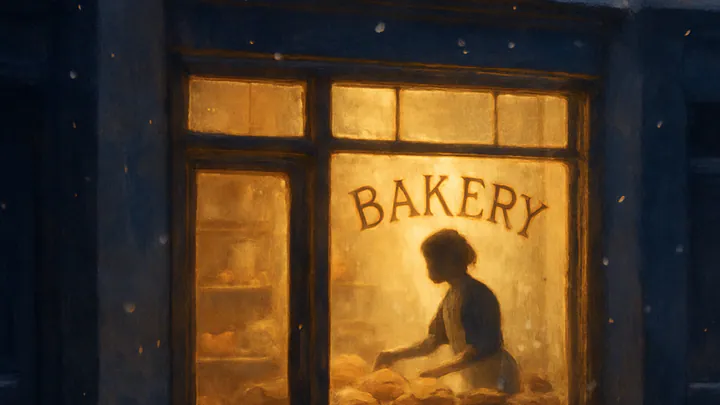
The bakery on Fenwick Lane wasn't there on Tuesday, and by Thursday morning it was. Hollis noticed because he had walked that particular block every day for eleven years, ever since his wife Marta had first asked him to bring home bread with sesame on top, and he had never, in all that time, seen a shop wedged between the shoe repair and the shuttered dry cleaner.
It was snowing, of course. He would understand that part later.
The window glowed the color of a lit candle held behind a hand. Gold lettering on the glass read, simply, Open Today. There was no name. Hollis stopped, adjusted the scarf he had knitted badly for himself the winter after the funeral, and pressed his gloved palm to the glass.
A woman inside looked up and smiled as though she'd been expecting him for some time.
He went in because he was cold, and because his knees hurt, and because he was seventy-one years old and had stopped inventing reasons not to accept small warmths.
A bell above the door made a sound like a spoon touching a cup. Inside smelled of butter and something darker — molasses, maybe, or a memory of it. The cases were nearly empty. One pear tart. Two rolls dusted with what looked like coarse salt. A single, unfrosted round cake sitting on a wooden board as though it had been carried a long way to get there.
"You've come in from the snow," the woman said. She was younger than him and older than his daughter, with flour on her forearms and eyes the pale gray of a January sky. "Sit down. I'll bring you what you want."
"I haven't decided."
"That's all right," she said. "I have."
She set down a small plate. On it was a slice of dense, dark bread, spread with unsalted butter and a spoonful of honey. Hollis stared at it. It was the bread his mother used to make on Sunday mornings in the house on Ardmore Street, in a kitchen that had been demolished forty years ago to make room for a highway ramp.
"Where did you get this recipe?" he asked.
"I didn't get it anywhere," the woman said. She was wiping her hands on her apron. "I just bake what people have forgotten they wanted."
Hollis put a bite in his mouth. He was not a man who cried in public, and he did not cry now, but he sat very still for a long time with his eyes on the table. When he could speak he said, "How much do I owe you?"
"Whatever you have in your left coat pocket," she said.
He reached in. There was a subway token from a city he had not visited in thirty years, a paperclip, and eighty-seven cents. He put it all on the counter. She swept it into a wooden drawer without counting.
"Come back," she said, "when it snows."
It snowed six times that winter, and Hollis came six times.
The second visit she gave him a bowl of soup he had eaten once, at nineteen, in a diner outside a bus station where he had waited for a girl who never showed up. He had thought about that soup, off and on, for fifty-two years. He had not known he was thinking about it.
The third visit she gave him a small square of cake with pink icing, the kind sold at children's birthday parties in the 1960s, sweet in a way modern things weren't allowed to be anymore.
The fourth visit she gave him a plain buttered roll and said, "This one's just a roll. Sometimes it's just a roll." He laughed for the first time in a season.
The fifth visit, he asked her name.
"June," she said.
"That's a summer name."
"I know," she said. "That's why I only work in winter. Balance."
He didn't ask what she meant. He was learning, at seventy-one, not to ask certain questions of certain answers.
On the sixth visit, in late February, she slid a plate across the counter with something on it he did not recognize. It was a small pastry, twisted, dusted with sugar, faintly green inside.
"I don't know this one," he said.
"No," June said. "You wouldn't. It's what Marta wanted to make for you the spring she got sick. She read the recipe in a magazine at the doctor's office and tore the page out and put it in her purse. She meant to try it when she felt better."
Hollis set his hands flat on the counter to keep them from shaking.
"How could you possibly —"
"I don't know how," June said gently. "I've stopped asking. I just bake what wants baking."
He ate it slowly. It tasted of pistachio and orange peel and something he could only call intention — the flavor of a kindness someone had meant to give him and had not been given time to.
When he finished, he sat with the empty plate a long while. The snow outside had thinned to a lace.
"June," he said finally. "What happens when the snow stops?"
"I close."
"And then?"
She smiled. It was not a sad smile, exactly. It was the smile of someone who had made peace with a thing he had not yet made peace with.
"Then I'm somewhere else," she said. "Baking for someone else. There's always someone forgetting something."
He nodded. He understood, or thought he did.
"May I ask one more thing?"
"You may."
"Do you ever bake for yourself?"
June looked at him with genuine surprise, as though the question had never been posed to her in whatever long unmeasured time she had been doing this. She considered it. Outside, the last flakes drifted past the gold lettering on the window.
"No," she said. "I don't think I remember what I've forgotten."
Hollis stood up. He took the scarf from around his neck — the badly knitted one, the one Marta would have laughed at and then worn anyway — and folded it on the counter between them.
"Then keep this," he said. "For next winter. When you can't remember why your neck is cold."
June touched the wool with two fingers, very lightly, the way a person touches something they are not sure they are allowed to have.
"Thank you," she said.
The bell above the door made its small spoon-and-cup sound as Hollis stepped out into Fenwick Lane. He did not turn around. He knew, without needing to look, that when he did the bakery would be gone, and the shuttered dry cleaner would be flush against the shoe repair again, as it had been for eleven years, as it would be until the next snow.
He walked home slowly. His knees still hurt. But his pockets were empty, and his mouth was sweet, and somewhere behind him a woman with flour on her forearms was, perhaps for the first time, wearing a scarf.