
The Tailor Who Mended Quiet Things
When a stranger brings in a coat that hums with old sorrow, a small-town tailor must decide what kind of repair her customer truly needs.
Drafted with AI. This version has not been reviewed by an editor, so it carries no ads — how we work.
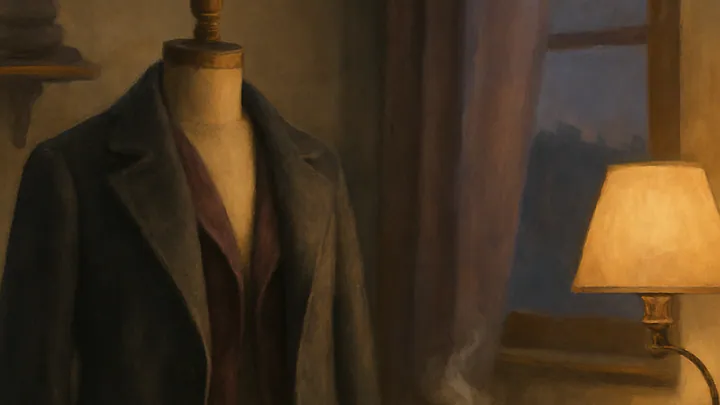
The coat came in on a Tuesday, draped over the arm of a man who looked like he hadn't slept since the previous decade. He set it on the counter the way other people set down infants — both hands, careful of the head.
"It hums," he said.
Margit, who had been a tailor for forty-one years and had stopped being surprised by most things around year nine, pressed her palm against the wool. It did hum. A low, uneven note, the way a refrigerator hums in another room, only sadder.
"How long has it been doing this?" she asked.
"Since my mother died." He folded his hands and then unfolded them, as if he couldn't decide what hands were for. "Three years next month. I thought it would stop. It hasn't."
Margit turned the coat over. Charcoal wool, double-breasted, the lining a dignified plum silk worn translucent at the shoulders. A woman's coat, cut for someone tall. The buttons were horn, and one was missing.
"You wear it?" she asked.
"I try. It's too big. But I can't — " He gestured vaguely, the way people gesture at the unfinished sentences inside them. "I can't put it in a closet, either. The humming gets louder when it's dark."
Margit nodded as if this were a perfectly ordinary complaint, which, in her shop, it nearly was. People had been bringing her quiet things for years. A scarf that smelled of a marriage. A child's snowsuit that crinkled with laughter no one could hear anymore. A wedding dress that had begun, very softly, to weep at the hem.
She had a drawer for the humming ones. She had a different drawer for the weeping ones. She had learned, over time, not to mix them.
"Leave it with me until Friday," she said. "I'll see what it needs."
The man hesitated. "What it needs?"
"Garments are like people," Margit said. "You can't just ask what's wrong. You have to ask what's missing."
He left a phone number on the back of a receipt and walked out into the grey afternoon, his shoulders the shape of a question.
The Listening
Margit closed the shop at six, as she always did, and brought the coat to the back room, where the light was warmer and the radiator ticked like a patient clock. She hung the coat on the wooden form she kept for difficult cases and sat down across from it with a cup of tea.
This was the part she never explained to anyone. Not the listening. The listening was the work.
She watched the coat the way one watches a sleeping animal. After a while, the hum began to organize itself into something almost like speech — not words, exactly, but the rhythm of words. The cadence of a woman who had something to say and had not been asked, lately, to say it.
"All right," Margit said softly. "I'm here."
The coat hummed.
She got up and ran her fingers along the seams. The right shoulder had been resewn at some point, neatly but not professionally — a home repair. The left cuff had been turned. The hem had been let down twice; Margit could see the old creases like the rings inside a tree. This was a coat that had been kept. Mended. Loved into its current shape.
And there, at the inside pocket, a small embroidery in red thread, barely visible against the plum lining. Three letters. For E.
Margit sat back down.
"Ah," she said.
The mother had not bought this coat. The mother had made it, or remade it, for someone named E. And E, presumably, was the man who had brought it in.
The humming wasn't grief. Or it wasn't only grief. It was a sentence that had never finished. A mother's last words, perhaps, or a mother's first words, or the long quiet middle that mothers and sons spend their lives forgetting to say to each other.
The Mending
On Wednesday, Margit took the coat apart.
Not entirely. She was a tailor, not a vandal. But she opened the lining at the back, the way surgeons open a chest, and she looked inside the architecture of the thing. She found what she expected to find and a little more besides: a folded square of paper tucked between the wool and the silk, sewn in deliberately, so that whoever wore the coat would carry it without knowing.
She did not read the paper. That was not her job. Her job was to put it where it could be found.
On Thursday, she resized the coat. She took it in at the shoulders by half an inch, brought the sleeves up by an inch and a quarter, narrowed the waist so it would sit against a man's frame instead of swimming around it. She replaced the missing horn button with one she'd been saving for years, a button from a drawer labeled Almost Right. She pressed the lapels. She steamed the lining until the plum silk lay flat and quiet again.
And then she moved the folded paper. She unpicked it from its old hiding place and re-sewed it into the new inside pocket — the one she had just resized — with three loose stitches that any fingertip would find on the first wearing.
By Thursday night, the coat had stopped humming.
It was simply a coat. A good coat. A coat that fit someone.
He came on Friday at noon, the way grieving people come to appointments: ten minutes early and apologizing for it.
Margit brought the coat out on a hanger. He stared at it for a long time before he touched it.
"It's quiet," he said.
"It is."
"What did you do?"
"I made it your size," Margit said. "That's all."
He put it on. The shoulders settled. The sleeves fell to his wrists. He stood in front of the long mirror, and Margit watched his face do the small private work that faces do when something fits for the first time.
His hand went, without his thinking about it, to the inside pocket. His fingers found the small square of paper. He looked at Margit.
"There's something — "
"Yes," she said. "I think she left it for you."
He didn't open it in the shop. He thanked her, paid her — too much; she gave half of it back — and walked out into a sunlight that hadn't been there an hour ago.
Margit watched him go. She finished her tea. She turned the sign on the door from Open to Closed for Lunch, though she had no plans to eat.
In the back room, the drawer of humming things had one less occupant. The drawer of weeping things was quiet. The radiator ticked. The light through the back window was the soft gold of an afternoon that had decided to be kind.
Margit picked up her needle. There was always something else, somewhere, that needed mending.