The Radio Operator on Meridian Ridge
High on a wind-scoured ridge, a lone radio operator picks up a voice that shouldn't be there — and finds herself the last link in a chain she never knew existed.
Drafted with AI and published automatically. Our editors set the standards and fix reported errors — how we work.
The voice came through at 3:14 a.m., which was strange for two reasons. First, nobody had used the 2182 kHz channel in eleven years. Second, the voice knew her name.
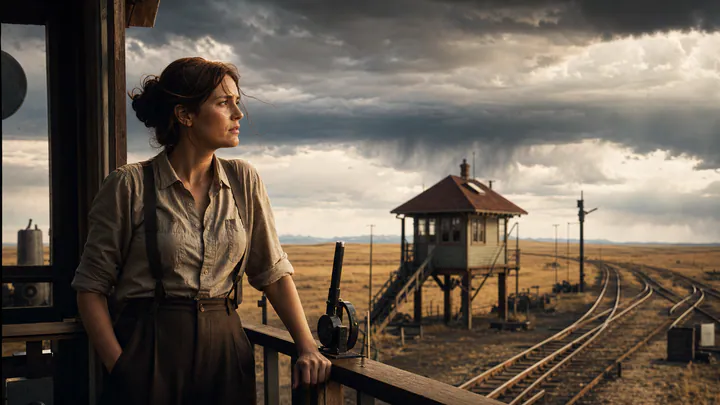
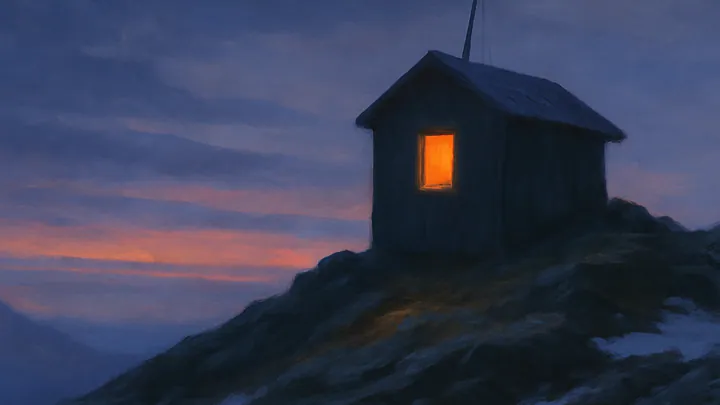
Ines set down her tin mug and let the coffee go cold on the desk. The hut on Meridian Ridge was built for one person and one purpose — to relay weather from the pass down to the valley station at Corvel — and after four winters she knew every hum and hiss the equipment could produce. This wasn't hiss. This was a woman, older than her, breathing between words as if she'd been climbing.
"Ines? Ines, if you're there, please answer. I know it's the middle of the night."
She stared at the console. The needle on the receiver twitched, small and patient. Outside, the wind pressed itself against the shutters like a large animal deciding whether to lie down.
She pressed the transmit key. "This is Meridian Relay. Identify, please."
A pause. Then a soft, startled laugh. "Oh. Oh, thank god. My name is Marta Weller. I'm — I'm calling from the old fire lookout on Ashen Head. Do you know it?"
Ines knew it. Everyone who worked the ridges knew Ashen Head. It had been decommissioned before she was born. The tower had partly collapsed in a slide six years ago and nobody had bothered to rebuild, because nobody watched for fires from towers anymore. Satellites did that.
"Ma'am," Ines said carefully, "Ashen Head isn't staffed. Hasn't been for a long time."
"I know," Marta said. "I'm not staff. I'm — I came up here to look for my father's notebooks. He was the last operator. He used to talk to a woman at Meridian on this frequency, every night at three-fourteen. He called it his appointment. I found his logbook an hour ago and I thought — I don't know what I thought. That maybe the frequency was still awake."
Ines looked at the clock. 3:16 now. The wind shifted a quarter turn, sighed, resettled.
"Who was the woman?" she asked.
"Her name was Ilse. Ilse Karo. She worked your hut in the seventies."
Ines felt something small and cold settle in the back of her throat. Ilse Karo was her grandmother. Her grandmother, who had died before Ines was born, whose photograph sat on the shelf above the transmitter in a black wooden frame — a young woman in a heavy coat, laughing at something outside the picture.
She had never known why her grandmother had chosen the ridges. Her mother had always described it with a kind of embarrassment, the way you describe a relative's odd hobby. She liked it up there. She said it was quieter than downstairs, which is the only joke she ever made.
"I'm her granddaughter," Ines said.
The Logbook
Marta was quiet for a long time. Ines could hear her breathing, and behind the breathing the peculiar acoustic of a broken structure — wind moving through gaps that were meant to be walls.
"Are you safe up there?" Ines asked. "Ashen Head isn't stable."
"I'm in the equipment shed, not the tower. It's holding. I have a bag, I have water. I came up before the front rolled in and I'll go down at first light." A rustle of paper. "Ines — may I call you Ines? — my father's logbook has entries every night for eighteen years. Just two words most nights. She's there. Or She's there. Storm. Or She's there. Meteor. Do you understand? He wasn't relaying anything official. He was just — checking. That she was still there."
Ines closed her eyes. She thought about her grandmother in this same chair, at this same hour, keeping an appointment with a man on the next ridge over. Neither of them ever climbing down to meet. Neither ever asking to.
"What did they talk about?" she asked. Her voice, she noticed, had gone thin.
"He doesn't write it down. Just She's there." A pause. "I think that was the whole of it. I think that was enough."
Outside, the wind rose and then, for a strange bright second, dropped completely. Ines heard the pines below the hut make the sound they made in stillness — a settling, like an old house.
"Marta," she said. "Why did you come up tonight? Really."
The older woman was quiet.
"My husband died in September," she said finally. "And I have been trying, for four months, to find one single thing that felt like a door instead of a wall. Tonight I remembered my father's appointment. I thought if the frequency was empty I would at least know. I thought I would go home in the morning and stop looking."
Ines picked up the tin mug. The coffee was skinned over and cold. She set it down again.
"It isn't empty," she said.
They talked until the sky above the ridge turned the color of the inside of a shell. Marta read aloud from her father's log — nothing intimate, only weather and the small comedies of equipment failure, but in the reading Ines heard the shape of a man who had been steady and slightly funny and had loved keeping an appointment. She told Marta about the photograph on the shelf, about the coat, about the laugh directed at something outside the frame. They agreed, without saying so, that they had probably been looking at each other, her grandmother and Marta's father, across two ridges and a valley of dark air. That the laugh had been for him.
At six-twelve, Marta said she could see the trail. She would go down now, while the light was clean.
"Will you be all right?" Ines asked.
"Yes," Marta said, and she sounded surprised to find it true. "Ines — tomorrow night. Three-fourteen. Would it be a terrible thing to ask?"
Ines looked at the photograph above the transmitter. Her grandmother, in the coat, laughing.
"No," she said. "It wouldn't be a terrible thing."
The channel went quiet. Ines sat for a while with her hand still on the transmit key, listening to the wind rebuild itself around the hut. She thought about how a frequency could sit dark for eleven years and still be a place. She thought about her grandmother, who had chosen the ridges, and whom she had always imagined as lonely, and who, it turned out, had kept an appointment.
She stood, stretched, and opened the shutters to the pale new morning. Down in the valley, lights were coming on in the houses at Corvel — small yellow squares, one after another, people beginning their day.
She wrote in her own log, in her clear square hand: 3:14. She was there.
Then she put the kettle on for fresh coffee, and waited, without impatience, for the next night.