The Night Baker of Halden Row
Every night at three, Yusra kneads bread for people she has never met. Tonight, one of them knocks on the door.
Drafted with AI and published automatically. Our editors set the standards and fix reported errors — how we work.
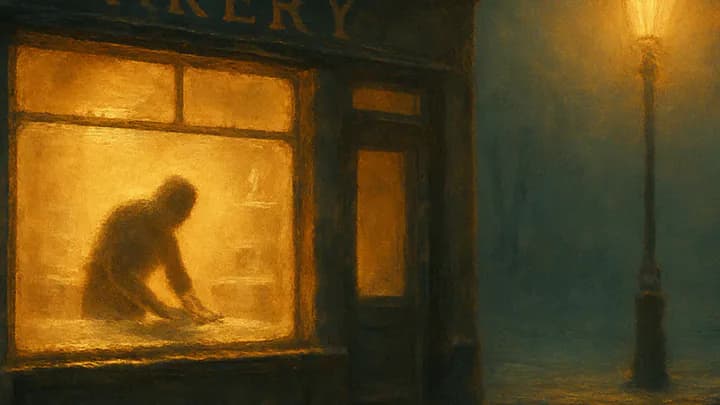
At three in the morning, the flour on Yusra's forearms looked like a second skin she was trying to shed. The oven ticked in the corner like a patient animal, and outside the fogged window of the bakery on Halden Row, the streetlamp painted everything the color of weak tea.
She worked from a list. Not a list of orders — she had those too, clipped to a nail above the proving drawer — but a smaller list, folded twice, kept in the pocket of her apron. On it, in her own careful handwriting:
Mr. Ivo — seeded rye, sliced. Leave under the awning.
Flat 3B — soft white, no crust burn. She's teething.
Bus depot — six rolls, brown paper, tuck behind the meter box.
Halden Row 14 — one loaf, any kind. Just one.
The last entry was three years old. She still baked for it.
Yusra shaped the rye by feel. Her mother had taught her that the dough tells you when it's ready the way a cat tells you when it wants to be let out — with a small, offended stillness. She slashed the top with a razor, three quick strokes, and slid it onto the peel.
The bell above the door rang.
She froze. The bakery didn't open until six. The door was locked. She had locked it herself, she was certain, because she always locked it, because Halden Row at this hour belonged to foxes and delivery vans and the occasional drunk singing to no one.
“We're closed,” she called, without turning.
“I know,” a voice said. A man's voice, low and apologetic, as if he'd knocked on the wrong door at a party. “The bell rang on its own. I only meant to look in.”
She turned then. He was standing just inside the doorway, which was, she noted with a cold small pulse behind her ribs, still locked. She could see the bolt from where she stood. He was neither tall nor short. He wore a coat the color of wet stone and he was holding his hat in both hands the way men in old films did when they were about to ask for work.
“How did you —”
“I'm sorry,” he said again. “I saw the light. I haven't seen the light in a long time.”
She should have been afraid. She catalogued her fear as one might catalogue a missing spice — noticed its absence, wondered where it had gone. Instead she said, “Sit down. You look like you've walked a long way.”
He sat at the small table by the window where, in daylight, old women drank cardamom coffee and argued about their sons. He set his hat on his knee. Under the fluorescent light his face was ordinary and tired.
“I used to live at number fourteen,” he said.
She slid the rye into the oven and closed the door and did not look at him. Her hands, which had been steady with the dough, were suddenly not steady.
“Fourteen has been empty three years,” she said.
“Yes.”
“There was a fire.”
“Yes.”
She turned. He was looking at his hat. There was nothing theatrical about him, nothing spectral. He looked like a man who had missed the last train and was working out what to do about it.
“You baked for us,” he said. “My wife used to bring the loaf in from the step. She said it was always still warm. She said whoever left it must have run.”
“I didn't run,” Yusra said. “I walked.”
“Why?”
She thought about it. She had thought about it a great many times, alone at this hour, with only the yeast for company. Her mother had started the list before her — the seeded rye for Mr. Ivo, whose wife had died; the soft loaf for the young mother in 3B who could not afford it and would not ask; the rolls for the drivers coming off the night shift. When her mother's hands had gone, Yusra had inherited the list the way other daughters inherited jewelry. She had added number fourteen herself, after the fire, because it seemed unbearable that the step should be empty when it had once been the sort of step where a loaf could sit and be found.
“Because someone should,” she said. “Because bread is cheap and grief is expensive.”
He smiled. It was a small, folded smile, the kind that had been kept somewhere safe for a long time.
“My daughter is eleven now,” he said. “She lives with her aunt in Portstow. She doesn't remember the loaves. She remembers almost nothing from before. But every Sunday she asks her aunt for bread and butter and salt. Just that. Bread and butter and salt. Her aunt thinks it's a phase.”
“It isn't a phase,” Yusra said.
“No.”
The oven clicked. The rye was turning. She could smell the crust beginning to set, the small caramel note that meant four more minutes.
“I wanted to say thank you,” the man said. “I've been trying to say it for three years and I couldn't find the door. Tonight the light was on and the bell rang on its own and here I am. I don't understand it and I don't need to.”
“You're welcome,” she said, because there was nothing else to say, and because she had learned from her mother that the correct response to gratitude was never to complicate it.
He stood. He put his hat on. At the door he paused with his hand on the bolt — which was, she saw, still shot across.
“Would you do something for me,” he said, “the next time you make the list?”
“Yes.”
“Take fourteen off. Put Portstow on. My daughter's aunt lives at Marsh Lane, number nine. She'll think it's the postman. She'll be annoyed. But my daughter will eat it.”
“Portstow is forty miles away.”
“I know,” he said. “I'm asking anyway.”
She nodded. He tipped his hat, and the bell rang, and the door did not open, and he was not there.
Before the Sun
She stood a long time with her hand on the counter. Then she took the folded paper from her apron pocket and smoothed it on the flour-dusted wood. She crossed out Halden Row 14 with a single clean line. Under it she wrote, in the same careful hand: Marsh Lane 9, Portstow — one loaf, any kind. Post on Fridays.
The rye came out at ten past four. She wrapped Mr. Ivo's under brown paper and tied it with string. She put the soft white for 3B in a cloth bag with a note that said cooler shelf, will keep two days. She counted six rolls for the bus depot and one extra, because one of the drivers had a new baby, and babies made everyone hungrier.
At five she stepped out onto Halden Row with her basket. The fog had thinned. The streetlamp had given up its tea-colored light and gone pale. Somewhere a fox was arguing with a bin.
She walked her route in the order her mother had taught her — Mr. Ivo first, because he woke earliest; then 3B; then the depot. At number fourteen she paused, out of habit, and did not leave a loaf. The step was clean. Someone, at some point, had swept it.
On Friday, she would go to the post office. She would ask about parcels to Portstow. She would learn what a loaf cost to send in a padded box, and whether it would arrive still soft, and whether an eleven-year-old girl who asked every Sunday for bread and butter and salt would know, when it came, that it had been meant for her.
She thought probably she would.
The sky over Halden Row began, very slowly, to consider being blue.