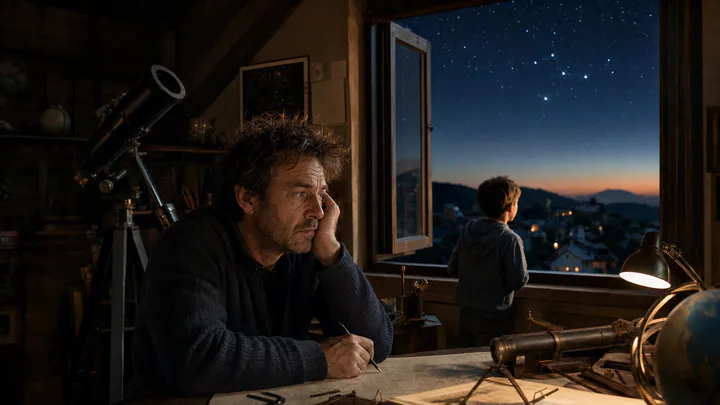
The Sound Archivist of Willow Bend
In a town that has begun to forget its own noises, an aging archivist plays back the recordings she's spent forty years collecting. Then one tape refuses to play.
Drafted with AI and published automatically. Our editors set the standards and fix reported errors — how we work.
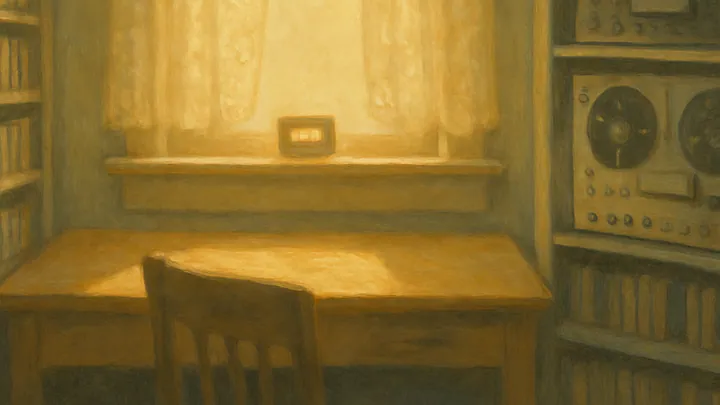
Odette Marchand had recorded the town of Willow Bend for forty-one years, and on the morning she noticed the silence, she was buttering toast. The knife scraped across the bread the way knives had always scraped, but underneath it there was nothing — no hum from the refrigerator, no ticking from the hallway clock, no far-off dog announcing the mail truck.
She set the toast down. She listened harder.
The refrigerator was, in fact, humming. The clock, in fact, ticked. When she paid strict attention, the sounds returned, each in its expected place. But the moment her mind drifted toward the butter, toward the small pleasure of a Tuesday, the world went quiet again, as though the town had learned to hold its breath whenever she wasn't looking.
Odette was seventy-three years old and had spent most of her life recording things that other people considered too ordinary to preserve. The wheeze of the bakery door. The particular squeak of the third pew at St. Anselm's. The way rain sounded different on the tin roof of the feed store than on the shingles of the library. Her archive filled two rooms of her small blue house: reels, cassettes, minidiscs, and, in the last decade, a wall of hard drives that blinked like patient animals.
She had never been able to explain, even to herself, why she did it. Only that sounds were the first thing a place forgot about itself, and someone ought to be paying attention.
The Cataloging Room
After breakfast she went to the cataloging room and pulled a cassette from 1994 — a Sunday afternoon on Merchant Street, recorded from the bench outside the barbershop. She slid it into the deck and pressed play.
Children. A bicycle bell. Mrs. Ivor calling her son in for supper, though it was only three in the afternoon; Mrs. Ivor had always called too early. The sound of a screen door slapping shut. A car with a loose muffler passing twice, the second time slower.
Odette closed her eyes and let the tape run. When it ended, she opened them to a strange quiet — not the ordinary quiet of a room, but a listening quiet, as though the walls themselves had leaned closer.
She walked to the window. On Merchant Street, four blocks away and invisible from her house, she could nonetheless hear — faintly, as if through cotton — a bicycle bell. A screen door. A woman calling a child in too early.
The town was echoing her tape back to her.
Odette sat down in her cataloging chair, which creaked in the manner it had creaked since 1987, and considered this. She was not a woman prone to alarm. She had lived alone long enough to know that surprising things often arrived quietly and asked only to be understood.
She tried another tape. A thunderstorm from the summer of 2003. She pressed play, and within a minute the sky over Willow Bend, which had been cloudless, produced a single, apologetic roll of thunder. No rain followed. Just the sound, as if the sky were clearing its throat to remember.
The Tape That Would Not Play
She worked her way through the archive for three days. Not every tape produced a response — the town seemed to remember some sounds more easily than others — but enough of them did that Odette began to understand what was happening. Willow Bend was losing its noises. The bakery had closed in 2019. The feed store had become a wine bar and then nothing. Mrs. Ivor had been dead for eleven years. The bicycles had been replaced by cars, and the cars by silence, because everyone worked from home now and no one drove anywhere between the hours of nine and five.
The town was forgetting how to sound like itself. And Odette, without meaning to, had become the last person who remembered.
On the fourth morning she reached the shelf marked 1978–1982, the earliest tapes, the ones she had made as a young woman with a borrowed recorder and more curiosity than sense. She pulled out a cassette labeled, in her own younger handwriting, Father, workshop, October.
Her father had been a cabinetmaker. He had died the following spring.
She slid the tape into the deck. She pressed play.
Nothing.
She checked the deck, checked the tape, checked the batteries in the backup player she kept for emergencies. The tape spun. The heads were clean. But no sound emerged — not hiss, not silence, not the faint mechanical breath a working tape produces even when its recorded content is quiet.
It was as though the tape had decided, on its own, not to give this one back.
Odette sat with it for a long time. She thought about how her father had whistled while he worked, always the same four bars of a song whose name she had never learned. She thought about how the plane had sounded moving down a length of oak, and how he had cleared his throat before saying anything important, and how the workshop had smelled of sawdust and pipe smoke and, on cold mornings, coffee.
She thought: the town cannot echo back what only I remember.
She thought: and perhaps that is the point.
She took the tape out of the deck and held it in her palm. It was lighter than she expected, or perhaps she was simply older than she remembered. Outside, a bicycle bell rang somewhere on Merchant Street, though no child had ridden a bicycle there in years.
Odette carried the tape to the window. The morning light fell across the archive — the reels, the cassettes, the blinking hard drives — and for the first time in forty-one years she understood that she had not been preserving the town. She had been preserving the parts of it she could bear to lose.
The rest — her father's whistle, the four bars of the unnamed song, the throat-clearing before the important thing — those she had kept somewhere the machines could not reach. Those she had been carrying all along.
She set the tape gently on the windowsill, where the sun could warm it. Then she went to the kitchen, put the kettle on, and listened, with great attention, to the sound it made as it began, very slowly, to sing.