The Last Ferry to Saltgrove Pier
When a young woman boards a midnight ferry that hasn't run in forty years, she discovers the passengers are waiting for someone — and the harbor remembers more than she does.

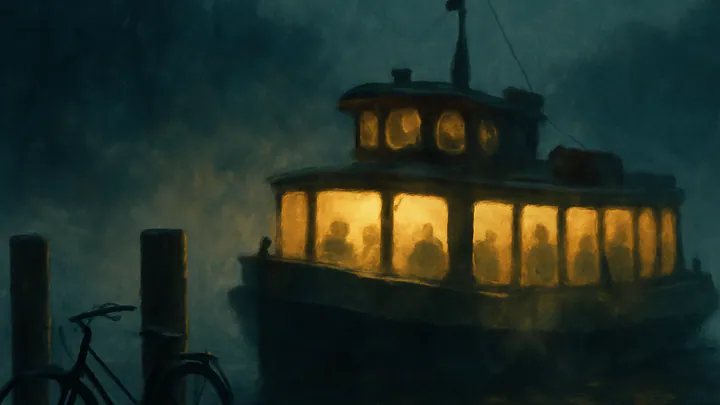
The ferry shouldn't have been there, and yet its yellow lights were already burning at the end of the pier when Esme arrived. She slowed her bicycle, one foot on the wet planks, and listened to the diesel hum that hadn't been heard in Saltgrove since before she was born.
It was a quarter to midnight. The wind smelled of kelp and old rope. She had come down to the harbor only because she couldn't sleep in her grandmother's house, where every drawer still held a pair of folded gloves and the radio kept tuning itself to a station that no longer broadcast. The funeral had been three days ago. The will would be read on Monday. In between was this — a small town that did not know what to do with her, and a girl who did not know what to do with the small town.
The ferry's name was painted along its bow in flaking gold: Marigold. Esme knew the name the way one knows a song heard in childhood. Her grandmother had ridden the Marigold to the mainland every Thursday for forty years, until the route was discontinued and the boat was sold for scrap. There had been a photograph on the kitchen wall: her grandmother at twenty, leaning against the rail, laughing at someone outside the frame.
And here it was. Lit up. Idling. Waiting.
A man in a navy cap stood at the gangway with a ticket punch in his hand. He was perhaps sixty, perhaps a hundred; the light made it hard to say. He looked at Esme the way one looks at an expected guest who is, nevertheless, slightly late.
"Boarding," he said.
"I don't have a ticket."
"You wouldn't," he agreed, and stepped aside.
The Passengers
The deck was warmer than the night. Brass fittings, varnished benches, a small saloon with windows fogged from the inside. Esme counted nine passengers, all in coats from another decade — wool, tweed, a green mackintosh with bone buttons. A boy of about ten sat with a wicker basket on his lap. An old woman knitted something long and grey that pooled around her shoes. None of them looked surprised to see her.
"You'll be Margaret's girl," said the woman with the knitting. Her needles did not pause. "You have her chin."
"Granddaughter," Esme said, because it seemed important to be exact. "Margaret was my grandmother."
"Was," the woman repeated, considering the word like a stone she might skip. "Well. Sit down, dear. We've a crossing ahead."
Esme sat. The ferry shuddered, and the lights of Saltgrove began to slide backward through the window. She thought she ought to be frightened. Instead she felt the particular calm of a dream you have decided not to wake from yet.
The boy with the basket leaned toward her. "Did you bring something?"
"Bring something where?"
"For the other side." He lifted the lid of his basket an inch. Inside, neatly folded, was a child's drawing of a house with too many chimneys. "I'm bringing this back to my mother. I didn't get to give it to her."
Esme's throat closed. She looked around the saloon and understood, slowly, what she was looking at. The man in the green mackintosh held a wedding ring in his open palm. The knitting woman's grey scarf, she saw now, had no end — it spilled from her needles in a long unfinished line, the way a sentence trails off when the speaker is interrupted forever.
Unfinished things. That was the cargo.
"I didn't bring anything," Esme whispered.
The boy looked at her kindly. "You did. You just haven't found it yet."
The Crossing
She walked the length of the boat. The conductor watched her with mild interest but did not stop her. At the stern, the wake unspooled in a white ribbon toward a shoreline that was no longer Saltgrove — or was Saltgrove from another year, with more lights, a taller church, a cannery that had burned down before Esme was born.
She pressed her hands to the rail. She tried to think of what she had left unfinished. The thesis she had abandoned. The phone calls to her mother she kept meaning to make. A friendship she had let drift because drifting was easier than apologizing. None of these felt right. None of these belonged on this boat.
Then she remembered.
The last time she had visited her grandmother, six months ago, they had sat in the kitchen and her grandmother had said, There's a story I want to tell you about your grandfather and the storm of '63, but not tonight, I'm tired. And Esme had said, Next time. And there had not been a next time.
The story. The one she would never hear. That was the unfinished thing she carried, and she hadn't even known she was carrying it until now.
She turned back to the saloon. The knitting woman looked up, and her face was no longer a stranger's. It was a face from the photograph on the kitchen wall, forty years older but the same chin, the same laugh-lines around the eyes.
"Oh," Esme said. It was all she could say.
Her grandmother — because of course it was her grandmother, and of course she had been on this boat all along — patted the bench. "Come and sit, love. I have time now. I have all of it."
Esme sat. The ferry's engine softened to a hum that was almost a held breath.
"It was October," her grandmother began. "Your grandfather had gone out in the dinghy because he was a stubborn man and the cannery owed him money. The storm came up from the south, the kind that makes the gulls go quiet first…"
Esme listened. She listened for what might have been an hour or a single long minute. She learned how her grandfather had tied himself to the mast with his belt. She learned that he had sung, the whole time, a song his mother had taught him in a language Esme had never heard her grandmother speak. She learned that when he came home at dawn, soaked and shivering, he had laughed before he cried.
When the story was finished, the knitting woman tied off the grey scarf with a neat, decisive knot. She folded it once and set it on the bench between them.
"There," she said. "That's done."
The ferry was at the pier again. Esme had not noticed it turning. The yellow lights of Saltgrove waited beyond the gangway, ordinary and modern and asleep.
The conductor touched his cap. The boy with the basket waved. Her grandmother did not wave; she only smiled the smile of someone who has set down a heavy thing she has been carrying a long way.
Esme stepped onto the planks. Behind her, the ferry's lights dimmed, then went out, and when she turned around there was only black water and the soft creak of pilings.
She walked her bicycle home. In her coat pocket, warm against her hip, was a folded length of grey wool she did not remember accepting. She would wear it through every winter of her long life, and when people asked where she had got such a beautiful scarf, she would say, truthfully, that her grandmother had finished it for her.
Frequently asked questions
What do the objects each passenger carries represent?
They embody the unfinished business the dead leave behind — gestures uncompleted, words unsaid, gifts undelivered. The story suggests grief is often less about absence itself than about the specific tasks left mid-sentence.
Why does Esme not recognize her grandmother at first?
Recognition in the story is tied to readiness. Esme has to identify her own unfinished thing — the untold story — before she can truly see who has been sitting beside her, which mirrors how memory often returns to us only when we are prepared to receive it.
How does the setting of Saltgrove shape the story's emotional weight?
Small coastal towns hold layered time particularly well: discontinued ferries, burned canneries, photographs on kitchen walls. The harbor becomes a place where past and present can plausibly touch, which gives the magical element a quiet rather than startling quality.
What is the significance of Esme keeping the scarf?
The scarf is proof that the encounter was real, but more importantly it is something completed — a thing her grandmother finished for her. It becomes a wearable inheritance, the opposite of an unfinished sentence.