The Watch Repairer's Uninvited Apprentice
When a stubborn twelve-year-old shows up at his shop demanding to learn the trade, an aging watchmaker discovers that time can still surprise him.
Drafted with AI. This version has not been reviewed by an editor, so it is kept out of search results and carries no ads — how we work.
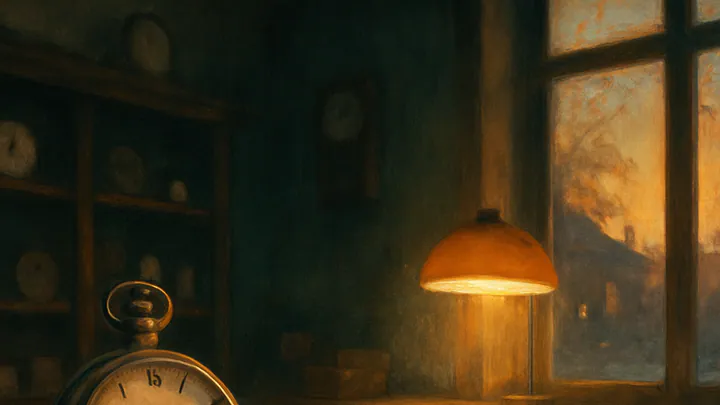
The bell above the door rang for the first time in eleven days, and Elias Corben did not look up. He counted the days the way other men counted debts — with a private, unshowy accuracy — and he had grown used to eleven.
"Are you the watch man?"
The voice was small and impatient, the kind of voice that expected to be argued with. Elias set down his loupe. On the other side of the counter stood a girl of perhaps twelve, her hair pulled back so tightly it seemed to hurt, her jacket two winters too small. She held a wooden box against her chest like a shield.
"I am a watch man," Elias said. "I don't know that I'm the."
"There's only one shop on the sign map," she said. "So you're the." She placed the box on the counter with great care, then pushed it toward him with two fingers, as if it might bite. "It stopped. I need you to teach me how to fix it."
Elias blinked. "Teach you."
"Yes."
"I don't teach."
"You can start."
He almost laughed. It had been a long time since anything had almost made him laugh, and the sensation was strange in his chest, like a spring uncoiling in the wrong direction. He opened the box.
Inside, nested in a scrap of blue felt, lay a pocket watch. Silver, scratched, the crystal spidered with a hairline crack. He turned it over. On the back, engraved in a hand steadier than the engraver had probably felt: For H., who kept me on time. — M.
"Whose is this?" Elias asked.
"Mine now," the girl said. Then, after a pause that cost her something: "It was my grandfather's."
"And your grandfather —"
"Isn't using it anymore."
Elias nodded once, the way he had learned to nod at funerals, and did not press. He set the watch on the green velvet pad and reached for his loupe.
"What's your name?"
"Wren."
"Wren. I can repair this in about a week. Come back Thursday next and —"
"I said I want to learn." She climbed up onto the wooden stool on her side of the counter without invitation, folded her arms, and waited. "I have money. I have four dollars and a can of peaches. That's for the lesson. The repair is separate."
Elias looked at her for a long moment. Outside, the November light was the color of weak tea. The shop smelled of oil and cedar and the faint, sweet dust of old paper. He thought about the eleven days. He thought about his wife's chair, which he had not been able to move from the corner of the workroom, and about how it had begun to accumulate objects — a coil of wire, a folded newspaper, a saucer — the way a shore accumulates driftwood when no one comes to sweep it.
"Keep the peaches," he said. "Wash your hands."
The First Lesson
The sink was in the back. She was gone a long time, and he suspected she was inspecting the shelves — the mainspring winders, the demagnetizer, the little brass tweezers arranged like a dentist's tools. When she came back her cuffs were wet and her expression was the careful blankness of a child trying not to seem impressed.
"First," he said, "you don't touch anything with your fingers. The oil on your skin will ruin the movement in six months. You use these." He handed her a pair of brass tweezers. She held them like chopsticks.
"Second, we listen."
"Listen to what?"
He wound the watch three careful turns and held it to her ear. She flinched, then went very still.
"Nothing," she whispered.
"Correct. A stopped watch tells you nothing about itself. That is the first thing to know about any broken thing. You cannot ask it what is wrong. You have to open it."
He showed her the case knife. He showed her how to brace the watch, how to find the seam, how to apply the smallest possible pressure until the back popped free with a sound like a bitten apple. Inside: the little universe of gears, jewels red as pomegranate seeds, a balance wheel no bigger than a fingernail.
"Oh," Wren said. It was not a word so much as a breath let out.
"Yes," said Elias. "Oh."
He named the parts for her. Mainspring. Escape wheel. Pallet fork. Balance. He told her the balance was the watch's heart, and that when it stopped the whole small country of the movement fell silent, and everything downstream forgot what to do.
"Is that what happened to this one?"
"Let's see."
Under the loupe, he found it almost at once: a hair. One single dark hair, coiled around the balance staff like a lasso. He drew it out with the tweezers and laid it on the velvet.
"That's it?" Wren said. "A hair?"
"Sometimes," Elias said, "the reason a thing stops is very small. Smaller than you expect. Smaller than the grief of it."
He had not meant to say the last part aloud. He glanced up. She was not looking at him. She was looking at the hair on the velvet, and her mouth had gone into the shape mouths make when they are determined not to do anything else.
"It's his," she said. "Isn't it."
"It could be anyone's."
"It's his."
Elias set down the tweezers. Outside, a car passed and did not stop. Somewhere in the back of the shop, the long-case clock his father had built in 1948 struck the quarter hour, softly, the way it always did, whether anyone was listening or not.
"What was his name?" Elias asked.
"Henry."
"H."
"H," she agreed.
"And M?"
"My grandmother. Margaret. She's the one who told me to bring it. She said Henry would want it running again, and she said —" Wren stopped. Started again. "She said I should learn something that has an ending. Something you can finish."
Elias thought about that for a long time.
"She's a wise woman," he said finally. "Though I would say a watch is the opposite. A watch is a thing you finish so it can begin."
Thursday Next
She came every day after school. He had not agreed to this and she had not asked. By the end of the first week she could open a case without scratching it. By the end of the second she could identify a worn pivot by sight. She was not gentle — she was a girl who had learned that gentleness was a thing other people did to you, and not always kindly — but she was patient, which was rarer and better.
On the fourteenth day she cleaned the balance of her grandfather's watch herself, with a brush finer than an eyelash, and Elias oiled the jewels with a dip so slight it could have been imagined. He handed the watch back to her. She wound it, three careful turns.
The tick, when it came, was small and steady and absurdly loud in the quiet shop. Wren held the watch to her ear with both hands, as if it might fly away.
"There he is," she said.
Elias, who had been counting eleven days and then twelve and then a number he had stopped counting, discovered that his own chest had done something similar, some long-stopped balance quietly beginning again, tick by unremarkable tick.
"There he is," he agreed. "Now. Tomorrow we learn the mainspring."
She nodded, very seriously, and slid off the stool, and did not smile until she was almost to the door — where, thinking herself unobserved, she did.