The Kite Maker's Last Afternoon Wind
On the windiest hill in the county, an old kite maker prepares a farewell flight for a customer who never came back — and finds someone unexpected waiting.
Drafted with AI and published automatically. Our editors set the standards and fix reported errors — how we work.
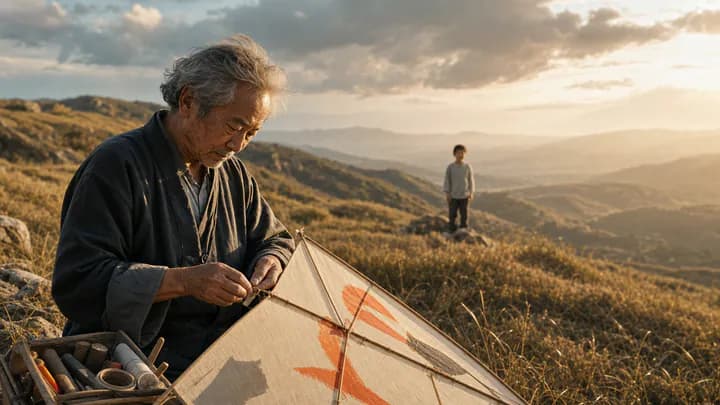
The wind on Coelho Hill came in three shifts, and Ivo had known all three since he was seven years old. Morning wind was shy and tugged at your sleeve like a child; noon wind was flat and lazy, good for nothing but drying laundry; but the afternoon wind — the afternoon wind knew what it was doing.
He climbed the hill slowly now, the way old men climb anything, with the kite folded against his ribs like a second heart. It was a diamond kite, blue paper stretched over bamboo, and he had built it thirty-one years ago in a workshop that no longer existed, for a customer who had never come back to collect it.
The doctor had told him, quite kindly, that he had perhaps a summer left. Ivo had nodded and thanked her and then walked home and taken the blue kite down from the rafters where it had waited, patient as furniture, through three roof repairs and one small fire.
"You've been up there long enough," he told it.
The Customer
Her name had been Renata, and she had come into his shop in the autumn of a year he could no longer number without doing math. She was maybe twenty-two, with paint on her knuckles and a scarf the color of persimmons, and she had asked him for a kite that could carry a letter.
"Carry it where?" Ivo had said.
"Up," she said. "Just up. As high as it can go, and then I want the string to break."
He had built it carefully. Blue paper because she asked for blue. A tail of white rag strips because he thought it would look like a comet against the sky. He had charged her only for materials, because he was young and she was beautiful and he was already, without knowing it, falling a little in love with the idea of her.
She had paid a deposit and promised to come back on Saturday.
She had not come back on Saturday, nor the Saturday after, nor any Saturday since. He had asked around, gently, the way one asks in a small town. She had left. Moved on. Some said to the capital, some said to the coast. One old woman at the market said Renata's mother had been ill, and Renata had gone home to nurse her, and that home was very far away.
The letter she had wanted to send with the kite was still tucked into the frame, folded three times, sealed with wax the color of dried blood. He had never opened it. It was not his letter to open.
The Hill
Coelho Hill in late June was all wild mustard and thistle, and the path had grown narrower every year, as if the earth itself were slowly forgetting people came here. Ivo rested twice on the way up, once on the flat stone where lovers used to carve initials, and once at the crooked pine that leaned over the drop like a man trying to read small print.
At the top he was surprised to find he was not alone.
A woman was sitting on the grass with her back to him, wrapped in a coat too heavy for the season. Her hair was white and short, cropped like a boy's. Beside her on the grass was a thermos and a small painted tin.
He almost turned around. He had wanted to be alone for this. But something in the shape of her shoulders — some old geometry of hunched attention — made him stay.
"Excuse me," he said.
She turned. Her face was lined and unfamiliar and completely familiar all at once, in the way faces sometimes are when you have imagined them for decades.
"Oh," said Renata. "You're still here."
Ivo sat down. He had to. His knees decided for him.
"I was going to say the same to you," he said.
She laughed, and the laugh was younger than the rest of her by forty years. "I came back last month. My daughter drove me. I've been coming up here every afternoon."
"Waiting for what?"
"Waiting to work up the nerve to come into your shop."
"The shop closed in 2004."
"Ah," she said. "That would explain it."
They sat for a while. The afternoon wind was starting to arrive, the way it always did, moving first through the tallest grass and then the shorter grass and then, at last, through the hair on the back of his neck.
"I have your kite," he said.
She looked at the folded blue thing in his lap. Her eyes filled, but she did not cry. She had, he suspected, done her crying already, in some other decade, in some other room.
"I couldn't come back," she said. "My mother was sick, and then my brother, and then I was sick, and then years just — happened. And after a while I was too ashamed. I owed you money and a kind of explanation I didn't know how to give."
"You paid a deposit."
"I paid almost nothing."
"You paid enough," he said. "The kite has been fed and housed for thirty-one years. That's a good rate."
She laughed again, wet this time, and reached for the kite.
He gave it to her. It felt strange to let it go. It had been, without his quite noticing, the oldest thing he owned that still had a purpose.
The Flight
They stood together and he showed her, because her hands had forgotten, how to hold the spool low and let out the line in small measured breaths. The wind took the kite eagerly, the way a dog takes a stick, and in less than a minute the blue diamond was a hundred feet up, tugging like something alive.
"The letter is still inside," he said. "I never opened it."
She looked at him with an expression he could not read. "Do you want to know what it said?"
"Only if you want to tell me."
She thought about it. The kite climbed. The white rag tail flickered against the sky like a signal in a code no one alive still spoke.
"It was a letter to my mother," she said finally. "To send after she was gone. I wanted to tell her some things I hadn't been brave enough to say. I thought if I sent them up high enough, she might read them from wherever she was going."
"And then she got better?"
"And then she got better. For eleven more years. And I put the kite out of my mind because I didn't need it anymore. And then, when I finally did need it, I was too far away and too ashamed and too tired."
The line was almost at its end. Ivo could feel it thinning in his palm, the last of it about to unspool.
"Do you want to send it now?" he asked.
Renata considered the sky for a long moment.
"Yes," she said. "I think she's had to wait long enough."
He handed her the spool. When the line ran out, she did not tie it off. She let it slip through her fingers, and the kite gave one small joyful jerk, as if surprised to be free, and then it climbed on its own, blue against blue, smaller and smaller, the letter still folded inside its bamboo bones.
They watched it until it was only a speck, and then until the speck was only a memory of a speck, and then Renata poured him tea from her thermos, and they sat on the grass on Coelho Hill in the good afternoon wind, two old people who had, at long last, finished a piece of business the world had been holding open for them.