Learning to Bend Glass for Nathan Road
A short story about Ka-yee, a stubborn Hong Kong girl who sweeps her uncle's neon workshop in Sham Shui Po and spends twenty-six years learning to bend light by hand.
Drafted with AI. This version has not been reviewed by an editor, so it carries no ads — how we work.
Story Time is original short fiction. The characters, places and events in this story are invented.
The broom caught on a curl of broken glass, and Ka-yee bent to pick it out with her fingers, which was the first thing Uncle Bing ever shouted at her about. "Dustpan!" he said, without looking up from the flame. "Glass doesn't care that you're fourteen."
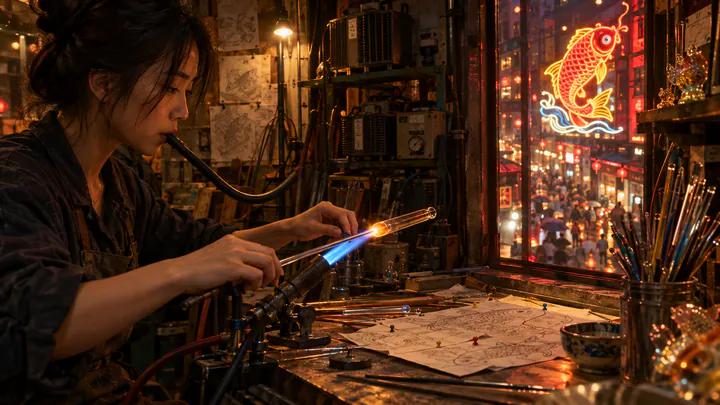
It was 1993, and the workshop on Yu Chau Street was the size of her family's kitchen and three times as hot. A ribbon burner hissed along the bench like a row of blue teeth. Transformers hummed on a shelf above the door, and the walls were papered with patterns drawn in grease pencil: a pawnshop bat clutching its coin, the swooping strokes of a tailor's name, a bowl of noodles with three wavy lines of steam.
She swept and watched. Uncle Bing held a tube of glass at both ends and turned it in the flame, slow and even, the way her grandmother turned a fish in the wok. A thin rubber hose ran from the tube's end to his mouth. When the glass sagged, he lifted it, folded it into an elbow, and puffed once through the hose so the bend swelled back to its proper roundness. Then he laid it, still glowing orange, onto the paper pattern.
"Why is the drawing backwards?"
"Because the sign faces the street. Not me."
At eight they ate at the dai pai dong under the stairs, beef ho fun and two glasses of milk tea so sweet her teeth ached. Uncle Bing picked bean sprouts out of his noodles one by one.
"Your mother says you're to study accounting."
"I want to make a sign you can read from the top of a bus. A moving bus."
He laughed. "On Nathan Road the bus goes slow enough to read a newspaper."
"Then a fast bus."
"Girls' hands shake," he said. "Too much feeling in them."
Ka-yee laid her hand flat above her bowl, fingers spread, and held it there through the steam. It did not move. Uncle Bing glanced at it and went back to his sprouts.
"Over noodles," he said, "anybody is steady."
In the summer of 1997 the rain didn't stop for a week, and the week the flags changed, Lei Kee Congee on Nathan Road ordered a carp.
It was to leap across the face of their building, nine metres from nose to tail, red neon for the body, gold for the scales, argon-blue for the water spraying off its fins. Uncle Bing drew it on brown paper that covered the whole floor, and they ate dinner standing up for a month so as not to step on it.
By then Ka-yee had a pink, shiny scar on the inside of her left wrist from the summer she was fifteen, when she'd practised on scrap tubes after he went home and had reached across the flame for the hose. She had not told him. He had seen it anyway, and the next week a pair of old leather cuffs appeared on her stool without comment.
Her mother had enrolled her in a secretarial course in Mong Kok, starting September. Ka-yee had not argued. She had simply kept coming.
"The eye," Uncle Bing said on the last night, holding out a short length of tube. "You do it."
A circle was the hardest bend there was. A straight line forgave you; a curve could hide a wobble. A circle showed every place your hand had lost its nerve.
She turned the glass over the flame until it went soft as a noodle, and her hands did not shake, though her knees did. She coiled it, puffed, coiled again, and pressed it onto the paper. It came out round. Almost round. A little fat on the left side.
Uncle Bing picked it up, held it to the bulb, and put it in the crate with the rest without a word.
Three weeks later they rode the number 2 bus down Nathan Road at ten at night, upper deck, front seat. The carp came up on the right, red and gold and leaping, and in the middle of its head was a ring of white light that she had made.
"The eye's a bit fat," Uncle Bing said.
The bus did not slow down. She saw the whole fish anyway.
By 2006 Ka-yee typed bills of lading for a freight forwarder in Kwai Chung from nine to six, and bent glass on Yu Chau Street from seven until the last bus.
Her mother counted this as a success. "Supervisor next year," she said over claypot rice at the stall on Ki Lung Street, scraping the crust from the bottom with great concentration. "Then you can stop with the glass. Your uncle is old. That shop is finished."
The shop was not finished, but it was thinner. Half the patterns on the wall were for signs that had already come down. A dentist on Tai Nan Street had asked Uncle Bing for a lightbox with LEDs, and he had told the man to go and buy a fridge, then.
That night he was bending a double-back for a karaoke bar's music note, and Ka-yee was waxing electrodes at the far end of the bench, when she heard the glass go wrong. It has a sound, a tiny tick when one side cools faster than the other. She looked up and saw his left hand trembling, the soft part of the tube beginning to twist and fold on itself.
She was across the room before she'd thought about it. She took the other end, turned it with him, and when it was even again, she let go.
He laid the bend on the pattern. It was good. Neither of them looked at his hand.
"Tomorrow," he said finally, "you do the bends. I'll talk to the customers."
"I'll talk to the customers too."
He pulled his mouth sideways. "They'll ask for LED."
"Then I'll tell them what LED can't do. Nicely. Not about the fridge."
The next week she handed her notice in at Kwai Chung. Her mother didn't speak to her until the Mid-Autumn Festival, and then only to ask whether the workshop had a fan yet.
In 2019 the carp had been dark for four years. Lei Kee had closed when the rent doubled, and now a notice from the Buildings Department was taped to the gate below it: unauthorised projecting structure, to be removed by the end of the month.
Ms. Szeto from the museum in West Kowloon wore a lanyard and very clean trainers. She had walked into the workshop, looked up at the patterns on the walls, and said, "Oh," in a way Ka-yee had liked. Then she had made her offer, which was generous, and explained the plans, which were careful: removal by specialists, a climate-controlled store, a place in a future gallery about the city's vanished streets.
"Would it be lit?"
Ms. Szeto hesitated. "Occasionally, perhaps. For conservation reasons, mostly not."
Uncle Bing listened from the folding chair by the door, both hands on his cane. They were still now only when they rested on something. "It's yours," he'd told her the night before. "You made the eye."
"It was made to be seen from a moving bus," Ka-yee said. "Not from a bench."
Ms. Szeto left her card on the bench beside the burner, and Ka-yee moved it before it could scorch.
The building's owner gave her one night. She went up the scaffolding on Thursday with a new transformer, cleaned four years of grime off the electrodes, and replaced a cracked section of the tail with glass she had bent that afternoon. Chi-lok, the boy from the flat below the workshop, who was eleven and had spent the summer sitting on her doorstep pretending not to watch, carried the toolbox up two flights and was not allowed any further.
At nine o'clock she threw the switch.
The transformer buzzed, then caught. Red ran up the carp's body like something waking. The gold scales came on one by one, then the blue spray, and last of all the eye, slightly fat on the left side.
On the pavement, people stopped. Phones went up. A woman holding a bag of oranges said, "I used to eat there with my father," to nobody in particular. A number 2 bus went by, and every face on the upper deck turned.
Uncle Bing stood at the kerb with his cane, looking up. He didn't say anything about the eye.
In the morning the crew came and took the carp down in sections. Ka-yee wrapped each one in newspaper and had them carried to Yu Chau Street, where she hung them from the ceiling hooks above the bench: a fin, a tail, a curve of back, the eye. Patterns you could see from underneath.
Chi-lok was on the doorstep at four, school bag still on.
She lit the burner, handed him the leather cuffs, and put a length of scrap tube into his hands, one end in each.
"Turn it," she said. "Slower. Both hands together."
The glass went orange. His fingers trembled on it.
"My hands are shaking," he said.
"Everyone's hands shake." She put her own over his, just for one turn. "Keep turning. It'll tell you when."