What the Beekeeper Heard in the Orchard
When a retired beekeeper returns to her sister's orchard for the last harvest, the hives begin humming a song she thought only their mother remembered.
Drafted with AI and published automatically. Our editors set the standards and fix reported errors — how we work.
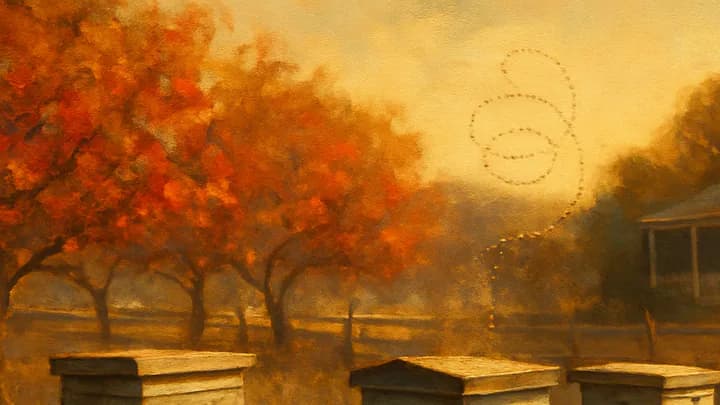
The bees knew Ines was coming before the truck turned off the county road. She could tell by the way they poured out of the far hive in a slow spiral, as if drawing a signature in the air above the orchard.
Her sister Marta stood on the porch in a sweater the color of wet bark, arms folded. She had not aged the way Ines expected. She had aged the way their mother had — sideways, into a sharper version of herself.
"You brought the veil," Marta said, nodding at the netted hat in the passenger seat.
"I brought everything."
"You didn't have to."
"I know."
They stood on either side of the truck door for a long moment, the way people do when they are trying to decide whether to hug or to pretend they already had. In the end Marta reached for the suitcase, and Ines let her take it, and that was its own kind of embrace.
The First Afternoon
The orchard lay behind the house in eleven crooked rows. Apples, mostly — the small tart kind their father had refused to graft over, even when the co-op offered him better stock. Between the last row and the fence line stood the four hives, weathered to the color of driftwood, humming in the low autumn sun.
Ines walked out to them alone while Marta made tea. She had not tended a hive in six years, not since her hands began doing the thing her hands now did — trembling first, then forgetting. The doctor had a long word for it. Ines preferred to think of it as her body practicing for stillness.
She knelt in the grass a respectful distance from the nearest box and listened.
The hum was wrong.
Not sick-wrong. Not the thin panicked note of a colony in collapse. This was a rounder sound, a chord almost, rising and falling in a pattern she recognized without at first knowing why. She closed her eyes. A lullaby. Their mother's lullaby, the one about the moon lending its coat to the field mice, hummed slow through wax and wing.
Ines opened her eyes. The bees went on with what bees do, which is to say a thousand small errands at once. But underneath their industry, there it was — that tune, unmistakable as a face.
She sat back on her heels and laughed, one short breath of a laugh, because there was no one to say it to.
The Harvest
Marta had planned three days of work. Pick the last of the apples, press what could be pressed, pull the honey supers before the first frost. She had a schedule taped to the refrigerator, written in her small deliberate hand.
"I don't need you in the trees," Marta said over supper. "Rafael's boys are coming Saturday. I need you at the hives. You always were better at the bees."
"I haven't touched a frame in years."
"They'll remember you."
Ines looked at her sister across the table. Marta was cutting a pear into precise sections, the way their father used to, wasting nothing. There was a great deal in the room that had not been said in a decade — about the house, about the will, about who had stayed and who had gone, about the winter their mother died while Ines was three states away and unreachable. None of it was going to be said now, either. But Marta had left the pear on Ines's side of the plate.
"All right," Ines said. "The bees."
"Good."
That night Ines lay in the small upstairs room that had once been hers and listened to the house tick and settle. She thought about the tune in the hives. She thought about how memory worked in creatures with no brains to speak of — how a colony could hold, in its collective body, the shape of a scent, a season, a hand that had been gentle with them for forty years.
Their mother had kept those hives before either of them was born.
What the Bees Said
Ines worked the hives slowly over the next two mornings. She did not use smoke; she never had. She hummed instead — badly, tunelessly, the way their mother had taught her. "They don't care if you can sing," their mother used to say. "They care that you're breathing steady."
The bees let her lift the frames. They walked across her gloves in their unhurried way, and once, when she paused to rest her wrist, a single worker landed on the netting near her mouth and stayed there for the length of a long breath, as if listening.
The song was still there. Beneath everything.
On the second afternoon Marta came out to the fence with two mugs of cider and stood watching. Ines set down the frame she was holding and pulled off her veil.
"Do you hear it?" she asked.
"Hear what?"
"The hum. Listen underneath."
Marta tilted her head. The wind moved through the last apples. Somewhere a crow was making its opinions known. Marta listened for a long time, and Ines watched her sister's face, and for a moment she was afraid of what it would mean if Marta heard nothing.
Then Marta's mouth did a small complicated thing.
"The moon," she said, "lends its coat."
"To the field mice," Ines finished.
They stood at the fence a while longer without speaking. Marta's eyes were wet, and she did not bother to hide it, and Ines loved her for that more than for any of the harder, quieter kindnesses of the past two days.
"How long has it been like this?" Ines asked.
"Since spring. I thought I was going crazy. I thought — I don't know what I thought. I didn't call you because I didn't want you to think I was calling you for the wrong reason."
"What would be the wrong reason?"
Marta laughed, a wet laugh. "Missing you."
Ines set her mug down on the fence post very carefully, because her hands were doing the thing again, and she did not want to spill cider on her sister's boots. Then she stepped forward and put her arms around Marta, veil and gloves and all, and Marta held on.
Behind them the hives went on with their soft impossible song, patient as any inheritance.
The Last Morning
Ines left on Sunday with two jars of honey wrapped in a dish towel and a promise to come back for the spring inspection, which they both understood might or might not be a promise she could keep.
At the end of the driveway she stopped the truck and rolled down the window. The orchard was quiet in the way orchards are quiet in October — everything gathered in, everything waiting. But if she held her breath, she could still hear it, faint as a thumbprint on glass.
She wondered, driving away, how long a song could live inside a hive. Whether the daughters of these bees would carry it, and their daughters after them, until the tune had traveled so far from its origin that no living person would recognize it as anything but the sound bees made in an old orchard in the fall.
She hoped so. She hoped a very long time.
She hummed along until the road turned.