Where to Put Smoke and CO Alarms on Every Floor of Your Home
A floor-by-floor plan for smoke and carbon monoxide alarms in a two-story house with a basement and attached garage, with a counted shopping list, spots to avoid and a testing calendar.
Drafted with AI and published automatically. Our editors set the standards and fix reported errors — how we work.
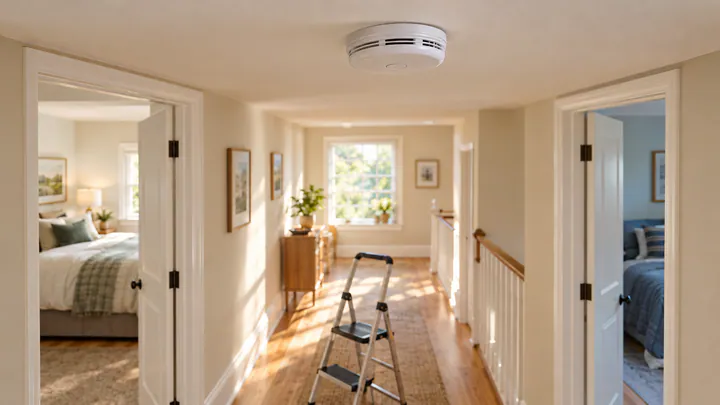
A typical two-story house with a basement and an attached garage needs smoke alarms inside every bedroom, outside each sleeping area and on every level, plus carbon monoxide (CO) alarms outside the sleeping area and on each living level. For the example home in this guide that comes to six units: four smoke-only alarms and two combination smoke/CO alarms. Below, the guide works through that floor plan room by room, explains where each type goes and why, and finishes with a testing and replacement calendar you can stick to.
This is a planning checklist for battery-powered or plug-in alarms you can add yourself after a move or a renovation. If you are wiring a hardwired, interconnected system into a new build, your local building code and a licensed electrician decide the layout. Landlords checking their legal duties should read their local regulations, and renters should check their lease and talk to the landlord before removing or relocating any alarm that is already installed.
Smoke alarms and CO alarms do different jobs
A smoke alarm detects particles from a fire, and because smoke rises, it belongs high: on the ceiling or high on a wall, as the manufacturer's instructions specify. A CO alarm detects carbon monoxide, an invisible, odorless gas produced when fuel such as natural gas, oil, propane or wood burns incompletely. A furnace with a cracked heat exchanger, a blocked flue or a car left running in an attached garage can all release it.
The two dangers call for different placements. Fire can start anywhere, so smoke alarms spread throughout the house, with extra cover where people sleep. CO builds up quietly, and the main risk is that it overcomes people while they are asleep, so CO alarms concentrate near bedrooms and on the levels where people live.
A smoke alarm will not detect CO, and a CO-only alarm will not detect smoke. Neither replaces the other.
Smoke alarms: bedrooms, hallways and every level
The U.S. Fire Administration's smoke alarm guidance sets out three placement rules: inside each bedroom and sleeping area, outside each bedroom and sleeping area, and on every level of the home, including the basement. It also recommends interconnected alarms, so that when one sounds, they all sound.
Use this checklist on your own floor plan:
- Every bedroom: one smoke alarm inside, including guest rooms, nurseries and any room where someone regularly naps or sleeps, such as a converted office.
- Outside each sleeping area: one in the hallway or landing that leads to the bedrooms. If bedrooms sit in two separate wings, each wing counts as its own sleeping area and needs its own hallway alarm.
- Every level: at least one per floor, including the basement and any finished attic room, even on a floor with no bedrooms.
- Interconnection: wireless interconnected battery alarms link to each other without new wiring, so a fire in the basement sets off the alarm outside the upstairs bedrooms too. Check that every unit you buy is compatible with the others before mixing models.
Interconnection matters most in a two-story house. With the bedroom doors shut, a basement alarm sounding on its own may not wake anyone upstairs.
CO alarms: outside sleeping areas and on each level
The Consumer Product Safety Commission's CO alarm page says CO alarms should go on each level of the home and outside sleeping areas. The same page says they should not be installed in attics or basements unless those spaces include a sleeping area.
That basement exception surprises people, because the furnace and water heater are often down there. The point is to protect the places where people breathe the air for hours at a time, especially while asleep. If anyone sleeps in your basement, such as a teenager's room, a guest bed or an in-law suite, the basement counts as a sleeping level and gets a CO alarm outside that room.
So plan CO alarms by level and by sleeping area, not by counting appliances. Your alarm's instructions or your local code may add requirements, so read both before you finalize the plan. If your home has no fuel-burning appliances, fireplace or attached garage, ask your local fire department whether CO alarms are still required where you live, since many jurisdictions set their own rules.
Why combination units suit some spots and not others
A combination smoke/CO alarm puts both sensors in one housing. It earns its place where the plan calls for both alarms in the same spot, which in most homes means the hallway outside the bedrooms and the main living level. You get one device to mount and one test button.
Elsewhere, it adds cost without adding protection:
- Inside bedrooms, the placement rules call for smoke detection. The hallway CO alarm just outside covers the sleeping area, so a CO sensor in each bedroom is optional.
- In a basement with no sleeping area, the CPSC's CO alarm guidance advises against a CO alarm, so a smoke-only unit fits better.
- End of life: when either sensor reaches the end of its rated life, the whole unit has to be replaced. Separate units let you replace each on its own schedule.
- Mounting height: combination units are designed for ceiling or high-wall mounting. Some standalone CO alarms plug into an outlet at a lower height. Follow the instructions for whichever unit you buy.
Combination units also use different sound patterns or voice messages for smoke and CO. Learn them on installation day, because a CO alarm means getting everyone outside into fresh air and calling for help. It is not a reason to go looking for a fire.
Worked example: a two-story house with basement and garage
Here is an illustrative floor plan with typical rooms:
- Basement: unfinished, with the furnace, water heater and laundry. No one sleeps there.
- Main floor: entry, living room, kitchen, dining area and a half bath, with a door from the mudroom into the attached garage. No bedrooms.
- Upper floor: three bedrooms off a single hallway, plus two bathrooms.
| Location | Alarm | Reason |
|---|---|---|
| Basement ceiling, near the bottom of the stairs | Smoke only | Every level needs a smoke alarm. Smoke rising toward the stairwell passes this spot. No sleeping area, so no CO alarm. |
| Main floor, living area or hallway between the living room and the garage door, well away from the stove | Combination smoke/CO | Covers smoke and CO for a living level, and sits on the path any garage fumes would take into the house. |
| Upper hallway outside the bedrooms | Combination smoke/CO | Outside the sleeping area, where both alarms are called for. |
| Primary bedroom | Smoke only | Inside each bedroom. |
| Bedroom 2 | Smoke only | Inside each bedroom. |
| Bedroom 3 | Smoke only | Inside each bedroom. |
The shopping list comes to 4 smoke-only alarms (basement + three bedrooms = 1 + 3) and 2 combination smoke/CO alarms (main floor + upper hallway), for 6 units in total. That gives smoke detection at 6 points and CO detection at 2. Buy all six as one interconnectable family so a single alarm sets off the rest.
Adjusting the plan to your house
- Basement bedroom or guest bed: add a smoke alarm inside that room and a CO alarm outside it. A seventh unit as a combination alarm in the basement hallway, plus the bedroom smoke alarm, brings the total to 8.
- Bedrooms split across two hallways: add a hallway alarm for the second sleeping area.
- A nursery or home office used for naps: treat it as a bedroom.
- Split-level homes: each half-level counts as a level.
The attached garage
The garage itself is usually not on the list. Car exhaust, dust and the heat and cold of an unconditioned space can cause false alarms or push a household alarm outside its rated operating range, which is printed in the manual. Protect the house side instead: the main-floor unit near the garage door in the table above does that job. If you want a warning for a garage fire, look at heat alarms rated for garages, and check the operating range before buying.
Spots to avoid: kitchens, bathrooms, vents and dead-air corners
A badly placed alarm either misses smoke or goes off so often that someone pulls the battery. Avoid these spots, and use the manufacturer's instructions for exact minimum distances, since they vary by model:
- Directly beside the stove or toaster. Cooking smoke causes nuisance alarms. Put the main-floor alarm in an adjoining room or hallway, not over the cooktop. If your model has a hush button, use it for burnt toast instead of disabling the alarm.
- Inside or right outside bathrooms. Shower steam can trigger smoke sensors. In the upstairs hallway, mount the alarm toward the bedroom doors rather than beside the bathroom door.
- Next to heating and cooling vents, ceiling fans and windows. Moving air can blow smoke away from the sensor or carry dust into it.
- Dead-air spaces. The corner where the wall meets the ceiling and the very peak of a steep vaulted ceiling can trap a pocket of air that smoke reaches late. The manual shows the acceptable zones for that model.
- Attics and unoccupied basements, for CO alarms. The CPSC's CO alarm page advises against these unless they include a sleeping area.
- Behind furniture or curtains. A CO alarm that plugs in low needs open air around it. Don't hide it behind a sofa.
A testing and replacement calendar you can keep
The routine has three parts: a monthly test, a yearly maintenance date and a replacement date written on each unit. The U.S. Fire Administration says to test smoke alarms monthly and to replace the entire smoke alarm every 10 years.
| When | Task | Notes |
|---|---|---|
| Installation day | Write a replace-by date on each unit with a permanent marker | Smoke alarms: 10 years on, following the USFA smoke alarm guidance. CO and combination units: use the life stated in the manual, which may be shorter. |
| Every month (pick a fixed day, such as the first Saturday) | Press the test button on every alarm | With interconnected units, confirm that the others sound too. Six units take about five minutes. |
| Once a year (pick an easy date to remember, such as your move-in anniversary) | Replace batteries in units with replaceable batteries. Gently vacuum or dust the vents. Check every replace-by date. | Sealed long-life units have no battery to change. Follow the manual's cleaning method. |
| Whenever a unit chirps | Check the manual for that chirp pattern | It may mean a low battery or end of life. A unit at end of life needs replacing, not a new battery. |
| Replace-by date | Swap in a new unit | If your units are interconnected, check that the new one is compatible with the rest. |
Worked example: setting the replace-by date
Most alarms have a manufacture date printed on the back, and that date, not the day you bought it, is the safer starting point. Say a smoke alarm at the bottom of your basement stairs shows a hypothetical manufacture date of March 2024. Applying the U.S. Fire Administration's 10-year replacement rule gives a replace-by date of March 2034. Write "Replace by 03/2034" on the side of the unit where you can see it from a stepladder. If a combination unit's manual gives a shorter life, write that earlier date on it instead.
When you move into a home with alarms already in place, take each one down and read the date. If there is no date, or the date suggests the alarm is near or past its replacement point, replace it. That costs roughly $20 to $60 per unit, depending on type and features.
Put the monthly test in your phone calendar as a repeating event with an alert. Keep a list of the six locations with each unit's replace-by date, taped inside a utility closet door or stored in your phone's notes, so the yearly check takes minutes rather than a hunt through the house.