Why Sweaters Pill, and How to Remove and Prevent Bobbles
Pilling comes from friction working short, loose fibers free. Here's how to read the clues in your own sweater, choose between a comb, stone, shaver or tape, and wash and wear knits so the bobbles come back more slowly.
Drafted with AI; reviewed by Najam Kausar on . How we work.
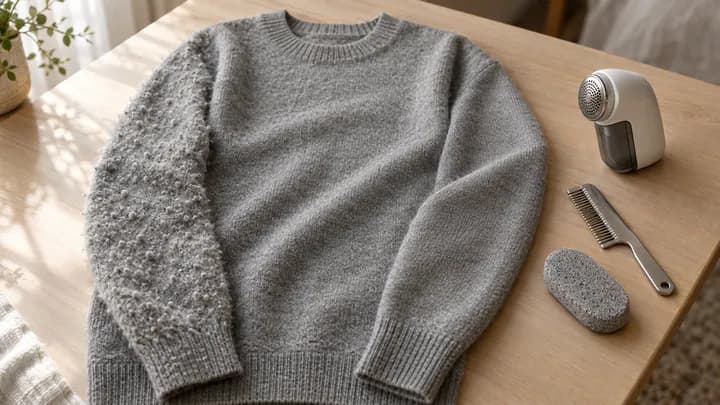
Sweaters pill because friction pulls short, loose fibers out of the yarn and rolls them into tiny tangled balls that stay anchored to the surface. Price doesn't protect you: a $300 cashmere crewneck can bobble as fast as a $25 acrylic one. If your knitwear looks tired after a few wears, the fix has three parts: work out why that particular sweater is pilling, remove the pills with a tool suited to its fiber, and change the washing and wearing habits that create the friction in the first place.
This guide covers pilling only. Moth holes, shrinkage and felting (where wool fibers lock together and the fabric turns dense and stiff) are different problems with different fixes.
What pills are and why they gather where they do
A pill starts as a loose fiber end poking out of the yarn. Rub that surface and neighboring loose ends twist around it, forming a small fuzzy knot. The knot stays tethered by a few fibers still caught in the yarn, so it sits on the fabric instead of falling away.
That is why pills cluster in predictable places: under the arms, along the sides where your arms swing against your body, on the cuffs and forearms that rest on desks, and wherever a bag strap or seatbelt crosses. The pattern on your own sweater tells you a lot. Pills confined to those zones mean ordinary wear friction. Pills spread evenly over the whole garment, including the back and the middle of the chest, usually point to the washing machine or to a yarn that sheds easily everywhere.
Reading the clues in your sweater's fiber and yarn
Check the care label and then look closely at the knit. Three features decide how quickly a sweater pills.
Short staple fibers
"Staple" is the length of the individual fibers spun into the yarn. Short fibers have fewer twists holding them in place, so their ends escape sooner. Lower-grade cashmere, some lambswool and many acrylic yarns are spun from shorter fibers, which is why two cashmere sweaters at very different prices can behave so differently. Longer-staple wool and cashmere, and fibers like silk, tend to pill less, though nothing is immune.
Synthetic blends
Blends that include polyester, nylon or acrylic often look worse over time than pure wool. The synthetic fibers are strong, so the tethers holding each pill don't break. With pure wool, many pills eventually snap off on their own during wear and washing; on a blend they tend to stay put and accumulate. If your sweater has stubborn, hard little balls that won't brush away, check the label for a synthetic content.
Loose knits and soft-spun yarns
Yarn that is lightly twisted, brushed for a fluffy finish, or knitted at a loose gauge gives fibers more room to work free. Hold the sweater up to a light: if you can see a lot through it, or the yarn feels airy and squashy rather than smooth and firm, expect more pilling. Tightly knitted, smooth, plied yarns hold their fibers in better.
A quick diagnosis
- Pills only at underarms, sides and cuffs: normal wear friction. Removal plus the wearing habits below will help most.
- Pills all over after the first wash: too much agitation in the machine, or a soft-spun yarn. Change how you wash it.
- Hard pills that won't brush off: likely a synthetic blend. A shaver or comb will be needed, and they'll return.
- Heavy pilling on a new natural-fiber sweater: new knits often shed their loosest fibers early, and pilling commonly eases after the first few rounds of removal. If it doesn't slow down, the yarn is probably short-staple.
Removal tools compared
Four tools do most of the work. They differ mainly in how much control you have and how much fabric they can take with them.
| Tool | Speed | Typical cost | Risk to fabric | Best for |
|---|---|---|---|---|
| Fabric comb (fine metal teeth) | Slow to moderate | Roughly $5–$15 | Low with light strokes | Fine cashmere, merino and other lightweight knits |
| Sweater stone (pumice block) | Moderate | Roughly $8–$15 | Low to moderate; can scuff fine knits | Thicker wool and chunky knits |
| Electric fabric shaver | Fast | Roughly $15–$40 | Moderate to high if overused; can snag texture | Flat, smooth knits and synthetic blends with stubborn pills |
| Tape or lint roller | Fast for loose fuzz | Roughly $3–$10 | Very low | Light fuzz, loose pills and a final cleanup pass |
Comb
A fabric comb catches pills on its teeth and lifts them off. It is slower than a shaver but you feel exactly how much it grabs, which makes it the safer choice for fine, expensive knits. It struggles with large, deeply anchored pills on synthetic blends.
Sweater stone
A stone is a block of pumice that drags pills off as you stroke it over the fabric. It works well on sturdy, thicker wool, where it removes pills without much effort. On thin cashmere it can rough up the surface, so test it on an inside seam first.
Electric shaver
A battery or plug-in shaver has spinning blades behind a perforated guard. It clears a whole sleeve in a minute or two, which is why it's the obvious pick for a pilled synthetic blend. The cost is that it cuts whatever pokes through the guard, including the surface of the yarn itself. Go over the same area too often and the fabric thins. Avoid it on cables, ribbing and bouclé, where raised texture can be pulled into the blades.
Tape or lint roller
Wrapping packing tape sticky-side out around your hand, or using a lint roller, lifts loose fuzz and pills that are barely attached. It does almost nothing for firmly anchored pills, but it is the gentlest option and useful after combing to pick up debris.
A disposable razor is sometimes suggested as a free alternative. It works on very flat knits, but it is easy to slice into the yarn, so we'd only consider it on a sweater you aren't worried about.
Removing pills without thinning the fabric
Technique matters more than the tool. The aim is to take off the pill and as little of the yarn underneath as possible.
- Lay the sweater flat on a hard surface. A table or countertop gives you a firm base; a bed or your lap lets the fabric bunch, and bunched fabric is where shavers snag.
- Smooth the area slightly taut with your free hand. Flatten it without stretching the knit out of shape.
- Work gently in one direction. Use short, light strokes with a comb or stone, moving the same way each time. Scrubbing back and forth loosens fresh fibers and creates the start of new pills.
- With a shaver, let it glide. Keep it flat, don't press down, and keep moving. One or two passes over an area is usually enough.
- Check as you go. Hold the sweater up to a window every few minutes. If an area looks more see-through than the rest, stop there.
- Finish with tape or a lint roller to lift the loose fluff left behind.
Accept some fuzz. Chasing every last pill on a soft-spun yarn removes yarn faster than it removes pills. Depilling a little and often, say every few wears, keeps pills small and easier to lift, and spares you a heavy session on a badly pilled sweater.
Washing and drying habits that cut friction
Every wash rubs the sweater against itself, other clothes and the drum. The less rubbing, the fewer pills.
- Turn knits inside out. The outer face, the one people see, then takes less of the abrasion.
- Hand wash or use the gentlest cycle. For hand washing, use cool to lukewarm water and a wool or gentle detergent, then press the sweater through the water rather than rubbing or wringing. In a machine, choose the wool or delicate setting, cold water and a low spin, and put the sweater in a mesh laundry bag.
- Wash with similar items. Keep knits away from jeans, towels and anything with zippers, hooks or Velcro, all of which grind against yarn.
- Skip the tumble dryer. The tumbling is pure friction, and heat brings shrinkage risk on top. Roll the sweater in a towel to press out water, then dry it flat on a towel or drying rack, reshaping it as it dries.
- Wash less often. Wool in particular can usually be aired overnight between wears instead of washed each time. Spot-clean small marks and save full washes for when the sweater actually needs one.
Follow the care label where it gives specific instructions; it reflects the fiber and construction of that garment.
Wearing habits: bag straps, desks and rotation
If your pills sit in tight zones, the cause is something you do every day, and small changes make a visible difference.
Bags and straps
A crossbody bag rubs a diagonal band across the chest and a patch on the hip where the bag bounces. Backpacks pill the shoulders and upper back. On days you wear a delicate knit, carry a handheld bag or tote on the hand, or switch the strap to the other shoulder so the wear is spread out.
Desks, chairs and coats
Forearms resting on a desk edge or laptop palm rest wear the sleeves; textured office chairs rub the back. Pushing sleeves up while typing, or wearing a smooth shirt over a pilling-prone knit at the desk, cuts that contact. Coats with rough wool or fleece linings can also pill the sweater underneath, while a smooth lining glides over it.
Rotation
Giving a sweater a day or two of rest between wears lets the fibers relax and recover their shape, and it simply halves the friction any one garment takes. Rotating three or four knits through a week spreads the wear instead of concentrating it on a favorite.
When pilling means something else
If removing pills reveals thin patches or the beginnings of holes at the elbows or underarms, the yarn itself is wearing through. Depilling won't fix that; darning or reinforcing the area will. And if a sweater pills heavily no matter how gently you treat it, the yarn is the limiting factor. That's useful to know next time you shop: look for tightly knit, smooth yarns and longer-staple fibers, and be wary of very soft, fluffy knits at a low price.