Garment Quality in 2026: How to Spot Well-Made Clothes
A practical, hands-on guide to judging how well a piece of clothing is made — fabric, seams, weight, and finishing — in under a minute, in a store or online.

TL;DR: Judge a garment in four moves — read the fiber composition, hold the fabric up to the light, tug a seam apart to see the stitching, and check the inside finishing. Those four checks predict how a piece will look after fifty washes far better than the price tag ever will.
Garment quality is the combination of fiber, fabric construction, cut, and sewing that determines how long a piece of clothing holds its shape, color, and surface. It is a physical property you can assess with your hands in about a minute — not a brand attribute you have to take on faith.
Our team has found that most shoppers already sense when something feels cheap but can't name why, so they default to price as a proxy. That proxy is unreliable in 2026, when the same factory can produce a $29 shirt and a $290 one. What follows is the vocabulary and the sequence to replace the guesswork.
What is the fastest way to check quality in a store?
Run this 60-second sequence on any garment before it goes near a fitting room. It works on shirts, dresses, knitwear, trousers, and coats alike.
- Read the composition label first (10 seconds). It's inside the side seam or at the neck. If it says 100% acrylic on a $180 sweater, you can stop there.
- Hold it up to the light (10 seconds). A dense weave or knit blocks light. If you can read your hand through a supposedly opaque garment, it will be thin on the body and will thin further with washing.
- Gently pull one seam apart (10 seconds). Grip either side of a side seam and pull laterally with light pressure. If white thread and gaps appear between stitches, the stitch density is low and the seam will eventually split.
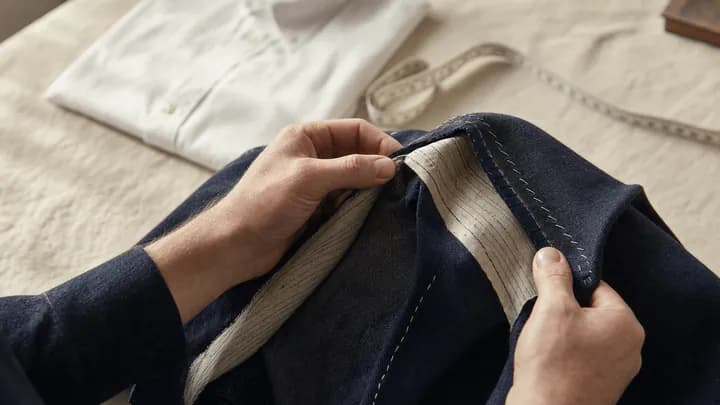
- Turn it inside out (20 seconds). This is where cost-cutting hides. Look for finished seam edges, a lining that is stitched rather than glued, and a reasonable seam allowance.
- Scrunch and release (10 seconds). Ball a section of fabric in your fist for five seconds, then open. Deep creases that stay are a preview of how the garment will look after an hour of sitting.
None of these checks require expertise. They require permission to touch the clothes properly, which shoppers rarely give themselves.
Which fabrics actually last, and which fall apart in a season?
Durability depends less on whether a fiber is natural or synthetic than on staple length and how tightly the yarn is spun. Long fibers spun tightly resist pilling and abrasion; short fibers loosely spun shed and tangle almost immediately.
| Fiber | Performs well for | Main weakness | What to look for |
|---|---|---|---|
| Long-staple cotton (Pima, Supima, Egyptian) | Shirting, tees, denim, bedding | Wrinkles; shrinks if untreated | Named staple type, smooth surface, weight stated |
| Merino wool | Knitwear, base layers, tailoring | Moth damage; pills at friction points | Micron count listed (19.5 or lower is fine next to skin) |
| Linen | Warm-weather shirts, trousers, dresses | Creases constantly; weak when wet | Slubby texture, good drape, not stiffened with filler |
| Lyocell / TENCEL | Drapey dresses, blouses, shirting blends | Can lose crispness over time | Named as lyocell, not just "viscose" |
| Viscose / rayon | Fluid drape at low cost | Weakens and shrinks when wet; often dry-clean only | Care label; avoid for anything you'll wash weekly |
| Polyester | Outerwear, linings, activewear, pleat retention | Traps odor; can feel plasticky in cheap weights | Recycled content, tight weave, breathable construction |
| Acrylic | Cheap warmth, bright colors | Pills severely, often within weeks | Generally worth avoiding above entry price points |
| Nylon / polyamide | Abrasion resistance, hosiery, technical shells | Shiny hand feel; heat-sensitive | Denier rating on technical pieces |
| Elastane / spandex | Stretch and recovery | Degrades with heat and time; 2–5% is plenty | Percentage above 8% in wovens usually signals shortcuts |
The honest caveat: a fiber blend is not automatically worse. A cotton-elastane shirt at 97/3 recovers its shape better than pure cotton, and a wool-nylon sock outlasts pure wool by a wide margin. What matters is whether the blend serves a function or simply cuts cost.
How do you read a composition label without being fooled?
Read the percentages in descending order and ask what each fiber is doing. The dominant fiber sets the character of the garment; anything under about 5% is usually a performance additive rather than a cost-saver.
Three specific traps our team sees repeatedly:
- "Wool blend" that is mostly not wool. A coat labeled 30% wool, 60% polyester, 10% other fibers is a polyester coat. The wool is there for the word on the swing tag.
- "Other fibers" as a catch-all. Regulations in many markets allow small undeclared percentages to be grouped. A large "other fibers" figure means you don't actually know what you're buying.
- Viscose posing as silk. Viscose drapes beautifully in the store and can shrink, water-spot, and lose body after the first wash. It is not a silk substitute for anything you wear often.
What does GSM tell you?
GSM (grams per square meter) is fabric weight, and it's the single most useful number a brand can publish. For T-shirts, roughly 140–170 GSM is lightweight and often semi-transparent, 180–220 GSM is a dependable everyday midweight, and 220 GSM and above is a structured heavyweight. For wool coating, anything under about 400 GSM will feel insubstantial in real winter weather.
What construction details separate a $40 piece from a $400 one?
Construction quality lives on the inside of the garment: stitch density, seam finishing, pattern matching, and whether components are sewn or fused. These are the details that survive washing, and they're the ones fast production eliminates first.
Stitch density and seam finishing
Count stitches along an inch of a straight seam. Well-made garments typically run somewhere around eight to twelve stitches per inch; budget production often drops to five or six because fewer stitches means faster sewing and less thread. Then check how the raw edge is handled — a French seam or a bound edge on a blouse signals real investment, while a single overlocked edge is the standard minimum.
Pattern matching and grainline
On stripes, checks, and prints, look at the side seams, the pockets, and the center front placket. Matched patterns mean the manufacturer cut the fabric generously rather than nesting the pieces to waste as little as possible. Then hang the garment and look at the side seam — if it spirals toward the front or back, the piece was cut off-grain and will always twist on the body.
Fused versus sewn
Press a jacket lapel or a shirt collar between two fingers. Fused interfacing feels flat and papery and eventually bubbles after dry cleaning; a sewn or floating canvas feels springy and rolls back into shape. On trousers, check whether the waistband is lined and whether there's extra fabric in the seam allowance — that reserve is what makes future alterations possible. If you're planning to have a piece adjusted, our guide to what's worth altering and what tailoring actually costs covers which changes are realistic on which garments.
Does price predict quality in 2026?
Price predicts quality weakly and inconsistently. Retail price incorporates brand equity, marketing spend, store leases, and markup, and a luxury label may use the same mills and factories as a mid-market one. Our working rule is simple:
- Below a certain floor, quality is genuinely constrained. A $12 wool-look coat cannot contain meaningful wool. Physics and material costs are real.
- In the mid range, variation is enormous. This is where the physical checks pay for themselves, because a $90 shirt may beat a $300 one on every measurable point.
- At the top, you're often paying for design, finish, and brand. Sometimes that buys hand-finishing and exceptional mills. Sometimes it buys a logo. The inside of the garment tells you which.
The more useful metric is cost per wear: purchase price divided by realistic number of wears. A $250 coat worn 100 times a year for four years costs about 60 cents a wear. A $60 trend piece worn three times costs $20 a wear. This is the arithmetic behind building a compact wardrobe of pieces that combine easily rather than a closet of single-outfit purchases.
How do you judge quality when you can't touch the garment?
Online, substitute published specifications for your hands. The three data points that matter most are full fiber composition, stated fabric weight, and close-up photography showing seams and hardware.
- Demand the full composition. If a listing says only "soft knit fabric," assume the composition is unflattering.
- Look for weight in GSM or ounces. Brands confident in their fabric publish it. Brands that aren't, don't.
- Zoom on the details. Buttons, zippers, topstitching, and the inside of the collar are usually visible in the gallery if the brand is proud of them.
- Filter reviews for the word "wash." Reviews written after laundering are the only ones that describe durability. Search reviews for "pilled," "shrank," "faded," and "second wash."
- Read the care label before buying. "Dry clean only" on a weekday blouse is a recurring cost most people never factor in.
What about secondhand and vintage?
Secondhand is frequently the highest-quality option at a given price, because garments made in earlier decades often used heavier fabrics and deeper seam allowances than equivalently priced new pieces. It also removes the guesswork about durability — the item has already survived years of wear.
Inspect in this order: underarms and crotch seams for thinning, elbows and seat for shine, hems for repairs, and the whole garment held to light for moth holes in wool. Check that zippers run their full length and that any elastane hasn't gone slack and crunchy, which is the one failure mode age guarantees. A well-cut vintage wool coat with a tired lining is a good buy; a stretch garment from 15 years ago rarely is.
What are the most costly quality mistakes?
- Buying dark fabric in bad lighting. Store lighting hides both weave sparseness and off-grain twist. Walk to a window or a doorway.
- Trusting a heavy feel that comes from coating. Some cheap fabrics are finished with sizing or resin that washes out, taking the body of the fabric with it. Rub the surface firmly — if a fine powder appears, that weight is temporary.
- Ignoring the hardware. Zippers and buttons are the most common point of total failure. A plastic zipper on a coat you'll wear daily will outlast nothing.
- Assuming natural equals durable. Loosely spun short-staple cotton pills as badly as acrylic. Fiber name alone proves nothing.
- Skipping the size-up test. A garment that fits only when perfectly still is a garment you won't wear. Sit down in the fitting room and raise both arms.
One honest exception: quality checks matter less for genuinely short-life items. A neon piece bought for one event doesn't need French seams. The checks are for the garments you intend to keep, which is most of what belongs in a closet you actually reach for every week.
Key takeaways
- Quality is physical and checkable: composition, light test, seam pull, inside finishing, scrunch test — about 60 seconds total.
- Staple length and yarn twist predict pilling and durability better than whether a fiber is natural or synthetic.
- Fabric weight in GSM is the most useful number a brand can publish; its absence online is itself information.
- Price is a weak proxy for quality in the mid and upper market — cost per wear is the more honest number.
- Secondhand often delivers better construction per dollar, provided you inspect underarms, seat, hems, and hardware first.
Frequently asked questions
How can I tell if clothing is good quality in a store?
Do a four-part check: read the fiber composition label, hold the fabric to the light to see how dense the weave is, pull a seam gently apart to see how much thread shows, and look at the inside finishing. A garment that passes all four is almost always well made, regardless of the brand on the tag.
Does a higher price mean better quality clothing?
No — price reflects brand positioning, marketing, and retail markup at least as much as construction. Mid-priced garments frequently outperform luxury ones on fabric and stitching, which is why the physical checks matter more than the tag.
Is polyester always bad quality?
No. Polyester is durable, wrinkle-resistant, and genuinely useful in outerwear, activewear, and linings, but it traps odor and can feel plasticky in cheap weights. The problem is usually low-grade polyester used to imitate a natural fiber, not the fiber itself.
What is GSM and what number should I look for in a T-shirt?
GSM means grams per square meter and measures fabric weight. For T-shirts, roughly 140–170 GSM is lightweight and prone to transparency, 180–220 GSM is a solid everyday midweight, and 220 GSM and above is a heavyweight tee that holds its shape.
How do I judge quality when buying clothes online?
Look for the full fiber composition, a stated fabric weight in GSM or ounces, close-up product photos, and reviews that mention how the item held up after washing. If the listing hides composition or weight, treat it as a red flag and rely on a generous return policy.
Why do my sweaters pill so quickly?
Pilling happens when short fibers work loose from the yarn and tangle at friction points, so it is most common in short-staple cotton, acrylic, and loosely spun wool blends. Tightly spun, long-staple yarns pill far less, and washing inside out on a gentle cycle slows the process.
Are secondhand clothes a good way to get higher quality?
Often yes, because older garments were frequently made with heavier fabric and more generous seam allowances than similarly priced new pieces. Inspect the underarms, crotch seams, and hems for thinning, since those wear out before the rest of the garment shows any age.