Belt Width, Size and Color: Matching a Belt to Your Outfit
Choose a belt that fits your trouser loops, your waist and your shoes. Width, sizing and color-matching rules, plus a three-belt set that covers most outfits.
Drafted with AI. This version has not been reviewed by an editor, so it carries no ads — how we work.
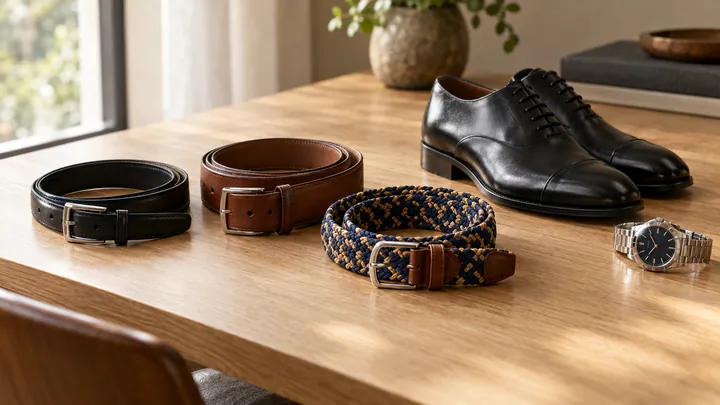
A belt looks right when three things line up: a width that suits your trouser loops, a size one or two up from your waist, and leather that matches your shoes in both color and finish. Get those right and two or three belts will cover nearly everything you wear, from an interview suit to weekend jeans. This checklist is for anyone buying a first proper leather belt or putting together a small set. If you mainly want wide statement belts cinched over dresses and coats, those follow looser styling rules and this guide won't help much.
1. Pick the width your trousers were made for
Width is the first thing to settle, because a belt that is too wide for its loops never sits flat. Dress belts are typically around 1 to 1.25 in (2.5 to 3.2 cm) wide. Casual belts for jeans run around 1.5 in (3.8 cm), and that extra quarter inch often won't pass through the narrower loops on dress trousers. Pushed through anyway, the leather bunches, the loops strain and the trousers pucker at the waistband.
Going the other way causes its own problem. A slim 1 in dress belt in the deep, wide loops of heavy jeans looks underpowered and tends to ride up and down. In general, narrower reads dressier and wider reads more casual.
| Belt type | Typical width | Wear it with |
|---|---|---|
| Dress belt | About 1–1.25 in (2.5–3.2 cm) | Suits, dress trousers, smart chinos |
| Everyday casual leather | About 1.25–1.5 in (3.2–3.8 cm) | Chinos, jeans, cords |
| Jeans or work belt | About 1.5 in (3.8 cm) and up | Jeans, workwear, heavy cotton |
- Measure the inside width of a belt loop on the trousers you wear most. A ruler laid across the loop is enough.
- Choose a belt that slides through with a little room to spare rather than one that has to be forced.
- If you own both dress trousers and jeans, measure one pair of each. Your loops tell you whether a single in-between width can cover both or whether you need two.
2. Size the belt from your trouser waist
Buy a belt one or two sizes above your trouser waist size, and aim to fasten it on the middle hole. Belt size is normally measured from the point where the leather folds around the buckle bar to the middle hole, and the belt wraps around the outside of your trousers and tucked shirt, so it needs a little more length than the waist measurement inside the waistband.
Fastening on the middle hole gives you room both ways: a notch tighter for lighter trousers, a notch looser over a thicker sweater tucked in. The tail end should reach past the first belt loop beside the buckle without reaching the second. A tail that flaps past the second loop means the belt is too long; one that doesn't reach the first loop means it's too short.
Worked example: choosing a size
Say your trousers are labeled 32. A size 34 belt is the usual starting point. If that belt has a hypothetical five holes spaced 1 in apart, the middle hole sits at roughly the stated size and the outer holes give you about 2 in (2 × 1 in) of adjustment either way.
Trouser labels can be generous, so the most reliable method is to measure a belt you already own. Lay it flat and measure from the fold at the buckle to the hole you actually use. If that comes to about 34 in, buy a 34. If it lands between sizes, check the brand's size chart, because some round up and some round down. Belts sold in centimeters convert at 2.54 cm per inch, so 34 in is about 86 cm (34 × 2.54 = 86.36). Brands differ on whether a metric size describes the belt or the waist it fits, so read the chart rather than guessing.
- Note your usual trouser waist size and add one or two sizes.
- Measure your best-fitting current belt from the fold at the buckle to the hole you use.
- Check that the tail will clear the first loop but not the second.
- If a belt is slightly long, look for a screw or clamp buckle. Those let a cobbler, or sometimes you, shorten it from the buckle end without punching new holes.
3. Match the leather to your shoes
The belt and shoes are the two leather pieces at either end of your trousers, and the eye connects them. Two rules do most of the work:
- Same color family. Black belt with black shoes, brown belt with brown shoes. Browns don't need to match exactly, but keep them close in depth: dark brown with dark brown, tan with tan or mid-brown. Burgundy or oxblood shoes go with a dark brown belt or one in the same red-brown.
- Same finish. Shiny, polished shoes call for a smooth, polished belt. Matte leather or suede shoes look better with a matte or suede belt. A glossy belt with suede loafers looks mismatched even when the browns are close.
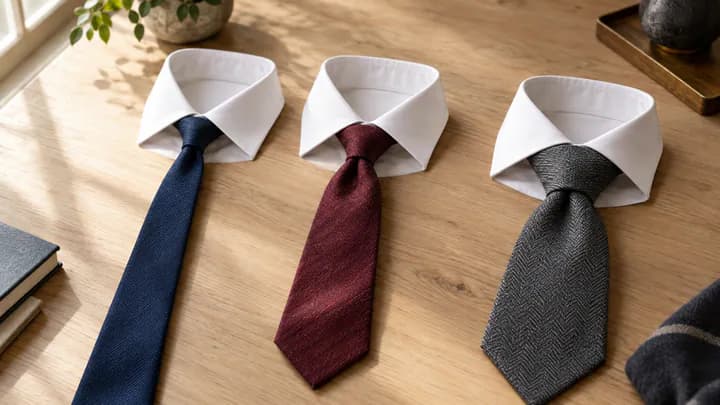
The rules relax as outfits get more casual. With sneakers, canvas shoes or boat shoes, the belt doesn't have to echo the footwear, and a woven or canvas belt often looks more natural than leather. With a suit, the opposite applies: black shoes and a black dress belt are the safe base. From there, details such as which tie knot suits your collar and occasion do more for the look than the belt does, since the jacket covers most of it.
4. Choose the buckle size and metal tone
A buckle should be in proportion to the strap. On a dress belt, that means a small, slim buckle with a polished or satin finish. Casual belts can carry a chunkier buckle in brushed, antiqued or matte metal. A large logo buckle fights with tailoring, so keep those, if you own one, for jeans.
The two common styles are the frame buckle with a prong, which is the classic choice for both dress and casual belts, and the plate buckle, a flat rectangle that hooks into the strap and reads clean and modern. Either works with a suit as long as it stays small.
- Coordinate the metal tone with your watch case and other hardware where practical: silver or steel with silver, brass or gold tone with gold.
- Look at your shoes too. Monk straps carry buckles and many loafers have metal bits, so those are worth matching.
- Don't overthink it. A wedding ring or eyeglass frames in a different metal won't spoil the look; aim for the most visible pieces to agree.
- If you wear one watch most days, buy your dress belt in that metal tone first.
5. Woven, suede and canvas belts for casual outfits
Non-leather and textured belts fill the casual gaps that a smooth leather belt covers less well, especially in warm weather.
Woven stretch belts
These are braided from elastic cord, sometimes mixed with leather trim, and they have no punched holes: the prong goes through the weave at any point. That makes the fit finely adjustable, which suits shorts, travel days and anyone whose waist varies through the day. Many are sold in S/M/L or by waist range rather than a single number. The trade-off is formality: they belong with chinos, shorts and linen, never with a suit.
Suede belts
A suede belt pairs naturally with suede shoes, chinos, corduroy and flannel trousers. It scuffs and marks more easily than smooth leather and doesn't like rain, so it works better as a second or third belt than as the one you wear every day.
Canvas web belts
Cotton web belts with a slide or D-ring buckle are inexpensive, light and fine with shorts and beach clothes. They tend to fray and fade within a few seasons and look out of place with anything dressier than chinos.
6. A three-belt set that covers most outfits
Three belts handle almost everything in a typical wardrobe if each has a clear job. Prices vary widely with leather quality: as a rough US guide, a full-grain leather belt typically costs roughly $40–$120, and a woven stretch belt roughly $20–$50.
| Belt | Suggested spec | Covers |
|---|---|---|
| Black dress belt | Smooth polished leather, about 1–1.25 in, small buckle in your watch's metal tone | Suits, dress trousers, black dress shoes |
| Brown leather belt | Mid- or dark brown, about 1.25 in so it fits both chino and jean loops, slightly more casual buckle | Chinos, jeans, brown shoes and boots |
| Woven stretch belt | Braided, in a neutral such as navy, tan or a mix | Shorts, linen, summer chinos, sneakers |
The middle belt does the most work, so check its width against both your chinos and your jeans before buying. If your jeans have wide loops and your chinos narrow ones, a 1.25 in strap is usually the compromise that fits both.
- Add a dark brown dress belt as a fourth only if you regularly wear brown dress shoes with suits.
- Consider a suede belt if you own several pairs of suede shoes.
- Reversible belts, black on one side and brown on the other, save space for travel, but the shared buckle can only match one set of shoes, and the edges are often less finished.
- Bonded leather, made from scraps glued together, is cheaper but tends to peel at the edges and around the holes. Full-grain or top-grain leather costs more up front and holds its shape far longer.
When a belt is due for replacement
Even good leather wears out at the hole you use most. Replace or retire a belt when you see:
- Cracking around the most-used hole, or that hole stretched into an oval.
- A warped or curling tip (the tongue end) that no longer lies flat in the loops.
- Layers separating at the edges, or edge paint flaking away.
- A bent prong or a loose buckle that won't stay fixed. A cobbler can often swap the buckle if the strap is still sound.
To slow the wear, rotate between belts rather than wearing one daily, hang them by the buckle or roll them loosely instead of leaving them bent at the hole, and condition smooth leather now and then with a leather conditioner.