Wind Speed Over the Valparaíso Gantry
A short story about a veteran crane operator in Valparaíso racing a closing tide window while the wind climbs toward the limit and everyone on the radio wants one more box.
Drafted with AI. This version has not been reviewed by an editor, so it carries no ads — how we work.
Story Time is original short fiction. The characters, places and events in this story are invented.
"Fifty-nine," the readout said, and then, while Rosendo was still looking at it, sixty-two.
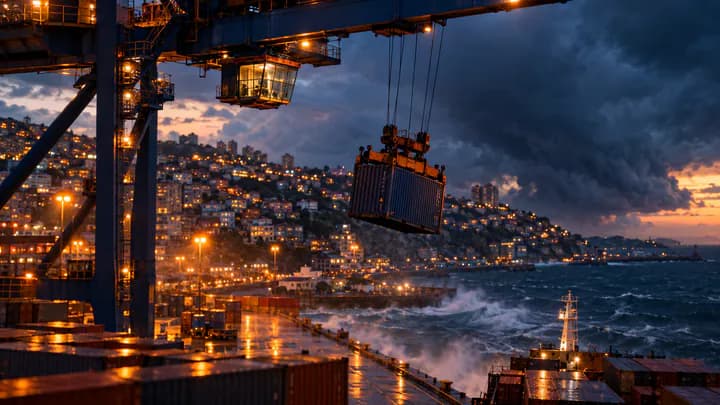
He let the hoist joystick drift back to centre and felt the spreader keep going without him, a forty-foot box of copper cathode sliding half a metre seaward on its wires before the anti-sway caught it and coaxed it home. Thirty metres below the glass floor of the cab, the deck of the Cap Andina was lit hard white, lashing rods stacked along the rail like cutlery, the open hold of bay twenty-two waiting with its cell guides bare.
"Grúa cuatro, Iturra. How many?"
"Six," Rosendo said into the handset. "Counting this one."
"Six. Good. Pilot boards at nineteen thirty-five, and then the lid goes on and she's gone. You have till then and not a minute after. The agent is breathing on my neck."
The clock taped above the windscreen said 18:51. Six boxes and a hatch cover in forty-four minutes was nothing on a calm day. In his forties, when this was still the old state port and they paid by the move, he had done thirty an hour and gone home to eat pastel de choclo without feeling it in his shoulders. With a norte pushing up the bay it was a different arithmetic. The wind came in through the seal of the cab door with a thin note, like someone blowing across the mouth of a bottle, and behind the terminal the hills had begun to light up house by house, Cerro Artillería first, then the rest, the way they always did when weather came.
He fed the box down into the guides, felt the corners bite, and watched the twistlocks drop.
"Maestro Rosendo? It's Yerko." The boy's voice was too close to the microphone. "The next one's on the chassis, the reefer. Do the lashers go up now or do I wait for you?"
"Wait for me. And get out from under the trolley rail. Stand by the bollard where I can see your helmet."
"Okay. Yes. Sorry."
Yerko was twenty-two and three weeks into the job and asked everything twice, which Rosendo had decided was better than asking nothing. He found the orange helmet by the bollard, a small bright coin on the wet concrete, and brought the spreader down onto the reefer.
Sixty-three. Sixty. Sixty-six.
The yellow lamp on the console came on at sixty-five and stayed on. The red lamp and the horn were for seventy-two. Procedure said that at seventy-two sustained, or repeated gusts above it, the operator stopped hoisting, landed the load, parked the trolley and set the storm brakes. Procedure did not say what to do when the number sat at sixty-eight and looked at you.
He lifted the reefer. The whole crane, twelve hundred tonnes of painted steel, flexed under him in a long slow sway that he felt in the backs of his knees. Thirty-one years, and he had never once stopped a crane for wind. Other men had. Contreras had stopped three times in a single winter in ninety-eight, and by spring the whole quay called him Veleta, the weathervane, and whistled when he climbed the ladder. Contreras had taken a job at a supermarket warehouse in Viña. Rosendo still saw him sometimes at the feria, buying lemons.
Two years. Marisol had a sister in Quillota with a quarter-hectare of avocados and a spare room, and every Sunday now she read him the bus timetable as if it were a menu.
The reefer went in clean. 18:59.
"Iturra, this is Benavides for the line." The agent spoke the way men in good jackets spoke on a crane channel, carefully, like someone crossing a kitchen in socks. "The master asks me to remind everyone that if he misses high water he sits until tomorrow afternoon and loses his Callao window. I'd like to give him a number."
"Tell him four boxes," Iturra said. "Tell him Rosendo is the best we have."
Rosendo did not answer that. He took the third box, a light one, empty bottles for the wine valleys going north, and it flew on the wires like laundry. Sixty-nine. He held it high over the quay and waited for a lull, and the lull came, and he ran the trolley out and dropped it into the guides in one motion that would have made him proud on another night.
The fourth box. 19:08. Sixty-seven, seventy, sixty-six.
From crane three, a hundred metres along the quay, Fuenzalida came on: "Bit of a breeze up there, viejo?"
"Bit."
"I'm on empties. Like flying kites." Fuenzalida laughed and clicked off.
Fifth box. 19:14. His coffee had gone cold in the thermos cap on the console and he did not remember pouring it. The windscreen ticked with spray, though it was not raining; the wind was lifting the tops off the swell inside the breakwater and throwing them thirty metres up at him.
"Maestro, the last one is the heavy one," Yerko said. "Thirty point five. It says on the paper. Do I—should I tell the lashers anything?"
"Tell them to stay at the end of the hatch until it's down. Not in the bay. At the end."
"At the end. Okay."
19:19. He brought the spreader down on the last forty, the copper, and felt the weight come on through the frame of the seat, the hoist motors deepening their note. He lifted it clear of the chassis, slow, a metre, five, fifteen, and began the trolley run out over the water.
The gust hit him halfway. Seventy. Seventy-one. The box did not drift this time; it swung, a real swing, the long end coming round toward the stack on the next bay, and the anti-sway groaned through the cab floor as it fought. He stopped the trolley. The box kept moving. Two metres of pendulum, thirty tonnes of metal, hanging over the open cell, and at the end of the hatch two lashers in reflective vests stood holding their rods and looking up.
"Come on, viejo," Iturra said softly, almost kindly. "It's the last one. Put it in and give me the lid."
"Pilot boat's leaving the breakwater," Benavides said.
"Maestro?" Yerko. "The lashers are asking if they should get off the hatch."
Seventy-one. Sixty-eight. Seventy-one.
He could do it. That was the trouble. He could feel exactly how he would do it: wait for the box to come back through centre, drop it a metre, let the guides take it, trust the hands that had done this forty thousand times. Nine times in ten it went in. He had built a career on nine times in ten.
"Yes," he said. "Everybody off the hatch. Now. Yerko, clear the apron behind the chassis lane, I'm bringing it back."
"Rosendo—"
"Bringing it back, jefe."
He ran the trolley home at a crawl, the box swinging under him, the lashers climbing down the ship's ladder, the orange helmet moving away from the yellow lines at a half-run. Over the apron he lowered by centimetres, waited for the swing to come through, and set the copper down on the concrete. It landed on a corner, rocked, and settled square. He opened the twistlocks, raised the empty spreader, parked the trolley at the backreach and set the storm brakes. The pins went in with a clunk he felt through his boots.
"Grúa cuatro, parada por viento," he said. "Nineteen twenty-one. Gust seventy-one."
For a while no one said anything on the channel at all.
"One box," Iturra said finally. "And the lid."
"And the lid."
"Understood." Iturra clicked off without another word, which was worse than shouting.
At 19:29 the readout said forty-four. At 19:31 it said nineteen. At 19:33 it said six, and then it said nothing, a zero with a decimal point, and the cab stopped humming, and the flag on the agency building across the road hung down its pole like a wet towel. The swell inside the breakwater lay down flat and shone.
"Veleta," Fuenzalida said on the channel, not unkindly. "You want me to come over and blow on it for you?" Someone else laughed, a lasher or a checker, before thinking better of it.
"It's flat, Rosendo," Iturra said. "Do you see it? It's flat."
He saw it. After a storm stop the brakes and the sway gear had to be inspected before the crane moved again; that was twenty minutes for maintenance to climb up and sign, and the pilot did not wait twenty minutes for anybody. At 19:41 Benavides came on and said, very politely, that the pilot boat had turned back and the master had been informed and he thanked everyone for their efforts tonight.
Rosendo switched off the cab lights. He did not want to be a lit box hanging over the quay for everyone to look up at. In the dark he could see the whole terminal laid out: the ship with its one open bay, crane three still working, the hills glittering all the way up. On the apron, beside the copper box, the orange helmet had stopped. Yerko stood with one gloved hand flat against the steel, as if checking it was really down.
Rosendo found the logbook by feel and the pen clipped to it, and wrote by the glow of the console: 19:21. Detenido por viento. Ráfaga 71. Carga pesada en balanceo sobre bodega abierta, personal en escotilla. He looked at it, then went back and wrote the seventy-one again, larger, so whoever read it in the morning would not have to squint.
The radio clicked. "Maestro?" Yerko said. "Maintenance is coming. Do I go up with them, or do I wait for you?"
Rosendo screwed the cap back onto the cold thermos and looked down at the box sitting square on the concrete, exactly where he had put it.
"Wait for me," he said.