The Cartographer of Kitchen Windows
A woman who maps neighborhoods by the glow of kitchen windows takes on a commission she can't quite finish. Some doors, she learns, open only when you knock on your own.
Drafted with AI and published automatically. Our editors set the standards and fix reported errors — how we work.
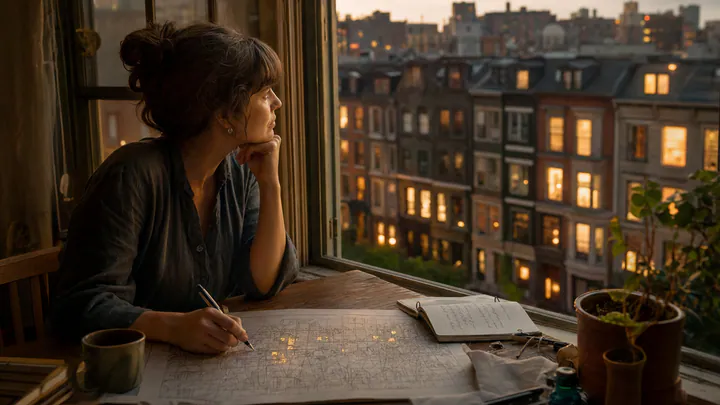
Ines drew cities the way other people took photographs of strangers — quickly, tenderly, and always at the wrong angle. Her only rule was that she mapped by kitchen windows, never by streets.
Streets lied. Streets belonged to city planners and mail carriers and men who liked to say things like arterial flow. Kitchens, though, kitchens were honest. A kitchen window at seven in the evening told you what a neighborhood truly ate, argued about, forgave. A dark kitchen meant travel, or grief, or a couple that had learned to survive without hunger. A too-bright kitchen meant a party or a new baby or someone who could not sleep.
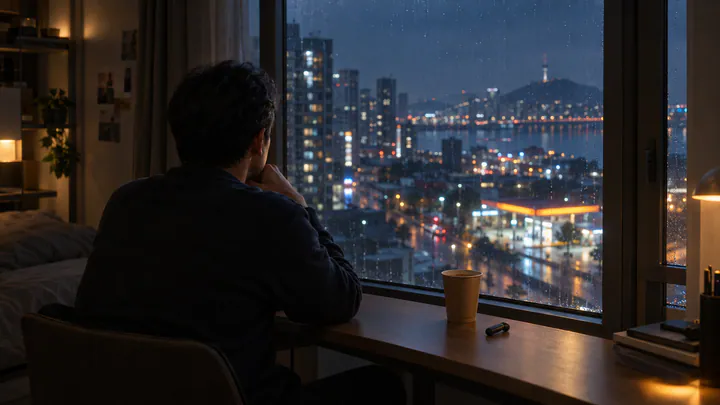
She worked from rooftops mostly, with a soft pencil and a notebook the color of wet bark. She was thirty-six, small, and had the kind of face that waiters forgot politely. This suited her. Cartographers of the private hour ought not to be memorable.
The commission came by letter, which was already strange. Most people found her through the framer on Ivy Lane, who kept her maps in a back room for those who asked twice. But the letter arrived on Tuesday in an envelope the pale green of hospital walls.
Miss Ines, it read. I would like a map of the seventeen kitchens visible from the roof of 44 Ardent Street, on a Thursday, between six and nine in the evening. One of them is mine, though I have not seen it in some time. Payment enclosed. — A. Sorel.
Folded into the letter were four crisp bills and a small brass key with no tag.
The Roof at Ardent Street
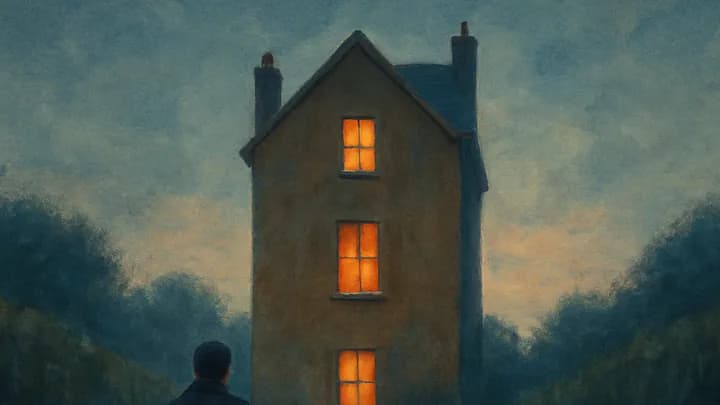
44 Ardent Street was a narrow building the color of an old tooth, wedged between a laundry and a shop that sold nothing Ines could identify. The brass key opened the street door. The stairwell smelled of cardamom and wet plaster. On the sixth landing a rope ladder took her the rest of the way, and then she was on the roof, and then she was, as always, home.
She counted. Seventeen kitchens, exactly, spread across the block like a hand of cards laid face-up. She began to draw.
Kitchen one: a man frying something with too much oil, gesturing at a phone propped against a jar. Kitchen two: two teenagers doing homework at the counter, one eating cereal, one crying without noticing. Kitchen three: an old woman who watered a single basil plant with the ceremony of a coronation. Ines sketched them all in her shorthand — a bracket for a stove, a spiral for steam, a small closed circle for loneliness, a small open one for company.
She worked until her fingers stiffened. By nine she had mapped sixteen kitchens. The seventeenth she saved for last, the way as a child she had saved the yolk of a fried egg.
It was on the top floor of the building across the alley, and it was dark.
Not off, exactly. There was a faint bluish glow, the kind an unattended television makes, or the kind that comes from a fridge left open by someone distracted. Ines squinted. A shape moved past the window, or seemed to. She wrote in the notebook: Kitchen 17. Occupied. Uncertain.
Then she went home and did not sleep well.
She returned the next Thursday, and the Thursday after. Sixteen kitchens continued their weekly plays: the frying man now had a woman who laughed at his phone; the crying teenager had stopped crying and started reading a novel with a green cover; the basil plant had died and been replaced with an aggressive-looking fern.
Kitchen seventeen stayed dark.
On the fourth Thursday Ines wrote to A. Sorel at the return address on the envelope, which turned out to be a stationer's on the west side of the river. The stationer, a kind man with ink on his cuffs, blinked at her.
“Sorel,” he said slowly. “Sorel. We had a Sorel who kept a box here for letters, years back. She died, I want to say — well, I want to say a while ago. I could be wrong. Old brain.” He tapped his temple, apologetic. “Was she a friend?”
“A client,” Ines said, and then, because it seemed suddenly true, “maybe a friend.”
She walked home along the river. She thought about the brass key, still in her coat pocket, warm from her hand. She thought about the seventeenth kitchen, dark and waiting, and about the phrase one of them is mine, though I have not seen it in some time.
She thought about her own kitchen, which she had not really cooked in for eleven years, since her mother died and she had begun to prefer the honest kitchens of strangers to her own quiet one.
Kitchen Seventeen
The next Thursday, Ines did not go to the roof. She went instead to the building across the alley. Her hands shook a little on the buzzer panel. There were only twelve names for what should have been sixteen apartments, which was the kind of arithmetic buildings did when nobody was paying attention.
The top floor button had no name at all. She pressed it. Nothing answered. She pressed it again, and this time the door clicked open, as if a hand somewhere had simply remembered how.
The apartment on the top floor was hers.
Not literally. Not by deed. But she knew it the way you know a song from the second bar — the light in the hallway was the color of the light in her mother's hallway; the kitchen at the end had the small square window she'd mapped a dozen times from the wrong side, and a table under it, and on the table a jar of pencils, soft-leaded, worn to nubs.
On the counter sat a folded note, the paper gone slightly yellow.
Ines, it read. You have drawn everyone's kitchen but your own. This one has been waiting. Turn on the light. — A.
She stood a long time in the doorway. Outside, across the alley, she could see the roof of 44 Ardent Street, empty in the blue evening, the place where she usually stood. From here it looked very small, and very high, and very lonely.
She stepped inside. She set down her notebook. She found the switch above the stove — an old brass toggle, the twin of the key in her pocket — and she turned on the light.
Somewhere, she knew, on some other rooftop, some other cartographer with a soft pencil was beginning, at last, to draw her in.
She put a pot of water on to boil. She had no idea yet what she was going to make. That, she thought, was the point.